By Joshua Yousouph
Despite over N595 million provision in the 2026 Federal Government budget for agencies under the Ministry of Marine and Blue Economy for waterway clearing and wrecks removal, stakeholders in Nigeria’s inland waterways sector have called for stronger private-sector participation to tackle the persistent accumulation of marine litter, floating and underwater debris and other navigational impediments.
The call followed the National Inland Waterways Authority’s (NIWA) collaboration with a private firm, Parts Central to address marine litter and debris on Lagos waterways, with stakeholders describing the partnership as a welcome development that could complement government’s regulatory and financial interventions.
Consequently, stakeholders argue that the persistence of marine litter and navigational hazards requires a coordinated approach involving government agencies, private companies, waterfront communities and waterway users.
Findings by Shipping Position Daily reveal that NIMASA Act, 2007 gives it the responsibility to receive and remove wrecks and derelicts in Nigerian waters. The NIWA Act of 1997, also confers upon it the duty ‘’to survey, remove and remove wrecks and derelicts and other obstructions from the country’s inland waterways.
However, the removal of such wrecks and derelicts from the nation’s waters may have been difficult for both NIMASA and NIWA, because section 7 of the Nigerian Ports Authority (NPA) Act 1999 also gave it powers to remove wrecks and derelicts blocking access to Nigerian waterways.
While NIWA has clearly identifiable 2025 provisions of N385 million and N210 million, available 2026 budget, information does not show a distinct NIMASA and NPA allocation specifically dedicated to wreck removal.
Overall, wreck removal remains a multi-agency responsibility involving NIMASA, NIWA, NPA and the National Oil Spill Detection and Response Agency (NOSDRA).
The development has raised questions among stakeholders about the effectiveness and sustainability of existing government interventions, particularly as litter and debris continue to pose operational and safety challenges to waterway users.
Speaking with Shipping Position Daily recently, NIWA Lagos Area Manager, Engr. Sarat Braimah, said keeping the waterways clean was fundamental to unlocking the economic potential of the blue economy.
Braimah said Lagos, where about one-third of the state is covered by water, should serve as the starting point for an effective waterways-cleaning model that could be replicated across other parts of the country.
She explained that NIWA would retain its regulatory role, while urging waterfront owners to become active participants in protecting the waterways from pollution and indiscriminate dumping.
On his part, Chief Raymond Gold, Public Relations Officer of the Waterfront and Boat Owners Association of Nigeria (WABOTAN), argued that greater private-sector involvement could improve the execution of government interventions.
Gold said the private sector was often better positioned to deliver projects efficiently, particularly where government agencies faced challenges translating policies and budgetary provisions into sustained action.
“In the so-called saner climes, it is championed by the private sector, not public sector. Where you want to get results, want to get this done, bring it to the private sector, you get this thing done,” he said.
He welcomed the involvement of a private sector partner with NIWA; Parts Central, stressing that the initiative could make a difference if the private company was properly monitored and required to deliver measurable results.
Gold, however, emphasised the importance of accountability, noting that private-sector partnerships should complement existing government budgetary provisions rather than create uncertainty over the utilisation of public funds.
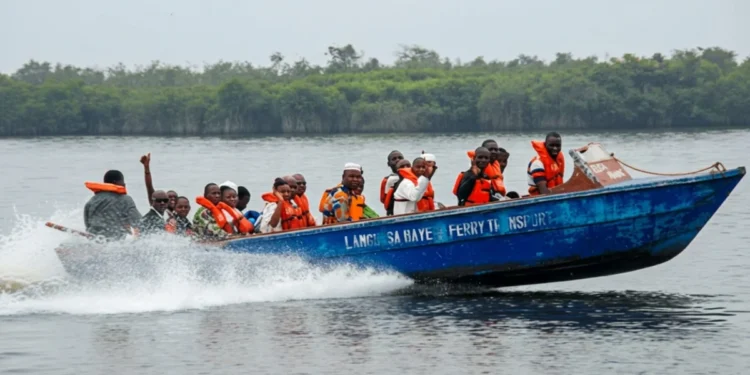
For Mrs. Modupe Lawale, Managing Director of Texas Connection Ferries Limited, the need for effective waterways cleaning is particularly urgent because marine litter directly affects commercial boat operators.
Mrs Lawale, who said her company has operated on Lagos waterways since 2004, said operators have repeatedly encountered wastes and floating objects capable of damaging their boats.
According to her, floating waste can become entangled in boat propellers, causing damage and disrupting commercial operations. Lawale welcomed the partnership with Parts Central and urged stakeholders to support the initiative, while ensuring that the private company delivers on its responsibilities.