Last Thursday was perhaps the first opportunity she had to meet face-to-face with stakeholders in the Nigerian port system. The occasion was the 2026 Maritime Reporters’ Association of Nigeria Annual Lecture (MAMAL).
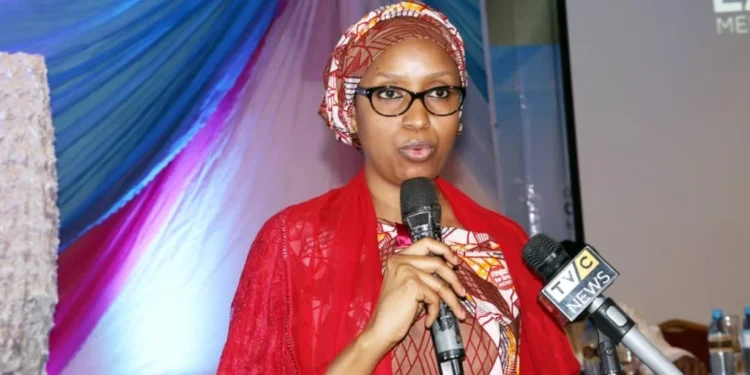
She faced the large gathering of media practitioners and key players in the port ecosystem to speak on: “Nigerian Ports: Ports Modernisation, Charges and the Competitiveness Question”. And she did a damn good job of it!
She left the Nigerian Ports Authority (NPA) in May 2021 under very controversial circumstances, having been appointed in July 2016. Since her removal, she had kept a dignified distance from the industry, for obvious reasons.
And about five years after her exit, Hadiza Bala Usman made a triumphant return to a familiar terrain: the Nigerian ports system. The ‘headmistress,’ as she is often called by her colleagues in the Federal Executive Council of President Bola Tinubu, where she serves as Special Adviser to the President on Policy and Coordination and Head, Central Results Delivery Coordination Unit, was her usual self at the well-attended event.
Typically, Hadiza Bala Usman gave a 33-page perspective on port modernisation, appropriate pricing for services, and responsibilities of stakeholders. She did that in a simple prose that captures the gamut of the challenges of managing the nation’s seaports in the face of rising competition in West and Central Africa, where Nigeria pushes to serve as a hub.
In an intentional appreciation for the support the media gave her during the period she presided over Nigerian seaports as the CEO of the NPA, she told the gathering that, “It is somewhat a homecoming for me, given the collaboration we had in the past. I will use this opportunity to thank you for the support we received during my tenure as Managing Director/Chief Executive Officer of the Nigerian Ports Authority (NPA)”.
Showing a remarkable understanding of the dynamism of port administration, especially in Nigeria where the infrastructure is aged and the system endemic, she told the stakeholders that the theme of the discussion was “both timely and fundamental to Nigeria’s economic future”.
She began by affirming that superficially, the subject of “Nigerian Ports Modernisation, Charges and the Competitiveness Question” may appear to be a discussion about ports, tariffs and infrastructure; but it is considerably more far-reaching.
According to Hadiza, discussions about port modernisation, charges and competitiveness are a discussion “that translates to the cost of doing business in Nigeria and the competitiveness of Nigerian manufacturers. It is a discussion about the cost of imported goods to the Nigerian consumer and about the ability of Nigerian farmers and manufacturers to export. It is a discussion about foreign exchange and investment. And ultimately, it is a discussion about whether Nigeria can position itself as the principal trade and logistics gateway to West and Central Africa or not”.
She commended the Federal Government for the landmark 2006 port concession, saying it was arguably the single most consequential reform in Nigerian port history.
The essence of this piece is not to dwell on the substance of the keynote address of the former Managing Director of the NPA. Rather, our focus is on the symbolism of the invitation by the maritime reporters, the theme of the event and the symbolism of the personae of the paper presenter, and the perspective she placed in the public domain.
Hadiza Bala Usman served as the first female Managing Director of the Nigerian Ports Authority.
During her tenure, she championed major structural and anti-corruption reforms. In 2016, she took over an organisation that was bogged down by inefficiencies. But, under her management, the NPA dismantled long-standing monopolies, reviewed corrupt joint-venture agreements, and significantly automated port operations to boost revenue. She holds the record of introducing an electronic call-up system for trucks doing business at Lagos ports. It was a revolutionary answer to decades of crude and opaqueness in the haulage business in the ports. The e-call-up system is also now operational in Lekki and Onne ports.
The process leading to her exit from the NPA started in May 2021, when the then-Minister of Transportation, Rotimi Amaechi, recommended her suspension, alleging that the NPA had failed to remit ₦165 billion in operating surpluses to the Consolidated Revenue Fund (CRF).
Consequently, then-President Muhammadu Buhari approved Amaechi’s recommendation, forcing her to “step aside”, while an administrative panel of inquiry investigated the claims.
The panel ultimately found no evidence of unremitted funds matching those claims, effectively clearing her name of the alleged financial misappropriation. But the irreparable and politically motivated damage had been done.
Giving an insight into her travails, she stated in her memoir, “Stepping on Toes: My Odyssey at the Nigerian Ports Authority”, which was published in 2023, that her removal was a retaliatory political move by Amaechi, rather than a matter of accountability.
In 2023, President Bola Tinubu appointed her as Special Adviser on Policy Coordination, where she remains a prominent figure in Nigeria’s policy space.
Despite being out of the maritime sector, she continues to advocate publicly for port reforms. This forms the fulcrum of her assertion last week that Nigerian port charges must drop to ensure West African regional competitiveness.
She was a deep critic of an issue which has been viewed as the main problem of the Nigerian port system – a balance in service delivery and appropriate pricing.
She posited that “the measure of a modern Nigerian port will therefore not ultimately be the size of its cranes, the depth of its channels or the billions invested in concrete and steel”. Rather, “it will be what those investments do for Nigerians. How quickly goods move. How cheaply businesses trade. How confidently investors commit capital. How much Nigeria exports. How efficiently government facilitates commerce. And ultimately, how effectively Nigerian enterprise competes with the world.”
She concluded in the well-researched keynote address that port stakeholders should “do what we can to hold the system accountable. We must encourage transparency, report responsibly, foster critical thinking and reflection by asking the tough questions and also spotlight progress in the sector towards this expected good end.”
These, in her opinion, are perhaps even more important than the physical modernisation of port infrastructure. It is the bedrock for fair and competitive port pricing.
Last week was indeed a good welcome back to a familiar turf for the Headmistress!