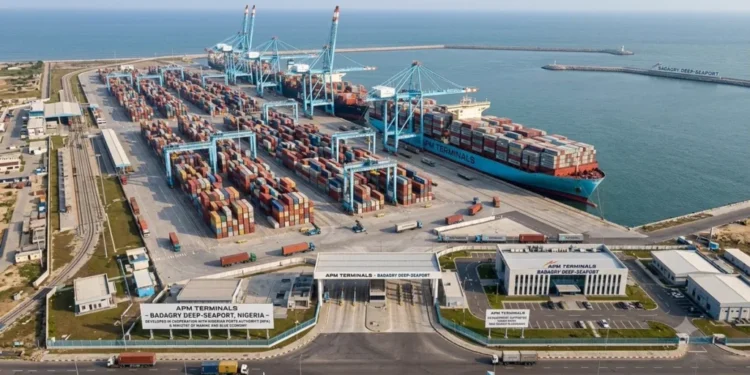
Maritime stakeholders have described the proposed Badagry Deep-Seaport as a potential gateway to strengthening Nigeria’s position as a major transshipment hub in West Africa.
The assessment follows the signing of several Memoranda of Understanding (MoUs) towards developing the proposed Greenfield port and attracting private-sector investment into the project.
The latest agreement, signed in Copenhagen on Sept. 7, involves APM Terminals and Badagry Port Development Ltd., committing both parties to exclusive negotiations on developing the proposed deep-seaport.
The development followed engagements by the Federal Government delegation led by the Minister of Marine and Blue Economy, Adegboyega Oyetola, during a visit to Denmark to strengthen maritime cooperation and attract investment into Nigeria’s port infrastructure.
According to the minister, the port will complement existing facilities by providing deep-water capacity for larger vessels, increasing cargo volumes and creating transshipment opportunities across Nigeria and West Africa.
The minister said APM Terminals’ involvement could further advance the project’s prospects, while discussions also covered the extension of the company’s port concessions at Lagos Port Complex, Apapa, and the West Africa Container Terminal (WACT), Onne.
Dr Ebiere Okoro, a maritime economist, said Badagry’s strategic location could enable Nigeria to attract cargo destined for neighbouring countries and strengthen its role in regional maritime trade.
Okoro said the port’s transshipment potential would, however, depend on efficient customs procedures, reliable road and rail connectivity, competitive port charges and seamless cargo clearance.
She said the development of the port should be complemented by an integrated logistics ecosystem capable of supporting the movement of cargo from the facility to major commercial centres.
She added that sustained private-sector participation, transparent concession arrangements and consistent government policies would be critical to attracting shipping lines and ensuring increased cargo volumes.
“Badagry can significantly expand Nigeria’s maritime footprint and strengthen our transshipment, but the port must be backed by efficient connectivity, competitive operations and policies that encourage long-term investment,” she said.
Mr Chinedu Eze, a freight forwarding practitioner, said the proposed port could provide an alternative gateway for importers and exporters while helping to reduce pressure on existing Lagos ports.
Eze urged the Federal Government to prioritise road, rail and other cargo evacuation infrastructure alongside the development of the port to prevent congestion from shifting to the hinterland.
He said efficient cargo evacuation would be essential to attracting shipping lines and positioning Badagry as a preferred transshipment destination for movement o cargo within West and Central Africa.
Another maritime expert, Mrs Amina Lawal, said the involvement of APM Terminals could enhance the project’s prospects, given the company’s experience in operating major container terminals and its international shipping connections.
Lawal said Badagry could strengthen Nigeria’s competitiveness by providing capacity for larger vessels and enabling the country to serve as a regional distribution point for cargo.
She urged the government to sustain a predictable regulatory environment and ensure competitive costs and efficient services for port users to make the facility attractive to international shipping operators.
“Badagry presents Nigeria with an opportunity to move from being largely a destination port to becoming a strategic regional transshipment centre if infrastructure, policy consistency and operational efficiency are delivered together,” she said.