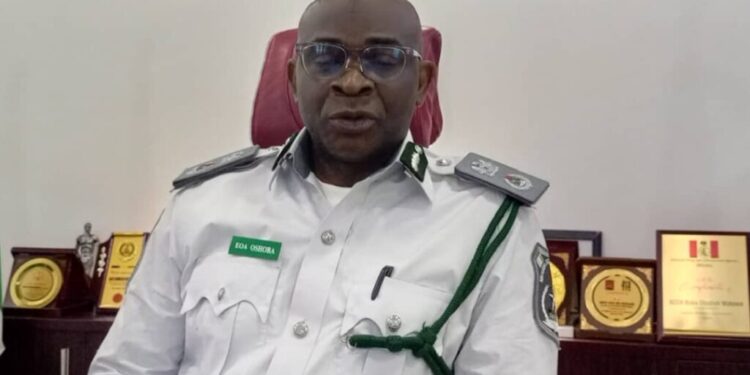
In this interview with the Customs Area Controller, Apapa Command of the Nigeria Customs Service, Comptroller Emmanuel Osoba (now retired), during a courtesy visit by the National Executive Council of the Association of Registered Freight Forwarders of Nigeria (AREFFN), he speaks on the need for stronger collaboration between Customs and freight forwarders, compliance, trade facilitation, Customs modernisation initiatives, Advanced Ruling System, Authorised Economic Operator (AEO), the One-Stop-Shop arrangement, foreign participation in Nigeria’s maritime sector, stakeholder training, port security and the need for continuous dialogue to resolve industry challenges. Our reporter – Joshua Yousouph was there.
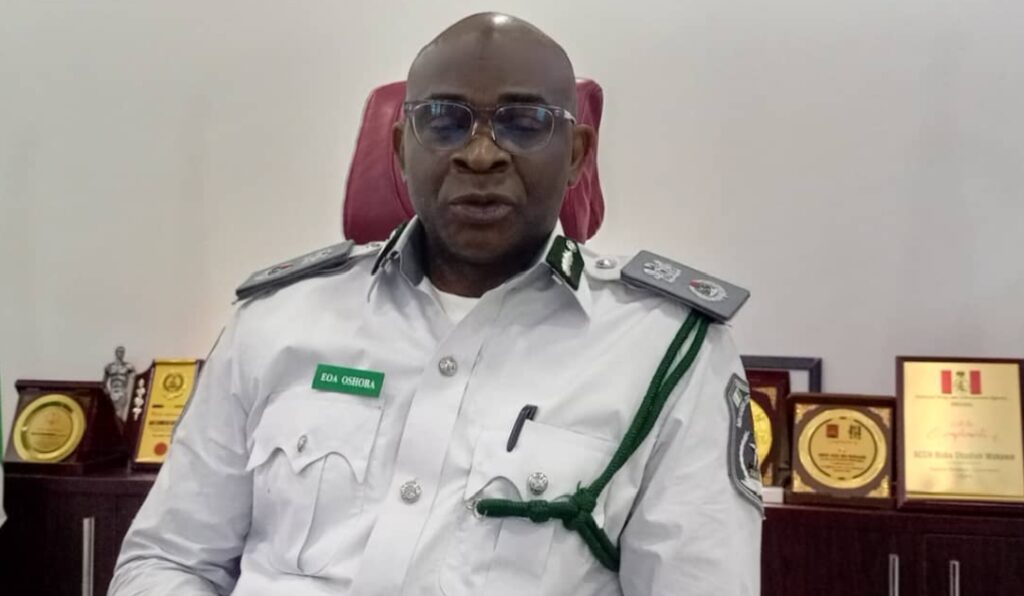
“Bring your concerns to us. If there are issues, let us resolve them through engagement’
“When containers have been exited, they should not continue to linger in the port”
You spoke extensively about consolidation. What does consolidation mean to you, particularly within the maritime industry and Customs, especially?
Consolidation is very important. We must acknowledge the good works of those who have gone before us and build on what they have achieved. Some people have already laid the foundation, and some are still contributing. We must consolidate those efforts for peace and progress because there is strength in unity. The constitution allows people to belong to associations of their choice and to form associations of like minds. That is a constitutional right. But at the same time, there should be an interest in the general good. If people are now trying to bring everybody together, that is a welcome development because it will benefit the industry, the different commands and agencies, and the country as a whole. In Customs, consolidation is also about building on relationships that have been established over time. People have come and gone, officers have come and gone, agents and other stakeholders have also changed, but we cannot say those who came before us did nothing. We are not reinventing the wheel. We must acknowledge their efforts and consolidate on the foundation they have laid.
Why is collaboration so important between Customs, clearing agents, and other stakeholders?
Collaboration is key. Without collaboration, we cannot achieve much. There used to be this mentality of “us against them”, but that is counter-productive. The truth is that we are all Nigerians. Whether you are an officer, an agent or a reporter, we are all Nigerians; first and foremost. We are all partners in the Nigerian project. We must therefore see ourselves as partners. The goal is the well-being of the Federal Republic of Nigeria, and we are all equal citizens. There are no second-class citizens. There must be constant collaboration among officers, agents and all the key stakeholders in the business. There must also be constant engagement. The better we perform as a command in terms of revenue generation, trade facilitation, ease of doing business and effective control, the better it is for the country.
Some stakeholders sometimes accuse Customs of disrupting businesses whenever it takes enforcement decisions. How do you respond to such concerns?
We must understand the role of Customs. Customs is protecting society through vigilance, enforcement and control. When we receive intelligence and intercept items such as cannabis or other harmful products, what we are doing is protecting society. Imagine such consignments getting into the streets and being consumed by the people. Imagine pharmaceutical products being brought into the country and repackaged before being sold to unsuspecting members of the public. We sometimes ask why certain health problems are increasing. We need to look at some of these things. Therefore, the efforts we are making should be seen as part of national progress. We are not doing things simply to show ourselves or to make life difficult for anybody. We are protecting society and we are committed to that responsibility.
What role do you expect clearing agents and other stakeholders to play in helping Customs fight illicit trade?
We want stakeholders and their members to work with us. Integrity and compliance are key. There are situations where an employer may ask somebody to do something that is not right. You have the responsibility to say no. But the truth is that sometimes some people will still allow such things to happen. The question is: who is bringing these prohibited goods into the country? Somebody is waiting to take those goods and introduce them into society. Our level of integrity must improve. When we talk about facilitating trade, we are talking about legitimate trade. Compliance is key. This is not an era where everything goes. We must always appeal to our conscience and ask ourselves what we are contributing to society. If dangerous or prohibited goods come into the country and somebody clears them, that person also has a responsibility. It is not only the person who imported the goods. Anybody who facilitates their entry also has a responsibility.
You mentioned the modernisation efforts of the Nigeria Customs Service. What are some of the tools stakeholders should take advantage of?
One of the things we are doing is enhancing scanning. At Apapa, containers coming into the command are scanned. Even where a consignment is subsequently subjected to physical examination, it has already gone through the scanning process. The images are also stored, and there are officers who examine those images. This is part of the modernisation efforts being implemented by the Comptroller-General of Customs and the management of the Service. We want stakeholders to understand that these tools are designed to improve compliance, facilitate legitimate trade and strengthen Customs control.
Importers should take advantage of Advanced Ruling, which allows an importer to obtain clarification before the goods are brought into the country. It covers areas such as classification, valuation and other relevant issues. Once the ruling is issued, it is binding on Customs. Therefore, when the goods eventually arrive, the importer already has clarity on the applicable treatment. This is one of the traditional tools we are promoting. If an importer consistently brings in a particular item and has concerns about its classification, value or other customs treatment, the importer should apply for Advanced Ruling, before bringing the goods in. That will help reduce disputes and compliance issues. Compliance is fundamental to AEO. It is not enough to be compliant occasionally. You must be consistently compliant. If you are not consistently compliant, you cannot benefit from AEO. The benefits of AEO include greater facilitation. For example, compliant operators can have their consignments move more efficiently, including directly to their warehouses or other designated locations, subject to the applicable procedures. It helps save time and resources. These are some of the modernisation tools that stakeholders should take advantage of. The one-stop-shop approach is another facilitation mechanism. Even where there are issues relating to valuation, classification or other matters, consignments can be allowed to move while the relevant issues are followed up through the appropriate process, including Post Clearance Audit. The important thing is that stakeholders should take advantage of these tools. If anybody within the command is unnecessarily delaying a job, stakeholders should let us know. The objective is to ensure that consignments are processed efficiently while the necessary Customs controls are maintained.
There have been concerns about the increasing participation of foreigners in certain areas of Nigeria’s business environment. What is your position on this?
I do not want to single out any particular country. But the issue of foreigners participating in certain areas of business in Nigeria is something that deserves national attention. There are regulatory agencies responsible for different aspects of the matter, including immigration and labour-related issues. The appropriate authorities need to clarify what roles foreigners are permitted to perform within the Nigerian business environment. One of the concerns is that some foreign-owned or foreign-controlled businesses operate under Nigerian names. If you look at some of the companies, you see Nigerian names, but the businesses are competing within the local market. That means the issue is not only about the foreigners themselves. It also involves Nigerians who may be providing the front for such operations. Therefore, it is a national issue that needs to be addressed.
It has implications for employment, livelihoods and ultimately security. Ports and airports are high-security areas. They are sensitive locations where access and operations should be properly regulated. If people who should not be operating in such sensitive environments are allowed to operate there, it creates concerns that need to be addressed. This is why I believe the matter should go beyond individual associations and should be escalated to the national level for proper consideration.
What can Customs do to improve the capacity of licensed clearing agents and their employees?
Training is very important. One of the conditions for licensing customs agents is that they must be knowledgeable about Customs operations. Their employees should also be conversant with Customs rules and regulations. We are open to providing training where necessary. If an association or group of agents identifies areas where its members need training, they can formally write to the command. We have capable officers who can provide training in areas such as valuation, Post Clearance Audit and other Customs-related matters. All they need to do is write to us and identify the areas where they require training. We can make arrangements for the appropriate officers and materials.
How important is continuous engagement between Customs and stakeholders in maintaining peace at the port?
Peace is paramount in this environment. Continuous engagement and continuous dialogue are not optional. They are essential. At no point should anybody be interested in confrontation. When there is confrontation, everybody suffers. If you have an issue with Customs, bring it forward. My office is open, and my officers are available. Let us discuss the issues and resolve them. It is better to resolve disagreements through dialogue than to go into confrontation. When there is conflict, you do not know the eventual outcome, and everybody can become a loser. The cost of maintaining peace in the industry is very small compared with the consequences of confrontation. Bring your concerns to us. If there are issues, let us resolve them through engagement. My office is open. We appreciate the collaboration, cooperation and patience of stakeholders. We also want stakeholders to understand that we are available to listen and address legitimate concerns.
You raised concerns about containers remaining at the port after they have been exited. Why is this an issue?
When containers have been exited, they should not continue to linger in the port. It is not the best practice to have exited containers remaining around unnecessarily. We need to ensure that the containers are moved out promptly. This is also connected to traffic and security. Stakeholders need to educate their truckers. There are situations where trucks stop around the port and activities take place that create problems. This can turn the environment into something resembling a marketplace or even a place where other activities take place. It is a security concern and also contributes to traffic problems. The port is a sensitive environment, and we need to ensure that it remains compliant with port safety and security requirements. I therefore appeal to stakeholders to educate their truckers and ensure that they understand the implications of their activities around the port.