By Joshua Yousouph
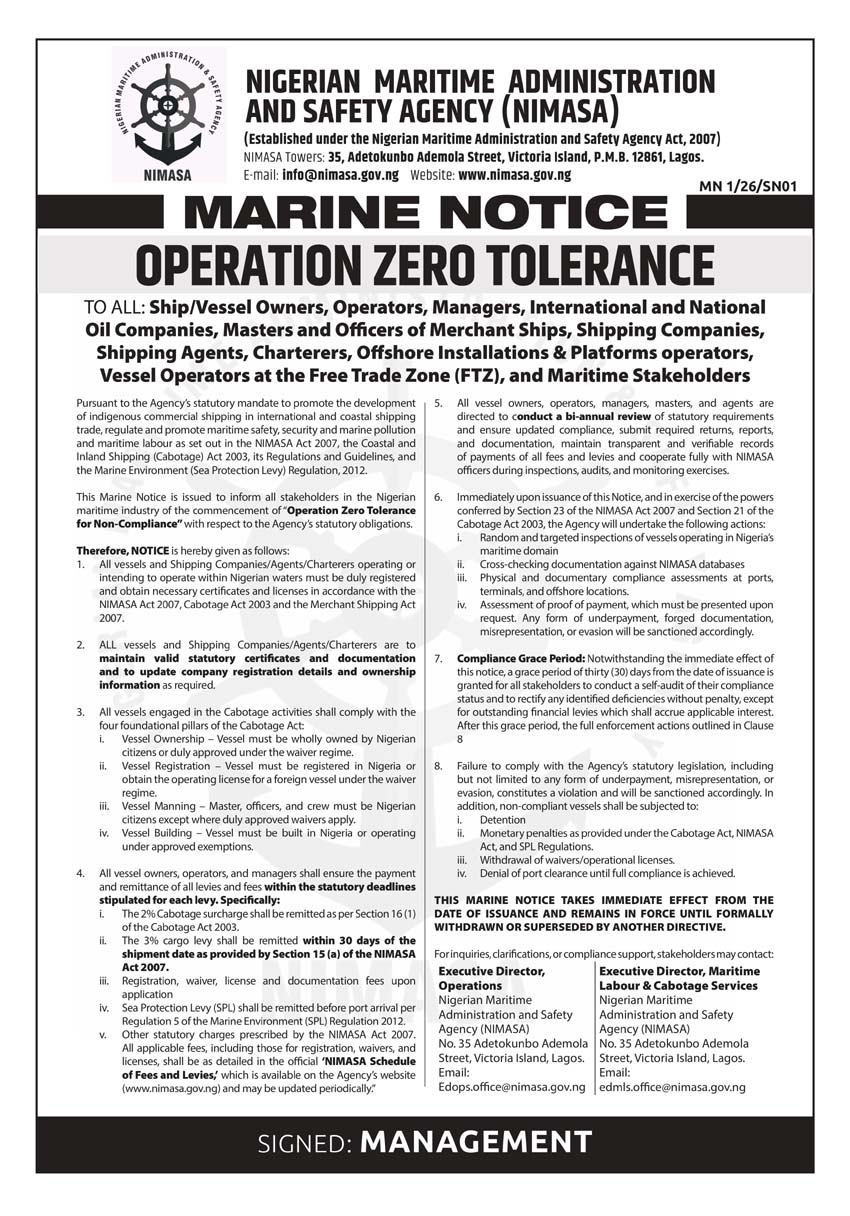
The Nigerian Navy has called for the establishment of special courts for maritime offences, citing prolonged trials and delays in the administration of justice as major setbacks to efforts to combat maritime crimes and secure Nigeria’s blue economy.
The call was made on last week in Lagos, during a panel session at the 4th Ehingbeti Blue Economy Hub themed “Securing Nigeria’s Blue Economy: Need to Strengthen Regulatory and Maritime Frameworks for Sustainable Coastal Development.”
The panel brought together representatives of the Nigerian Navy and Marine Police, a retired naval officer and other stakeholders who examined the security, regulatory, justice and socio-economic challenges limiting the development of Nigeria’s maritime domain.
Speaking on the panel, the Flag Officer Commanding, Western Naval Command, Rear Admiral A. A. Mustapha, disclosed that Nigeria was working towards an integrated maritime security strategy that would bring institutions responsible for maritime security under a common framework and enable the country to develop a common operating picture of activities within its waters.
Rear Admiral Mustapha who was represented by the Chief Staff Officer, Western Naval Command, Rear Admiral N.C Ekwom identified the Nigerian Navy’s Falcon Eye system and the Regional Maritime Awareness Capability System as important technological tools for maritime domain awareness.
According to him, the systems provide authorities with a broad view of activities within the maritime space, adding that artificial intelligence was increasingly being deployed to strengthen surveillance and maritime security. “You cannot secure what you don’t see and what you don’t know,” he said, stressing the importance of knowing what was happening across Nigeria’s maritime domain.
The FOC, however, expressed concern over the limited integration of maritime security agencies, noting that the Navy’s Maritime Command and Control Centre has an External Agency Cell designed to accommodate personnel from other agencies and enable them to operate from a common maritime picture.
He said the facility had about 15 seats for personnel from external agencies, but acknowledged that most of the command and control centers were yet to be fully integrated. He attributed the challenge partly to inadequate awareness and interest in the maritime sector, describing the situation as “maritime blindness.”
“Many of us, particularly in Africa, are maritime blind,” he said, explaining that maritime blindness meant a failure to recognise the importance and potential of the maritime domain in national development and decision-making.
Also speaking, the retired naval officer, Rear Admiral Olanrewaju Beckley (Rtd) identified the slow prosecution of maritime criminals as one of the major weaknesses in Nigeria’s fight against maritime insecurity.
Beckley listed illegal fishing, illegal bunkering, kidnapping for ransom, illegal refineries, terrorism and smuggling among the threats confronting the nation’s maritime domain. He said while the Nigerian Navy and other agencies had continued to tackle the challenges, the effectiveness of arrests was being undermined by delays in prosecuting suspects.
According to Beckley, the Navy operates a “detect, arrest and prosecute” framework, but maritime criminal cases often become prolonged after suspects and their vessels are detained. “But I must tell you that after arresting some of these maritime criminals, prosecution has become very difficult because you detain these people along with their vessels. It takes a lot of time for them to be prosecuted,” he said.
Beckley argued that prolonged judicial processes could ultimately result in suspects being released, creating a gap between maritime law enforcement and the administration of justice. The retired officer consequently advocated the establishment of special courts dedicated to prosecuting maritime crimes, saying such courts would accelerate the determination of cases and reduce prolonged detention without trial.
“So, if you have a special court for maritime criminals, it will allow you to address some of these long-term arrests without trial,” he said.
He also called for increased government investment in maritime security assets, including vessels, drones and manned aerial platforms, arguing that the scale of Nigeria’s maritime resources required a commensurate security investment.
He noted that the maritime sector contributes significantly to Nigeria’s economy and said the sector’s economic importance reinforced the need for greater attention to maritime security and development.
On inter-agency cooperation, the Assistant Inspector-General of Police, Maritime Police Command, AIG Okunade Ronke Nurat said the police and Navy were already collaborating in securing the nation’s waterways but acknowledged that more could be done.
AIG Okunade who was represented by CSP Olalekan Faniyi disclosed that senior Navy officers had recently monitored activities within the command and worked with police personnel on improving the deployment of technology and watercraft.
She said the relationship between both organisations had remained cordial, with officers from the Navy and Marine Police regularly meeting on the waterways without conflict.
“We are in good relationship with the Nigerian Navy. Our officers meet on the waterways, and there have been no problems. But we can do more,” he said.
Beyond security and enforcement, other speakers at the session called for greater investment in coastal communities, arguing that sustainable blue economy development must extend to people living along Nigeria’s waterways and coastal areas.
The panel’s recommendations included improved integration of maritime security agencies, wider deployment of surveillance technology, stronger collaboration between the Navy and Marine Police, increased investment in maritime security assets, specialised judicial mechanisms for maritime crimes, and greater economic empowerment of coastal communities.