By Oluyinka Onigbinde
No fewer than 13 stowaways have been arrested by the Nigerian Navy and handed over to the Nigeria Immigration Service (NIS) in four separate operations between March and June 2026, an investigation by Shipping Position Daily has revealed.
Checks by our correspondent show that the arrests, carried out by personnel of the Nigerian Navy Ship (NNS) Beecroft along the Lagos coastline, involved suspects who concealed themselves in rudder compartments and other hidden sections of outbound vessels heading for Europe, India and other foreign destinations.
The latest interceptions have once again brought to the fore Nigeria’s growing reputation as West Africa’s hotspot for stowaway activities, with maritime stakeholders warning that the trend continues to dent the country’s image among international shipping lines while exposing shipowners to huge financial losses.
Investigations revealed that the first operation was carried out on March 19, when naval operatives arrested Abdullahi Yakubu, 36, and Omoniyi Afotona, 25, aboard MV Seaspan Lahore near the Lagos Fairway Buoy. Further profiling revealed that Yakubu had previously attempted to leave the country through the same illegal route.
Nine days later, on March 28, the Navy intercepted three Ghanaian nationals aboard the tanker MT Anatolia at the Dangote Terminal, Lagos. The suspects were said to have travelled overland to Côte d’Ivoire before boarding the vessel by canoe in a desperate attempt to reach Europe.
Another three stowaways were intercepted on April 17 aboard the merchant vessel MSC Stella near the Lagos Fairway Buoy during a routine maritime security patrol.
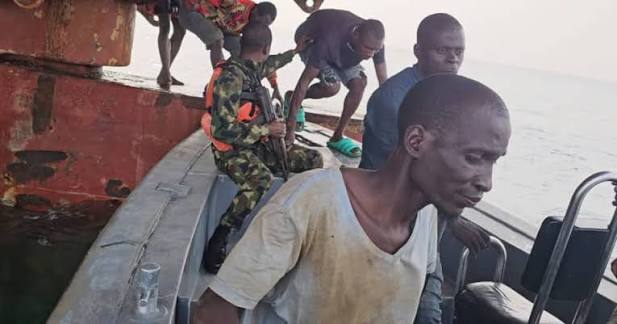
The biggest operation was recorded on June 17, when naval personnel rescued five men, aged between 24 and 43 years, from the rudder compartment of the bulk carrier MT Chinafrie Happiness at Tin Can Island Port while the vessel was preparing to sail for India.
In all four incidents, the suspects were handed over to the Nigeria Immigration Service for investigation and further necessary action.
Although the Nigerian Navy also recently announced the arrest of eight stowaways in separate operations this year, Shipping Position Daily’s review of documented operations identified 13 arrests across four confirmed incidents between March and June, suggesting that publicly available figures may not fully capture the scale of the problem.
Unlike previous years, neither the Nigerian Navy nor the Nigeria Immigration Service has released a consolidated year-to-date record of stowaway interceptions for 2026.
The trend comes against the backdrop of industry estimates showing that vessels calling at Nigerian ports recorded about 2,300 stowaway-related incidents in 2025.
However, maritime security expert; Mr Emmanuel Maiguwa has warned that even such figures may not reflect the true scale of the problem, arguing that a significant number of stowaway incidents may never be captured in Nigerian official records.
According to Maiguwa, the frequency of stowaway incidents should itself be treated as an indicator of weaknesses in Nigeria’s maritime security infrastructure.
“A stowaway is an indicator that your port can be accessed by anyone to meet the ship,” he said.
Maiguwa explained that Nigerian authorities may only be aware of cases that are reported to the police, Navy or other relevant agencies, while other incidents may be recorded by shipowners, security managers, insurers or international maritime security organisations after vessels have left Nigerian waters.
“If they show you the number of stowaway cases, we only know the one that they’ve told police or Navy and they call you people. That’s the only one we have. But there are incidents that the vessel has gone out and gone to another port,” he said.
He added that some cases could remain within shipping companies, particularly where the circumstances do not result in an official report to Nigerian authorities.
“Some have died on board the vessel. They have it. Some, the incident is kept between the owners because they have either thrown the people or they found them dead on the propeller. We will never hear it. The international community will never hear it,” Maiguwa said.
He said the existence of unreported cases means that publicly available statistics could represent only the visible portion of the problem.
“During Greg Ogbeifun’s event, I said it. I said there is a stowaway case every week out of Lagos port. If we don’t know it, it doesn’t mean it didn’t happen. They have the data,” he said.
Maiguwa’s assessment raises questions about whether the 13 arrests documented by Shipping Position Daily between March and June represent only a fraction of the actual stowaway activity linked to Nigerian ports.
He also linked the problem directly to weaknesses in access control across the maritime domain, arguing that people attempting to board vessels must first gain access to the coastline, anchorage or port environment.
“These guys do not come from the bottom of the sea. They come to the shore,” he said.
According to him, repeated stowaway incidents are not merely an immigration or illegal migration issue, but also an indication of gaps in maritime security infrastructure and the ability of authorities to control access to vessels.
The concerns come as the Chairman of the Shipping Association of Nigeria (SAN), Boma Alabi (SAN), also warned that the menace has become almost synonymous with Nigerian ports.
According to her, vessels calling at ports in Tema, Ghana; Lomé, Togo; and Cotonou, Benin Republic, rarely experience similar incidents, placing Nigeria at a competitive disadvantage within the sub-region.
She disclosed recently that shipping companies operating in Nigeria contend with an average of two to three stowaways every week across vessels calling at the country’s ports, amounting to an estimated 2,300 cases annually.
Alabi further revealed that every confirmed stowaway repatriated attracts a $2,000 statutory payment to the Federal Government through the Nigeria Immigration Service, aside from the additional costs of repatriation, vessel delays, insurance implications and other compliance expenses borne by shipowners.
She lamented that despite shipping companies paying statutory charges for maritime and port security, stowaways still gain access to vessels through rudder compartments and other concealed areas.
Describing the trend as a major challenge to Nigeria’s maritime sector, she warned that the recurring incidents continue to erode the competitiveness of Nigerian ports and discourage international trade.
Speaking with Shipping Position Daily, maritime security expert and former Senior Special Assistant on Maritime Services to former President Goodluck Jonathan, Mr Leke Oyewole, said the phenomenon is driven more by economic hardship than by security failures.
“If the national economy is very strong, robust and provides employment for people, nobody would think of stowing away to other countries where they can do menial jobs. That is the primary thing to be addressed,” he said.
Oyewole maintained that while improving the economy remains the long-term solution, agencies responsible for maritime safety, particularly the Nigerian Maritime Administration and Safety Agency (NIMASA), must strengthen preventive measures around ports and anchorages.
He called for stricter compliance with the International Ship and Port Facility Security (ISPS) Code, enhanced surveillance around vessels and better coordination among security agencies to prevent intending migrants from gaining access to ships before departure.
Meanwhile, NIMASA has commenced anti-stowaway sensitisation campaigns in riverine communities around Snake Island, Lagos, identified as one of the routes through which intending migrants gain access to vessels at anchorage.
Efforts by Shipping Position Daily to obtain a consolidated figure of stowaway interceptions for 2026 from the Nigeria Immigration Service headquarters in Abuja were unsuccessful as of press time.