By Oluyinka Onigbinde
Nigeria’s export performance has recorded a significant boost, with the volume of goods shipped out of the country rising by more than 25 per cent in the last two years, a development attributed to the Federal Government’s economic and port sector reforms.
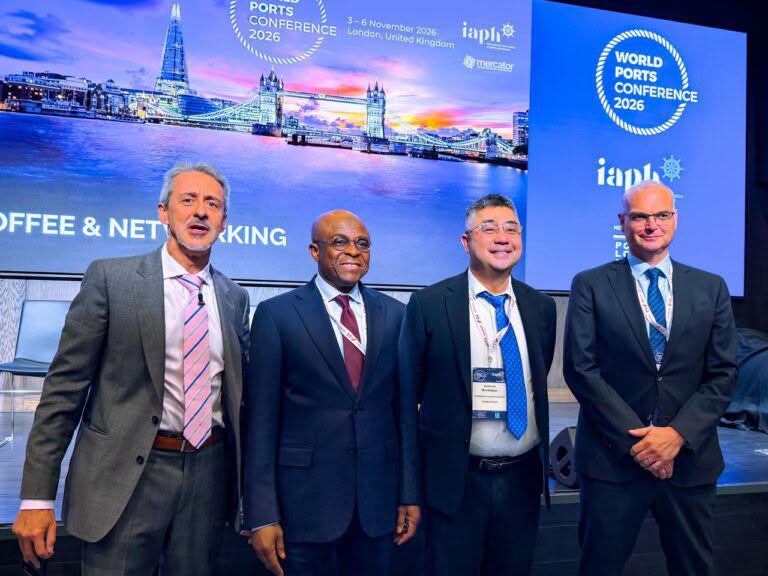
The Managing Director of the Nigerian Ports Authority (NPA), Dr Abubakar Dantsoho, disclosed this while speaking at the ongoing Annual World Ports Conference in London, organised by the International Association of Ports and Harbours (IAPH).
Dantsoho said the growth was not limited to the oil and gas sector, as exports of agricultural produce, manufactured goods and other raw materials had also witnessed considerable improvement.
He identified commodities such as cocoa and cashew as some of the non-oil products recording increased export volumes, noting that improved collaboration between the NPA and major terminal operators, particularly APM Terminals, had contributed to the development.
According to him, Nigeria’s large population and economic potential give the country a competitive advantage over other countries in West and Central Africa, while ongoing reforms are creating new opportunities for trade and investment.
The NPA chief said the authority was taking steps to sustain the export growth through the establishment of Export Processing Terminals across the country.
He explained that the terminals, currently about four in number, provide facilities for exporters to complete necessary cargo processing and documentation locally through collaboration involving the NPA, Nigeria Customs Service (NCS), terminal operators and other relevant government agencies.
Dantsoho said the initiative was designed to ensure that export consignments meet required standards before leaving the country, thereby reducing delays and other challenges associated with international trade.
On Nigeria’s position under the African Continental Free Trade Area (AfCFTA), he said the economic reforms of the present administration had strengthened the country’s capacity to compete favourably within the African market.
He noted that Nigeria was engaging other African countries, including Morocco, to deepen trade relations and exchange expertise, particularly in manufacturing and the development of emerging industries.
Dantsoho cited Morocco’s growing position as a manufacturing hub for electric and other vehicles as an area where Nigeria could benefit from stronger economic cooperation.
The NPA Managing Director also linked the country’s improved port performance to the recent recognition of two Nigerian ports among the world’s top 20 in the latest World Bank global ports ranking.
He attributed the achievement to improved operational efficiency, technology adoption and stronger partnerships with private sector operators and international stakeholders.
According to him, the authority would continue to strengthen its relationships with major maritime players in countries such as Morocco and South Africa to consolidate the gains recorded so far.
He further disclosed that revenue generated from port operations across Nigeria had quadrupled, alongside an increase in cargo volumes, describing the development as evidence of improved efficiency in the country’s maritime industry.
Dantsoho, who also serves as President of the Association of Ports in West and Central Africa, said Nigeria’s performance could be measured against other ports in the region through the association’s shared performance monitoring platform.
He maintained that Nigerian ports had recorded considerable improvements in efficiency compared with several other West African ports, while acknowledging similar progress in countries such as Tanzania and Kenya.
The NPA boss, however, stressed the need to sustain the momentum through continued investment, stronger regional cooperation and the avoidance of policy inconsistencies that could undermine the progress already achieved.
On infrastructure development, he revealed that the Federal Government was planning a $1 billion investment programme to expand and modernise Apapa Port as part of efforts to improve capacity and prepare the facility for future cargo demands.
He explained that the scale of investment required for port expansion made private sector participation inevitable, adding that the NPA was already working with APM Terminals and other major industry players to mobilise the necessary capital and technical expertise.
Beyond physical infrastructure, Dantsoho said the authority was also prioritising digital transformation through partnerships with international technology firms.
He disclosed that the NPA had developed a Single Window system through a partnership with a Singapore-based company and was currently working with another firm from Abu Dhabi on the development of a Port Community System.
According to him, the initiatives would improve coordination among port stakeholders, simplify cargo clearance procedures and strengthen the efficiency of port operations.
He added that the authority was also encouraging business-to-business partnerships within the private sector as part of a broader strategy to modernise Nigeria’s maritime industry and position its ports as competitive gateways for regional and international trade.