
By Joshua Yousouph
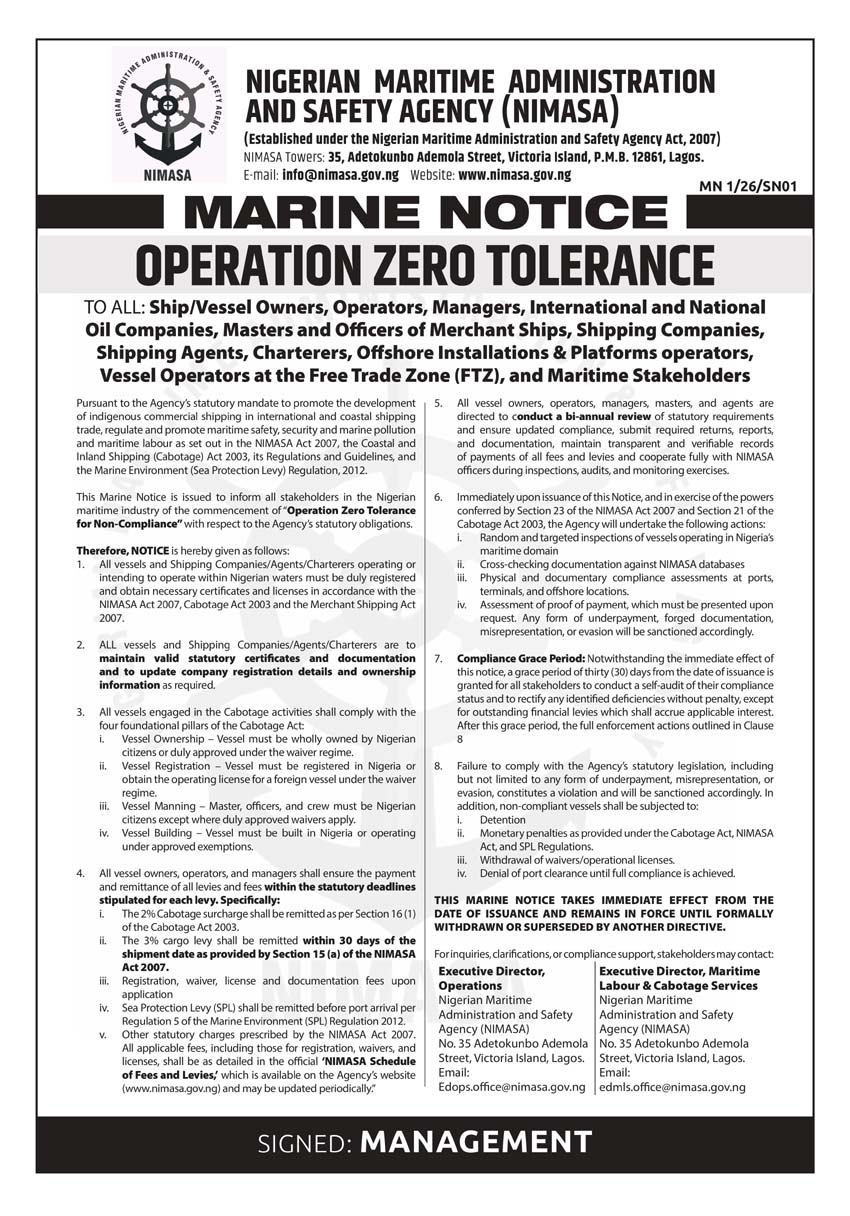
The Nigerian Port Economic Regulatory Agency (NPERA) Act 2026 empowers the agency to inspect port operators’ accounts, books, digital systems and shipment records without prior notice, while mandating registration and tariff filings for regulated service providers and introducing a one per cent import levy as part of its funding framework.
Under the new law, violations could attract heavy fines, suspension, blacklisting, licence revocation and criminal prosecution.
These implications were highlighted at an online webinar last week organised by maritime law firm Akabogu & Associates on the theme, “The New Port Order: What the NPERA Act 2026 Means to You.”
Maritime lawyers who spoke at the webinar urged maritime businesses to review their registration status, tariffs, contracts and compliance procedures ahead of the implementation of the new framework. They also advised operators to respond promptly to regulatory requests and participate in consultations as NPERA develops subsidiary regulations and guidelines.
Senior Partner of the firm, Dr Emeka Akabogu, SAN, described the legislation as potentially more consequential than the Cabotage Act 2003 and the Nigerian Maritime Administration and Safety Agency (NIMASA) Act 2007, citing its wider reach across the maritime industry and the national economy.
He said the law was intended to ensure fairness, accountability and value for investments by both providers and users of port services.
Akabogu said the effectiveness of the law would depend on industry-wide understanding and compliance. He cautioned that businesses should not assume existing regulatory approvals automatically satisfy NPERA’s requirements thereby raising concerns over regulatory overlaps.
Also speaking, Victor Onyegbado, Partner on Maritime and Energy at Akabogu & Associates, said Section 52 identifies the regulated sectors and services, including shipping, terminal operations, cargo handling, clearing and forwarding, logistics, storage, customs services, navigation, maritime administration and security services.
He advised stakeholders to determine whether their businesses fall within the provisions, warning that existing licences may not exempt them from NPERA’s requirements. Onyegbado explained that the NPERA Act repealed the NSC Act but did not repeal the laws establishing these other institutions, potentially leaving operators subject to multiple regulatory regimes.
Onyegbado urged businesses to review their pricing structures, prepare cost breakdowns and ensure compliance with the agency’s tariff requirements. He also drew attention to the one per cent import fee provided for under Section 19 as part of NPERA’s funding arrangements.
He said the Act did not clearly specify aspects of the levy, including its collection base and cycle, making further regulatory clarification necessary. The implementation of the provision could have implications for import-related costs, depending on how the levy is defined and administered.
On his part, Arome Adama, an Associate at the firm, said registration with NPERA was mandatory for businesses operating within the regulated sectors, including ports, terminals, off-docks and jetties. He warned that failure to register could attract a penalty equivalent to 10 times the applicable registration fee, alongside restrictions on the provision of regulated services.
According to him, the new requirement introduces an additional compliance layer for operators already registered with institutions such as NIMASA, the Nigerian Ports Authority (NPA) and the Council for the Regulation of Freight Forwarding in Nigeria (CRFFN).
Adama maintained that the registrations serve different statutory purposes and should not automatically be regarded as duplicative. She urged operators to audit their existing licences and complete any additional registration required under NPERA.
Under Section 26, NPERA is empowered to establish tariff bands for regulated services in consultation with operators and users. The agency can also require service providers to file and publish their tariffs, rates and charges. Operators are expected to comply with the applicable charges once filed and published as directed.
The provisions mark a shift from voluntary negotiations towards mandatory statutory oversight of pricing across the port ecosystem, with potential implications for shipping charges, terminal fees, freight forwarding and other service costs. The Act also empowers NPERA to inspect operators’ premises, accounts, books, digital systems and maritime shipment records without prior notice.
The law also provides for competition regulation within the port sector in collaboration with the Federal Competition and Consumer Protection Commission (FCCPC). Adama said NPERA’s approval of a tariff would not automatically shield an operator from investigation or sanctions for anti-competitive conduct.
Elizabeth Umoh, an Associate at the firm, said the agency could demand information relevant to its functions, warning that delays, withholding information or submitting false or misleading records could attract sanctions.
Penalties could include fines, warnings, suspension, blacklisting, licence or permit revocation and criminal prosecution. Umoh also cautioned that directors and officers could face personal liability where the legal conditions for such liability were established.
She said operators retained procedural rights, including the right to fair hearing and the right to demand written authority from officials seeking to inspect their premises. Businesses facing investigations should also be afforded the opportunity to make written submissions within 21 days, as provided under the applicable framework.
Umoh, however, raised concerns over the absence of clearly defined thresholds and time limits for blacklisting, describing this as a potential compliance risk for businesses. She explained that businesses could still face scrutiny over practices such as exclusionary conduct, while regulatory approval could provide a defence in specific circumstances where the challenged conduct was required or authorised by the regulator.