By Joshua Yousouph
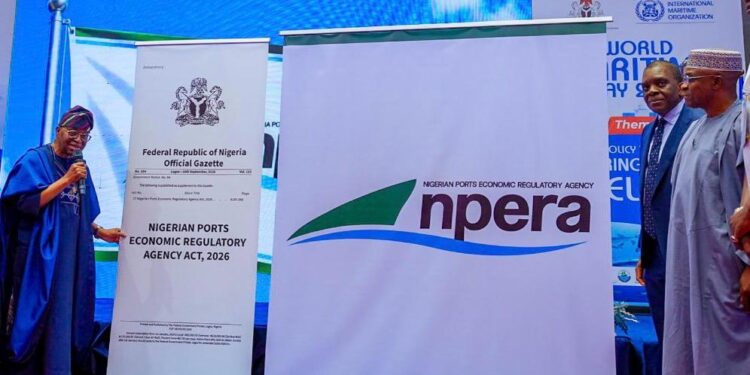
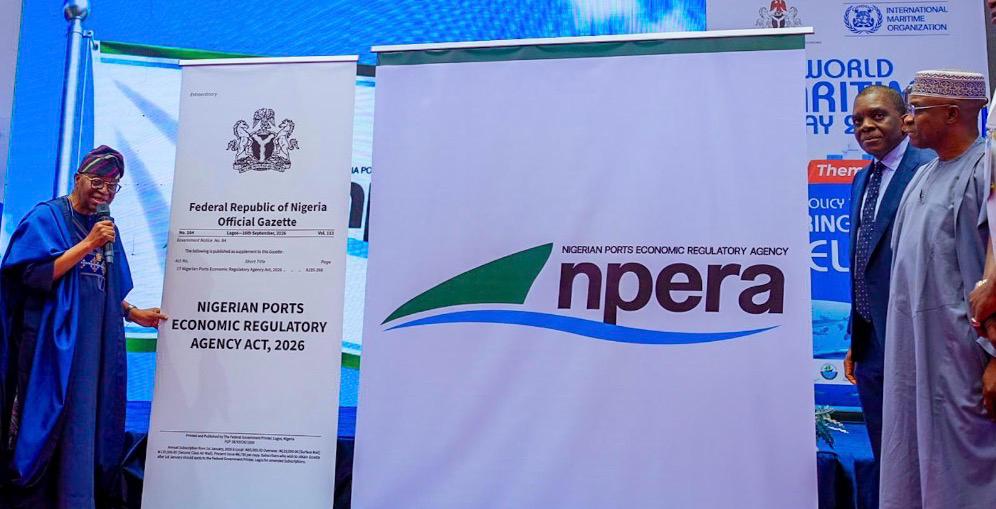
The Minister of Marine and Blue Economy, Dr Adegboyega Oyetola, has unveiled the gazetted Nigeria Ports Economic Regulatory Agency (NPERA) Act, 2026, and the agency’s official logo, while directing the immediate constitution of a ministerial committee to oversee the transition of the Nigerian Shippers’ Council (NSC) into the new regulatory body.
Oyetola made this known on Friday at the Third Quarter 2026 Citizens’ and Stakeholders’ Engagement of the Federal Ministry of Marine and Blue Economy, held in Victoria Island, Lagos.
The development follows President Bola Ahmed Tinubu’s assent to the NPERA Act in June 2026, establishing a statutory framework for port economic regulation after nearly two decades of efforts to institutionalise the function.
The Nigerian Shippers’ Council has served as Nigeria’s interim port economic regulator since 2014.
According to the minister, the new agency will regulate tariffs and charges, promote competition, enforce service standards, resolve commercial disputes and protect the interests of port users.
He stressed that the credibility of the regulator would depend on its independence, impartiality and freedom from responsibilities capable of creating actual or perceived conflicts of interest.
“The credibility of an economic regulator rests, in no small measure, on its independence, impartiality and freedom from responsibilities that could give rise to actual or perceived conflicts of interest,” Oyetola said.
He consequently directed NPERA to operate as an impartial arbiter, free from competing regulatory and operational responsibilities.
The minister’s disclosure comes as the maritime sector prepares for a new regulatory regime expected to reshape the oversight of port charges, service delivery and commercial relationships among port operators and users.
On infrastructure, Oyetola reaffirmed the Federal Government’s commitment to modernising Apapa, Tin Can Island, Onne, Rivers, Delta and Calabar ports, emphasising that the programme would promote balanced development across the country.
“No part of our national port system will be left behind in this modernisation programme,” he declared.
He added that ports outside Lagos remained critical to Nigeria’s economic future, noting that the government was also pursuing the development of six deep seaports at Ibom, Bakassi, Agge, Gateway, Ondo and Bonny to expand maritime capacity and strengthen the country’s position as a regional logistics hub.
On maritime security, Oyetola said Nigeria had maintained zero piracy incidents in its territorial waters through the Deep Blue Project.
He also identified the lifting of the 12-year United States Coast Guard Condition of Entry on vessels arriving from Nigeria in August 2026 as a significant achievement, linking the development to improvements in maritime security and compliance with the International Ship and Port Facility Security Code.
The minister further reiterated the government’s commitment to strengthening indigenous shipping, disclosing that he had directed the Nigerian Maritime Administration and Safety Agency (NIMASA) to work with approved Primary Lending Institutions to accelerate the processing and disbursement of the Cabotage Vessel Financing Fund (CVFF) to qualified applicants.
The CVFF is designed to support eligible Nigerian shipping operators in acquiring vessels and expanding their participation in the coastal and inland shipping trade.
On international cooperation, Oyetola cited Nigeria’s election into Category C of the International Maritime Organization Council in November 2025 and ongoing engagements with Denmark, India, Norway and the United Kingdom.
“Our approach to international cooperation is purposeful and results-oriented,” he said, stressing that partnerships must strengthen local capabilities and deliver measurable and sustainable outcomes.
The engagement, themed “Building Strategic Bilateral Partnerships for Sustainable Growth, Investment, and Technology of Nigeria’s Marine and Blue Economy,” brought together government officials, industry leaders, development partners and other stakeholders to discuss investment opportunities and reforms in the sector.
As part of the programme, the Ambassador of the Kingdom of Denmark to Nigeria, Jens Ole Bach Hansen, delivered a presentation on Denmark’s experience in building a sustainable blue economy, highlighting lessons for strategic partnerships, investment and technology transfer with Nigeria.
The unveiling of the NPERA Act and its official logo marks another step in the government’s efforts to establish a dedicated port economic regulator as it pursues infrastructure modernisation, improved service delivery, increased investment and greater competitiveness in Nigeria’s maritime industry.