Conventionally, deep seaports are maritime facilities designed to accommodate large, heavily loaded ships with deep drafts. These ports are crucial for international trade, facilitating the movement of goods in and out of a country. They typically have a water depth of at least 18 meters (or about 60 feet), which allows them to handle massive vessels that typical ports cannot.
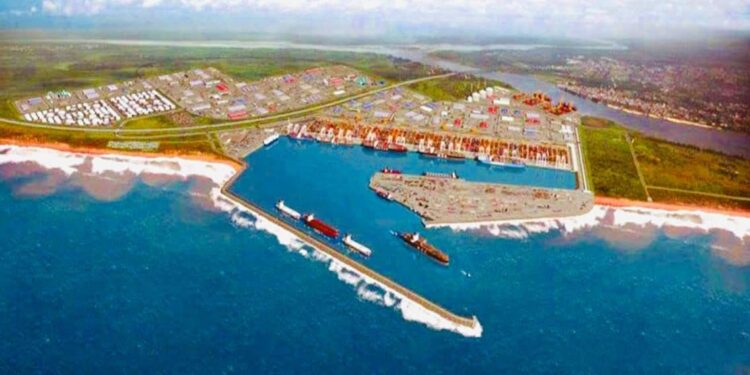
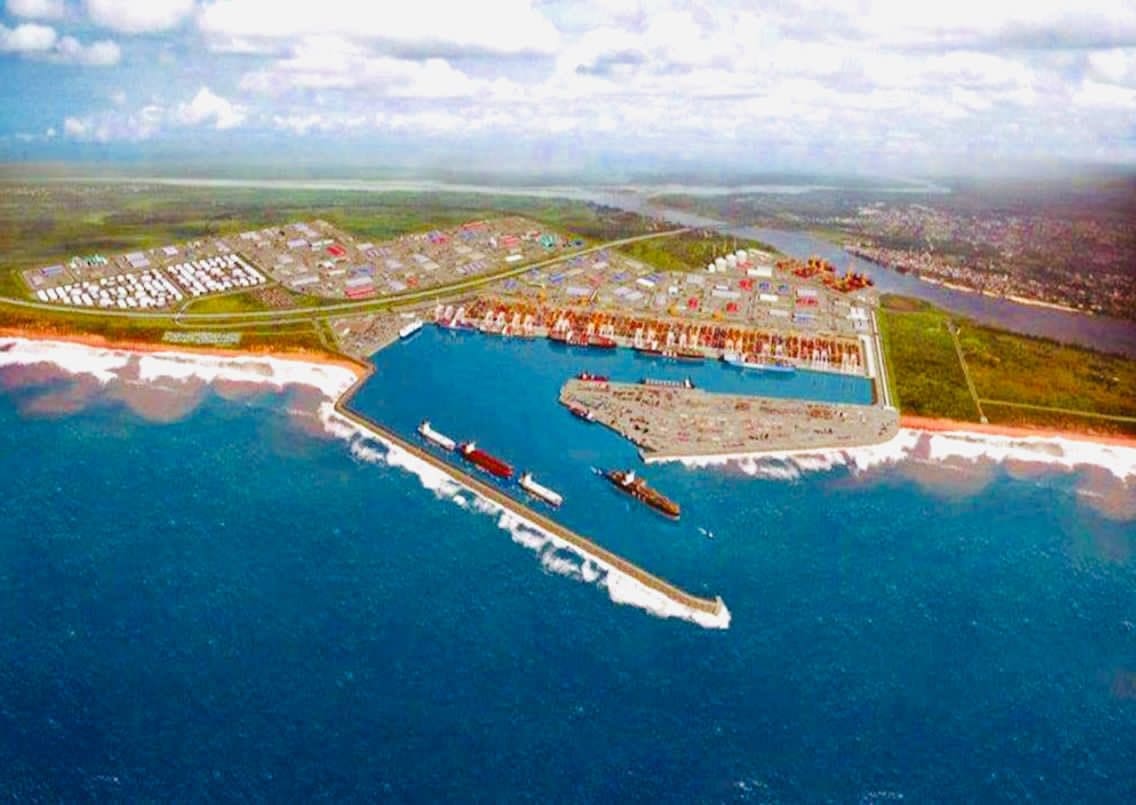
Earlier this month, Nigeria took a major step towards expanding its maritime infrastructure. A Federal Government delegation led by the Minister of Marine and Blue Economy; Adegboyega Oyetola signed a Memorandum of Understanding (MoU), with global terminal operator; APM Terminals, for the development of Badagry Deep Seaport.
The agreement was signed in Copenhagen, Denmark during an official visit by delegation to strengthen maritime cooperation and attract more investment into Nigeria’s ports.
The port is expected to provide additional deepwater capacity, accommodate larger container vessels, and create new transshipment opportunities for Nigeria and the wider West African market.
Available information is that the Badagry Deep Seaport is a massive Greenfield infrastructure project located in the Gberefun/Gueru area of Badagry, Lagos State. It covers 496 hectares of core port development land within a broader 1,131-hectare Free Trade Zone. It is estimated to cost between $2.59 billion and $3.7 billion. The first phase includes a container terminal designed to handle 1.2 million TEUs with an 18-meter channel draft to accommodate 21st-century mega-vessels.
The recent development is happening about four years after the Lagos State Governor, Mr Babajide Sanwo-Olu confirmed receipt of Federal Government approval for the construction of the Deep Seaport. It was first conceived in 2011.
Between 2011 and 2024, the sea port proposal had gone through conception stage to securing a Federal Government approval and eventually leading to the signing of a milestone agreement which established a 45-year Build-Own-Operate-Transfer (BOOT) model, featuring a five-year construction window and 40 years of operational control by the private and public partners owners.
Now that it’s almost certain that the new port will come on stream in a matter of years, most likely in 2031.
Nigeria currently accounts for over 70 per cent of cargo traffic within the West and Central African sub-region, while countries such as Niger, Chad, Mali and Burkina Faso also depend partly on Nigerian ports for international trade access.
One can boldly affirm that, while we are awaiting the berthing of Badagry Deep Seaport, the only deep seaport in Nigeria as at today is the Lekki port. It is Nigeria’s first and currently only operating deep seaport, located in the Lagos Free Zone. It is a multi-purpose port, which commenced full commercial operations in April 2023. It is also pertinent to envisage competition, especially between Badagry and Lekki ports.
The craving for deep seaports in Nigerian can be understood, because such ports seaports can be economic drivers as they handle larger volume of cargo and larger vessels, making them more efficient for international trade. Deep seaports can serve as transshipment hubs, facilitating the transfer of cargo to smaller vessels for distribution to other ports.
One of the major economic benefits is that it can reduce congestion at existing ports, improve efficiency, lower transportation costs, and attract more international trade
Official data reveal that, Lekki Deep Sea Port handles 40.6% of Nigeria’s total cargo throughput, establishing itself as the country’s leading seaport. This is according to the 2025 Operational Performance Report released by the Nigerian Ports Authority (NPA). This represents a significant structural shift in Nigeria’s maritime landscape, positioning the deep-sea facility ahead of older legacy ports, such as Apapa and Tin Can and Onne.
Superficially, both Lekki and Badagry ports should not be a threat to each other. Rather, the two facilities are designed to complement each other by anchoring at opposite ends of Nigeria’s trade corridors.
While Lekki Port dominates the eastern logistics corridor of Lagos, the Badagry portis seen as a strategic buffer designed to solve distinct geopolitical and logistical bottlenecks.
Both ports target entirely different trade flows, making direct competition minimal. The proposed Badagry port is located on the Western corridor and gateway. Located close to the Benin Republic border, its primary economic mission is to stop cargo diversion to Cotonou (Benin Republic) and Lomé (Togo) ports. It is expected to capture trade coming from the West African hinterland and the ECOWAS sub-region, serving markets on the western side of Nigeria and its borders.
On the other hand, the Lekki port is located on the eastern edge of Lagos, and it is directly tied to the Lagos Free Zone, the massive Dangote industrial complex, and export/import markets moving toward the eastern and northern parts of Nigeria.
However, a major vulnerability for Lekki Port has been its reliance on road networks, raising concerns about moving cargo through the gridlock-prone Lekki-Epe axis. Here, Badagry holds a significant logistical advantage in cargo evacuation options. Badagry also features a naturally deep, narrow lagoon highly suited for cargo barging.
Arguably, Badagry port also has an advantage of hinterland connectivity. The ongoing expansion of the Lagos-Badagry Expressway into a multi-lane corridor, coupled with an evacuation bypass via Agbara allows trucks to move goods directly to northern Nigeria without filtering through central Lagos traffic. The ongoing Badargy to Sokoto superhighway is an added advantage.
If nothing at all, the coming-up of Badagry port means that the rivalry between Mediterranean Shipping Company and A.P. Moller-Maersk has officially moved southwards to the West African coastline, igniting a high-stakes corporate “battle” over Nigeria’s multi-billion dollar deepwater gateways: Lekki Port and the upcoming Badagry Port.
This corporate chess match stems from a critical shift in global shipping: the formal end of the 2M Alliance. With Maersk and MSC now operating independently, they are directly fighting to capture West Africa’s massive container trade. MSC currently holds the regional crown as the top carrier by capacity, putting intense pressure on long-time market leader Maersk to strike back.
This probably explains the frontal role that A.P. Moller-Maersk is playing in the push for the actualisation of Badagry port.
On the other hand, the relationship between Lekki Deep Sea Port and Mediterranean Shipping Company (MSC) is a strategic commercial partnership, solidified by a major service agreement that positions Lekki Port as a central player in MSC’s West African logistics loop.
While MSC is not the terminal operator (the container terminal is operated by Lekki Freeport Terminal, a subsidiary of French shipping rival CMA CGM), MSC leverages Lekki’s deepwater infrastructure as a primary customer to move immense volume into Nigeria.
Specifically, MSC established a fixed weekly feeder shipping service to Lekki Port. The relationship relies on a highly coordinated hub-and-spoke transit system.
Interestingly, MSC utilizes its mega-vessels to drop international cargo at its massive transshipment hub in Lomé; about 100 nautical miles from Badagry. From Lome, MSC’s dedicated regional feeder ships carry those containers straight into Lekki Port, avoiding the severe congestion plaguing older Lagos ports.
On the export flank, MSC also has it wrapped-up, as Nigerian exporters drop off cargo at Lekki Port. MSC then ships them to Lomé, where it seamlessly hooks into MSC’s mainline network bound for Europe, Asia, and the Americas.
It is quite obvious that, the conceptualisation of the Badagry Deep Seaport will make an interesting business case study, as two leading shipping lines throw their weight behind sub-continents two leading deep seaports- Lekki and Badagry ports
Ultimately, the Nigerian economy, its stakeholders, especially the government, the shippers and other key players in the logistics chain will be the greatest beneficiaries of the breaking of the near-monopoly that Lekki port has had since it began operations.
From Lagos (where Lekki port is located), to Onne port in Rivers state, where the West African Container Terminal (linked to APM Terminal and by extension Maersk Line) is located, the battle for the sub-continent’s market will be an interesting one.