By Oluyinka Onigbinde
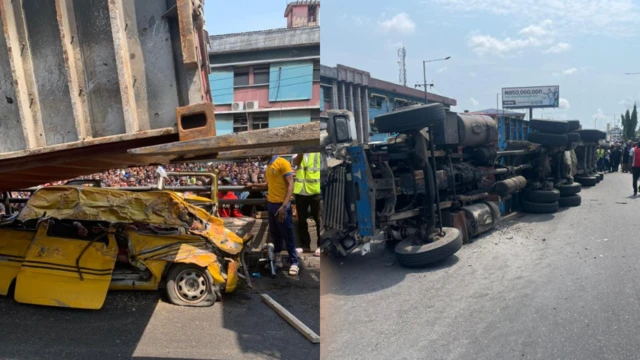
At least 20 people have so far been killed in truck-related road crashes across Lagos State in 2026, with several others injured, as fresh figures from the Lagos State Emergency Management Agency (LASEMA) reveal that accidents involving articulated vehicles accounted for 127 emergency responses between January and September.
The figures, drawn from various accident reports published during the year, highlight the continuing dangers associated with articulated vehicles on Lagos roads, where heavy-duty trucks share busy highways with commercial buses, private vehicles, tricycles, motorcycles and pedestrians.
LASEMA, in its nine-month emergency report obtained by our correspondent last week, disclosed that it responded to 696 incidents across the state, between January and September 2026. These included 206 road traffic accidents, 138 fire outbreaks, 127 truck and tanker-related emergencies, 64 medical emergencies and 24 building collapse and distressed building cases, among others.
The agency also recorded 78 casualties and 508 injuries across the emergencies handled during the period. However, it did not provide a breakdown of how many of the deaths and injuries resulted specifically from truck and tanker incidents.
An examination of selected truck-related accident reports published by Federal Road Safety Corps (FRSC), news organisations and emergency agencies shows that the incidents have occurred across several major corridors, including Epe, the Lekki–Epe Expressway, Sangotedo and the Badagry Expressway.
One of the most disturbing incidents occurred in January when a sand-laden truck crashed into a church along Hospital Road in Epe, killing six worshippers. Eyewitnesses said the truck’s brakes failed as it descended towards a roundabout, causing the driver to lose control and ram into the building.
In February, a granite-laden truck overturned onto a Toyota saloon car at Eleko Junction along the Lekki–Ajah Expressway, killing the male motorist and leaving his wife critically injured. The Lagos State Traffic Management Authority (LASTMA) said preliminary findings indicated that the truck had experienced a brake malfunction.
The situation worsened in March when four passengers died and four others were injured after a HOWO truck collided with a commercial minibus opposite Beechwood at Shapati, along the Lekki–Epe Expressway, inward Ajah.
Another fatal incident occurred on March 21 at Sangotedo, where a speeding tipper truck reportedly rammed into a stationary gas tanker along the Lekki–Epe Expressway. The resulting fire spread to three warehouses and about 10 roadside shops. The tipper driver and his assistant died, while the tanker driver escaped unhurt.
In another incident in Epe, a truck carrying yams reportedly lost control while attempting a U-turn at Aiyetoro Junction and rammed into a stationary commercial tricycle, killing one person and leaving three others seriously injured.
The series of incidents continued in August when five men died after a Toyota Camry collided head-on with an Iveco truck at Sawmill, near Mowo Bus Stop, along the Badagry Expressway. According to LASEMA, preliminary findings indicated that the car driver was speeding and driving recklessly before losing control and crossing into the opposite lane.
Although the incidents involved trucks, the circumstances varied, with reported causes including brake failure, loss of control, speeding and collisions with stationary vehicles. The cases underline the need for thorough investigations rather than attributing every crash to a single cause.
LASEMA said in the report stated that its average emergency response time improved to between 10 and 15 minutes during the nine-month period. The agency attributed the improvement to investments in rescue equipment, heavy-duty wreckers, digital flood-prediction technology and community preparedness.
According to the report, more than 15,000 community volunteers were trained and provided early warnings in over 58 incidents. The agency also said its zonal response bases helped it manage emergencies across the state without any incident escalating to mass-casualty level during the period.
The Permanent Secretary of LASEMA, Dr. Olufemi Damilola Oke-Osanyintolu, said the state government remained committed to protecting lives and property through proactive disaster-risk reduction, rapid response and sustained public sensitisation.
He urged motorists to ensure their vehicles were roadworthy and called on residents to observe safety precautions, particularly as the ember months approach.
The agency linked its improved emergency-response capacity to the THEMES+ Agenda of Governor Babajide Sanwo-Olu, which it said had supported the acquisition of rescue equipment and the development of emergency-management capabilities.
However, the figures raise questions about the balance between responding to truck-related emergencies and preventing them in the first place.
Regular mechanical inspections, effective enforcement of road-safety regulations, responsible loading practices and proper monitoring of articulated vehicles remain important measures for reducing the risk of avoidable crashes.
The publicised cases also point to the importance of obtaining a comprehensive, truck-specific breakdown of accidents, fatalities and injuries from the relevant authorities.