Stakeholders in Nigeria’s maritime sector have expressed deep concern that despite handling merchandise trade worth $38.3 billion in 2025, the country still has no seagoing vessels flying its flag, leaving all international cargo carriage to foreign-owned ships.
This is even as they called for integrated planning and coordinated implementation across government institutions as a key step to strengthening Nigeria’s maritime business and bridging long-standing policy gaps.
These were echoed at the 2025 Maritime Conference organised by BusinessDay themed “Strengthening Nigeria’s Maritime Business: Bridging Policy Gaps and Optimizing Global Competitiveness.” in Lagos on Tuesday.
While delivering her keynote address, the National President of Chartered Institute of Logistics & Transport (CILT) Barrister Mfon Usoro, raised concern over Nigeria’s failure to translate its huge maritime potential into tangible competitiveness, noting that none of the 4,100 seagoing vessels that called at Nigerian ports in 2021 flew the country’s flag.
She disclosed that Nigeria’s total merchandise trade in 2025 stood at $38.3 billion, with crude oil carriage accounting for $11.9 billion, while non-crude trade reached $8.3 billion. Yet, the absence of indigenous participation in international shipping has left all cargo in the hands of foreign-owned and foreign-flagged vessels.
The former Director-General of the Nigerian Maritime Administration and Safety Agency (NIMASA), recalled that as far back as the Obasanjo administration, Nigeria acquired 31 ships to boost indigenous fleet capacity, but poor planning, lack of technical manpower, and weak market studies led to their collapse.
“The market is there, but we are not participating. Despite the NIMASA Act granting national carriers exclusive rights to 50 percent of government-owned cargo and a share of international aid cargo, Nigeria still has no seagoing vessels to its name. This is not a policy gap—it is an implementation gap. Owning a ship is not like buying a car; it requires structure, financing, and daily marketing assessment to ensure sustainability,” she stressed.
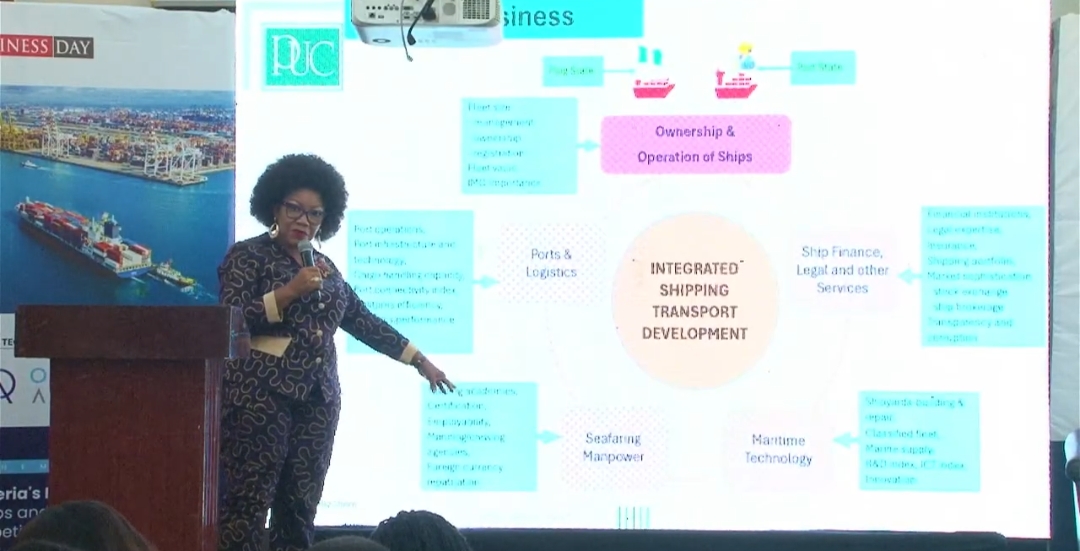
Presenting a maritime business schema, Usoro highlighted five clusters — ownership and operation of ships, ports and logistics, maritime technology, seafaring, and mining — which determine global competitiveness. She urged Nigeria to prioritise ship ownership and ports/logistics, backed by integrated planning among the Ministries of Finance, Petroleum, Agriculture, Mining, and trade agencies.
“It is clear that agencies working in silos cannot deliver the promise of indigenous shipping. For us to become competitive, maritime development must be treated as a national project, with coordination across all relevant ministries and incentives for private investors,” Usoro concluded.
In his welcome address, Frank Aigbogun, Publisher of BusinessDay newspaper, said Nigeria’s maritime sector must be repositioned as the backbone of trade, jobs, and economic growth. He highlighted recent milestones including the Lekki Deep Sea Port, fresh investments by global players like Maersk, and reforms at the Nigerian Ports Authority (NPA) and Nigerian Maritime Administration and Safety Agency (NIMASA).
He urged stakeholders to harmonize policies, digitize ports to cut costs and delays, secure Nigeria’s waterways, and scale up financing through creative partnerships. “Yet we must be honest,” Aigbogun cautioned. “Infrastructure gaps, congested ports, and regulatory fragmentation continue to choke competitiveness. Without serious investment in indigenous shipping, port modernization, and maritime skills, we risk missing the future.”
The Managing Director of NLNG Shipping and Marine Services Limited (NSML) , Mr. Abdul-Kadir K. Ahmed, underscored the importance of global standards and skills development. He said NSML currently manages 13 vessels, including LNG carriers and mega gas vessels, as well as the Bonny Island LNG terminal, which ensures safe and reliable cargo evacuation.
Ahmed who was represented by a Senior staff of the NSML, Mr. Ladipo Egbeyemi stressed that Nigeria could claim its place in the global maritime sector if it pursues deliberate policies and develops the right skill sets. “Today we have about 700 Nigerian seafarers managing vessels, supported by our Maritime Centre of Excellence, which trains and equips them with world-class competence,” Ahmed explained.
From a subnational perspective, Anambra State Commissioner for Transportation, Mrs. Patricia Igwebuike, emphasized the need to revive the Onitsha River Port as a viable complement to existing ports. She noted that most imports into Southern Nigeria are destined for Anambra and surrounding states, placing pressure on dilapidated road infrastructure.
“We must harness the Onitsha River Port through collaboration, training, and capacity building so that it contributes meaningfully to national trade,” she said, pledging that Anambra would pursue partnerships with federal agencies and international stakeholders to achieve this.
On his part, the National President of the National Association of Government Approved Freight Forwarders (NAGAFF), Chief Tochukwu Ezisi, represented by General Secretary, Chief Godfrey Nwosu, called for digital transformation and stronger ethics in maritime logistics.
“The future of maritime logistics will be defined by innovation, technology, and empowerment of coastal operators,” Ezisi said. “This conference should spark bold initiatives that drive inclusive, ethical, and efficient growth.”
The conference, which attracted policymakers, investors, regulators, and operators, was described by participants as a timely intervention to bridge policy gaps and position Nigeria as West Africa’s maritime hub.