By Oluyinka Onigbinde
The Managing Director of the Nigerian Ports Authority (NPA), Dr. Abubakar Dantsoho, has called for the adoption of greener and safer port operations across Nigeria, stressing that dockworkers remain critical to the country’s competitiveness in global maritime trade.
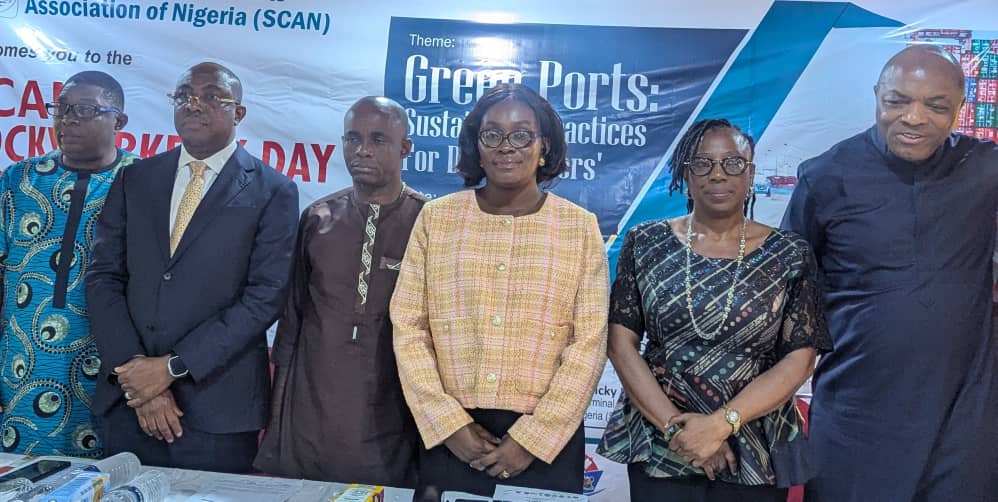
Dantsoho made the call on Thursday at the 2026 Dockworkers Day celebration organised by the Shipping Correspondents Association of Nigeria (SCAN) in Lagos, where he underscored the need for sustainable port practices and improved welfare for maritime workers.
Speaking on the theme, “Green Ports: Sustainable Practices for Dockworkers,” the NPA Managing Director said the global maritime industry was increasingly embracing environmentally responsible operations, cleaner technologies and climate-conscious practices, and urged Nigeria to keep pace with these developments.
He described dockworkers as the backbone of port operations, noting that their contributions are essential to cargo handling, vessel operations, trade facilitation and the overall efficiency of Nigeria’s ports.
According to him, every container handled, vessel serviced and cargo delivered reflects the dedication and professionalism of dockworkers, whose efforts support the smooth movement of imports and exports and strengthen the nation’s economy.
“Without the commitment, resilience and professionalism of dockworkers, our ports cannot function effectively,” Dantsoho said.
The NPA boss reiterated the Authority’s commitment to promoting workers’ welfare, safety and dignity within the port environment, warning employers and operators against neglecting labour standards and workplace safety requirements.
He stated that sustainable port operations can only be achieved when workers are adequately protected, respected and empowered.
“The era when workers could be treated as expendable assets has no place in our maritime industry,” he said.
Dantsoho also highlighted the importance of environmental sustainability in ensuring the future competitiveness of Nigeria’s maritime sector. He noted that ports around the world are adopting green technologies, improving energy efficiency and implementing cleaner operational practices to reduce emissions and minimise environmental impact.
He said the Nigerian Ports Authority remains committed to supporting initiatives that promote cleaner energy solutions, improved waste management systems and environmentally sustainable port operations.
According to him, achieving these goals requires the collective efforts of terminal operators, shipping companies, regulators and dockworkers, who are directly involved in day-to-day port activities.
The NPA Managing Director urged dockworkers to embrace environmentally responsible practices through proper cargo handling, adherence to safety and environmental regulations, waste reduction and active participation in green initiatives.
He further assured stakeholders that capacity building would remain a key component of the Authority’s port development agenda, with continued investment in training programmes designed to equip workers with the skills needed to adapt to emerging technologies and evolving industry standards.
Dantsoho also commended SCAN for sustaining the annual Dockworkers Day celebration, describing the platform as an important avenue for recognising the contributions of dockworkers and fostering dialogue on the future of the maritime industry.
He reaffirmed the Authority’s commitment to creating an enabling environment that supports decent work, sustainable port operations, increased investment and enhanced international competitiveness for Nigeria’s maritime sector.
The NPA Managing Director congratulated dockworkers for their contributions to national development and formally declared the 2026 SCAN Dockworkers Day celebration open.
Also speaking, the President of the Nigerian Chamber of Shipping (NCS), Alhaji Aminu Umar, said the success of green and smart ports depends largely on the readiness of the workforce.
Umar, who was represented by the Chamber’s Director-General, Mrs. Vivian Chimezie-Azubuike, stressed that Nigeria’s transition to greener ports must not leave dockworkers behind, calling for targeted training and workforce development to prepare workers for emerging technologies and sustainable port operations.
He emphasised the need for a comprehensive needs assessment to determine the number of dockworkers requiring training and the specific skills needed to improve productivity and adapt to technological changes.
“We don’t have the data. We need real data to know how many people are actually in need of training and to conduct a proper needs assessment that will identify who requires what kind of training that adds value to their jobs,” Umar said.
According to him, investments in automation, digital systems and environmentally friendly technologies must be matched by investments in human capital to ensure workers benefit from the industry’s transformation.
In his remarks, the President of the National Association of Stevedoring Operators (NASO), Mr. Bolaji Sunmola, said operational efficiency remains Nigeria’s most practical route to greener ports.
According to him, reducing cargo dwell time, vessel waiting periods and truck congestion around port corridors would deliver immediate environmental benefits by cutting fuel consumption and emissions.
“The carbon that is never emitted is the greenest of all,” Sunmola stated.
He called for the integration of measurable environmental performance standards into Nigeria’s ongoing port modernisation programme, including emissions reduction targets, equipment upgrades, waste management systems and cargo dwell-time benchmarks.
Earlier, the Deputy National President of the Nigeria Labour Congress (NLC), Prince Adewale Adeyanju, warned that the global shift toward green ports must not result in job losses or worker exclusion.
He noted that automation, renewable energy systems, digital logistics platforms and cleaner cargo-handling technologies are rapidly changing port operations worldwide.
“Any conversation about green ports must place workers at the heart of policy formulation and implementation,” he said, stressing that workers should be equipped with the skills needed to thrive in the changing maritime environment.