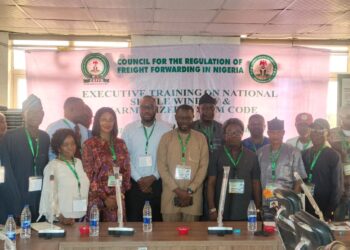
The Council for the Regulation of Freight Forwarding in Nigeria (CRFFN) has trained freight forwarders and key industry stakeholders on the National Single Window (NSW) initiative and the Harmonised System (HS) Code, as part of efforts to enhance efficiency in freight forwarding services and advance trade in goods across the country. The executive training, themed “Advancing Trade in Goods Through Efficient Freight Forwarding Service,” focused on equipping practitioners with knowledge of ongoing trade facilitation reforms aimed at reducing cargo clearance delays, cutting costs and improving regulatory coordination at Nigeria’s ports.
At the training, the Head of Change and Stakeholder Management for the National Single Window initiative, Mr. Ayokunnu Ojeniyi, explained that the National Single Window is an international trade facilitation concept and not a locally conceived idea, noting that it has been in discussion within Nigeria’s trade space for more than a decade. He said the system is formally defined by the United Nations Centre for Trade Facilitation and Electronic Business as a platform that allows parties involved in trade and transport to submit standardised information and documents through a single entry point.
Ojeniyi noted that Nigeria’s import and export processes currently involve multiple regulatory agencies, estimated at about 22, each requiring separate permits, licences and certifications. According to him, the existing arrangement forces traders to physically or digitally approach different agencies, resulting in duplication of documentation, delays and increased transaction costs. He explained that the National Single Window is designed to address these challenges by providing a single digital interface through which traders can obtain all necessary regulatory approvals.

He said that once a document is submitted on the National Single Window platform, it is automatically shared with all relevant agencies at the back end, eliminating the need for repeated submissions. He added that data harmonisation across agencies would ensure consistency of information, while enhanced transparency would make it easier for government authorities to monitor applications, track delays and identify agencies responsible for bottlenecks in the clearance process.

Ojeniyi further stated that the platform would support electronic payments, ensuring transparent billing and proper revenue assurance. According to him, the system would clearly indicate what traders are required to pay, reducing disputes and preventing multiple or conflicting payment demands. He stressed that the focus is on revenue assurance rather than revenue generation, noting that the objective is to ensure payments reach the appropriate government institutions through an accountable process.
He disclosed that the National Single Window would also introduce a centralised risk management framework, replacing the current fragmented approach where different agencies operate separate risk management systems. He explained that the centralised model would reduce duplication of inspections, improve compliance monitoring and facilitate faster clearance for low-risk consignments.

Ojeniyi said the initiative involves extensive engagement with stakeholders across the trade ecosystem, including freight forwarders, shipping lines, shipping agents, airlines, terminal operators, port authorities and regulatory agencies. He explained that shipping lines and airlines involved in cargo operations would submit manifests through the National Single Window, after which the information would be shared automatically with agencies such as the Nigerian Customs Service, the Nigerian Ports Authority and the Nigerian Maritime Administration and Safety Agency.

He revealed that a multi-agency steering committee has been established to oversee the implementation of the project, comprising key regulatory bodies such as the Nigerian Customs Service, Standards Organisation of Nigeria, Nigerian Ports Authority, Nigerian Maritime Administration and Safety Agency, National Agency for Food and Drug Administration and Control, among others. According to him, the committee receives quarterly updates and provides strategic direction for the rollout of the initiative.
Highlighting expected benefits, Ojeniyi said the National Single Window is aimed at simplifying import and export procedures, reducing bottlenecks and shortening clearance timelines. He cited international examples where the implementation of the system significantly improved trade efficiency, noting that Singapore, South Korea, Djibouti and Kenya recorded substantial reductions in cargo clearance times after adopting the platform.
He contrasted these outcomes with Nigeria’s current situation, where cargo clearance can take between 12 and 21 days, while exports average about 11 days. According to him, the medium-term target is to reduce import and export processing to as low as 24 hours. He added that over 90 per cent of cargo in Nigeria is currently subjected to physical examination, a figure he said should be reduced to below 10 per cent through improved risk management and the deployment of scanners at ports.
On the cost of doing business, Ojeniyi observed that clearing goods in Nigeria costs about 80 per cent more than in other West African countries, stressing that one of the objectives of the National Single Window is to bring clearance costs closer to regional standards.
Providing an update on implementation, he recalled that the National Single Window project was inaugurated by President Bola Ahmed Tinubu in April 2024. He said the project team has since carried out extensive assessments of existing import and export processes, as well as technological readiness evaluations, to establish a clear baseline before full deployment.
Responding to questions from participants, Ojeniyi cautioned that the National Single Window should not be viewed as a solution to all trade-related challenges. He explained that while the platform would significantly address process-related inefficiencies within ports and clearance procedures, it would not automatically resolve issues outside the ports, including challenges encountered along transport corridors.
He noted that complementary systems such as a Port Community System would be required to address broader logistics interactions among port users, adding that discussions are ongoing in that regard. He also addressed concerns about system downtime and demurrage, stating that efforts are being made to deploy reliable infrastructure with built-in redundancies and disaster recovery mechanisms to minimise disruptions.
On cargo examination, Ojeniyi said the availability of scanners remains critical to reducing reliance on physical inspection, noting that procurement processes are ongoing. He added that improved compliance by licensed customs agents and freight forwarders would be essential to achieving the intended efficiency gains.
The executive training, organised by CRFFN, formed part of broader efforts to prepare freight forwarders and other stakeholders for the full implementation of the National Single Window and to align Nigeria’s freight forwarding practice with international trade facilitation standards.
Also speaking at the training, the Registrar of the Council for the Regulation of Freight Forwarding in Nigeria, Mr. Kingsley Igwe, emphasised the critical role of the Harmonised System (HS) Code in professional freight forwarding practice, describing it as the foundation of cargo declaration and customs licensing. He explained that the HS Code is the primary instrument used for identifying goods in international trade and stressed that without proper HS classification, customs documentation and licensing would be impossible.
Igwe clarified that the HS Code is a global classification system administered by the World Customs Organization, and not by individual regulatory agencies, noting that it was introduced in 1983 and came into effect in 1988 to ensure uniformity in the description of goods across countries. According to him, the system was developed to eliminate discrepancies in how goods are described in different jurisdictions, allowing the same product to be identified uniformly whether it is traded in China, Nigeria or elsewhere.
He explained that while HS Codes are often confused with tariffs, the two are different, noting that the HS Code identifies the product, while the tariff determines the rate of duty applicable to it. He added that the HS Code is used not only for duty assessment, but also for regulatory compliance, trade statistics and enforcement of trade agreements, including rules of origin under the African Continental Free Trade Area.
The registrar further broke down the structure of the HS Code, explaining that it consists of six globally uniform digits, which cannot be altered by individual countries, while additional digits are added at the national level to reflect product-specific or statistical requirements. He noted that Nigeria operates a 10-digit HS Code system, with the first six digits recognised internationally and the remaining digits used for national classifications.
Igwe stressed that every consignment must be properly categorised under the HS system and warned that incorrect or improper declaration of goods could attract penalties.
He added that proper knowledge and application of HS Codes would increasingly form part of the criteria for licensing freight forwarders, describing it as a core requirement for professionalism in the industry.
He also noted that accurate HS classification would remain central to customs processes under the National Single Window platform.