By Oluyinka Onigbinde
The Nigeria Maritime Administration and Safety Agency (NIMASA) has come under severe criticism over the efficacy of its much-touted Deep Blue Project, which gulped a substantial $195 million investment by the government to fortify maritime security.
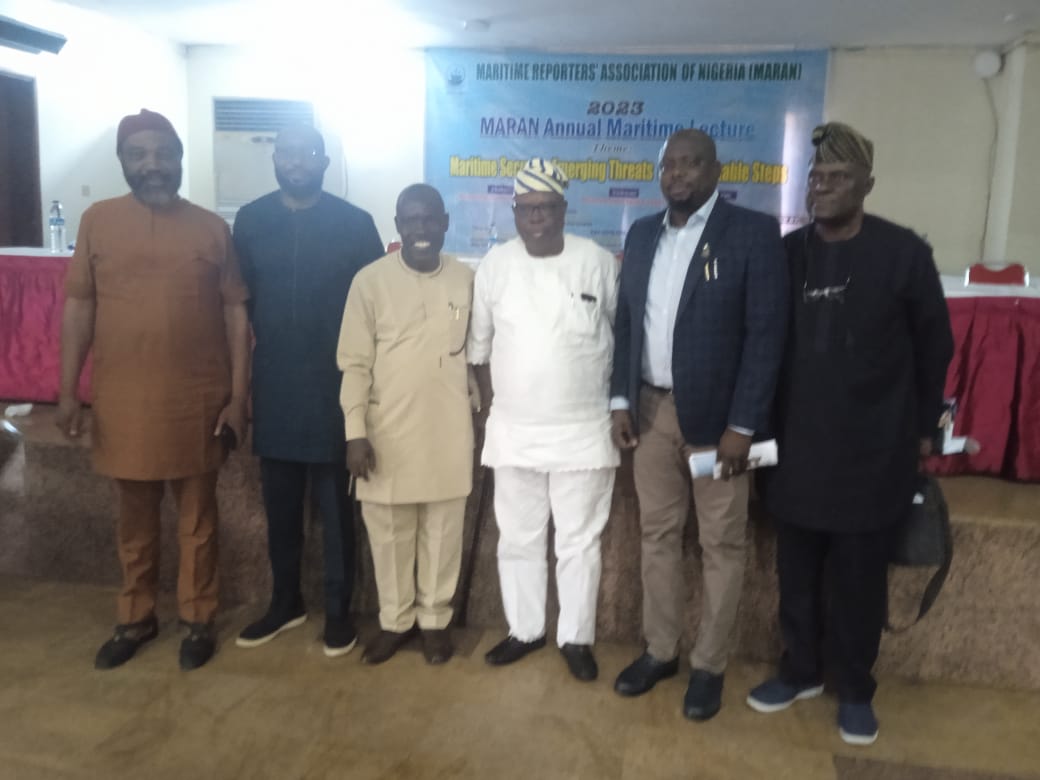
Maritime industry stakeholders who spoke at last week’s Maritime Reporters Association of Nigeria (MARAN) lecture in Lagos, fingered glaring inadequacies despite the huge investment.
The stakeholders lamented that foreign shipping companies continue to pay $50,000 per vessel for security patrol services for the safety of their crew, vessels and cargoes. This is even as industry leaders and experts are now questioning the effectiveness of the Deep Blue Project in achieving its intended goals.
The stakeholders who spoke at the annual lecture collectively urged the government, under the leadership of President Bola Ahmed Tinubu, to re-evaluate the effectiveness of current maritime security measures, while questioning the allocation and utilization of a whooping $195 million Deep Blue Project. Critics have argued that despite the substantial investment, the expected outcomes, particularly in terms of reducing financial burdens on foreign shipping companies, are yet to be realized.
Among those who expressed discontent is Mr. Temisan Omatseye, a former Director General of NIMASA, who advocated for a significant shift in security practices. He proposed that the Deep Blue Project should take on the responsibility of securing anchorage areas in the Nigerian maritime domain.
Omatseye noted that such a move would not only enhance security but also alleviate the financial burden on foreign shipping companies, potentially resulting in a decrease in the cost of imported goods.
He further stated that if the Deep Blue Project is effectively implemented, it could save the country the extra cost of goods added by shipping companies as a result of insecurity in the country’s waters.
Omatseye also addressed the controversial Secured Anchorage Area (SAA), previously operated by Ocean Marine Solutions Ltd. (OMSL). He urged the government to steer clear of politicizing the shipping industry and stressed the importance of seamlessly replacing the SAA if it were to be discontinued.
On his part, Mr Emmanuel Maiguwa, President of the Maritime Security Providers Association of Nigeria, echoed Omatseye’s sentiments during the event. He emphasized the urgent need for a competent agency to oversee anchorage security.
Maiguwa further underscored the necessity for a robust framework to address maritime security threats and urged the adoption of the International Ship and Port Facility Security (ISPS) code.
He also called for a proper framework that would help the country deal with maritime security threats, even as he kicked against the establishment of a coast guard, which he described as a mere nomenclature.
“If you look at it more specifically, we actually need to do a risk assessment, because I have been involved in a lot of risk assessments. One needs to look at the parameters surrounding the routes and the water, the region of the area that has personal traffic. So, it doesn’t start and end with that portion being secured”, he argued.
“I have always said that the ISPS provides only minimal requirements. It then means there are a lot of issues. In fact, the ISPS on its own is not applicable to all facilities.
“The ISPS is not an instrument conceived by the framework to deal with maritime security threats. It is not an instrument holistically to deal with terrorism.
“The framework is concerned that shipping will be used to launch terrorism attacks on the homeland and therefore it concentrated on the areas where foreign ships visit,” he said.
He however asked what happens to an adjacent facility that does not receive foreign vessels. What happens to our vessels that are actually outside the convention?
“Those were the risks to the environment. And I have said it and I will always emphasise that it is very important that we have a competent agency to man the anchorage,” he said.
On his part, Mr. Sesan Onileimo, a former President of MARAN and Editor-in-Chief of Shipping Position Media Group, lamented the role of unemployment as a contributor to maritime insecurity. He stressed the imperative to address the issue of youth unemployment.
He noted that youths who have received training in seafaring but lack employment opportunities are potentially becoming threats to maritime security.
“I will like to look at this from two angles; there are two categories of unemployed but willing youths: the ones trained by NIMASA under its National Seafarers Development Programme who were trained, qualified with or without CoC, but waiting to have something to do. They are there, they want to be active, they are the tools that are being used to foment trouble.
“The second leg are those boys and girls who are trained locally, some of them are trained at MAN, Oron, but there are those that are trained even in Agege (in Lagos) here who wear uniforms so much so like that of the Navy, they are equipped and recruited into that business that has turned out to be a source of threat to our maritime environment”.
Speaking further, he said: “I am saying this because in the course of my years as a maritime journalist, I have had course to interact with many of them. If you go to Liverpool (in Apapa) here, I am sure the Maritime Workers Union of Nigeria will bear me witness; the boys and girls who graduated from MAN Oron, who have turned out to be ‘canoe boys’, were not trained in Oron to be handling canoes and boats, but there is no job for them. These are the same boys who had five years of training, but afterwards, there is no job. Take that guy to Niger-Delta, he is ready to do anything for as long as the money is available”.
In response to these multifaceted challenges, Otunba Sola Adewumi, President of the Nigerian Indigenous Shipowners Association (NISA), emphasized the paramount importance of a secure sea for shipping activities. He urged collaboration among security agencies and the implementation of effective maritime security measures to safeguard the nation’s waters.
The NISA President, while acknowledging the importance of a secure sea for ships, questioned the efficiency of the people managing the existing security apparatus. He emphasized that the current challenges stem from the engrossment of security agents in personal gains, rather than ensuring the safety of maritime activities.
On his part, Captain Tajudeen Alao, President of the Nigerian Association of Master Mariners, shed light on the global perspective of maritime crime. He called for collaborative efforts to develop effective procedures and guidelines, acknowledging the complex nature of combating criminal activities on the high seas.
Amidst these calls for collaboration, Mr Godfrey Bivbere, President of the Maritime Reporters Association of Nigeria (MARAN), expressed concern over the resurgence of piracy s in the Gulf of Guinea. He called for improved coordination among relevant government agencies to combat maritime economic crimes and crude oil smuggling, emphasizing the need for a united front.
The President of MARAN drew attention to the escalating piracy activities in the Gulf of Guinea. He cited the International Maritime Bureau’s report of July 2023, which confirmed a surge in maritime incidents, including armed robberies and piracy, predominantly targeting anchored vessels within the region. Bivbere expressed MARAN’s concern about the high-profile illegal fishing linked to international syndicates and the statistics of Nigerian crude oil theft.
He emphasized the need for a more workable and result-oriented approach to combat maritime insecurity in the Gulf of Guinea. The association challenged the Nigerian government and its regional counterparts to confront and apprehend international syndicates involved in piracy and related crimes