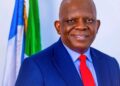
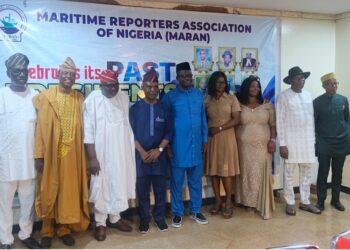
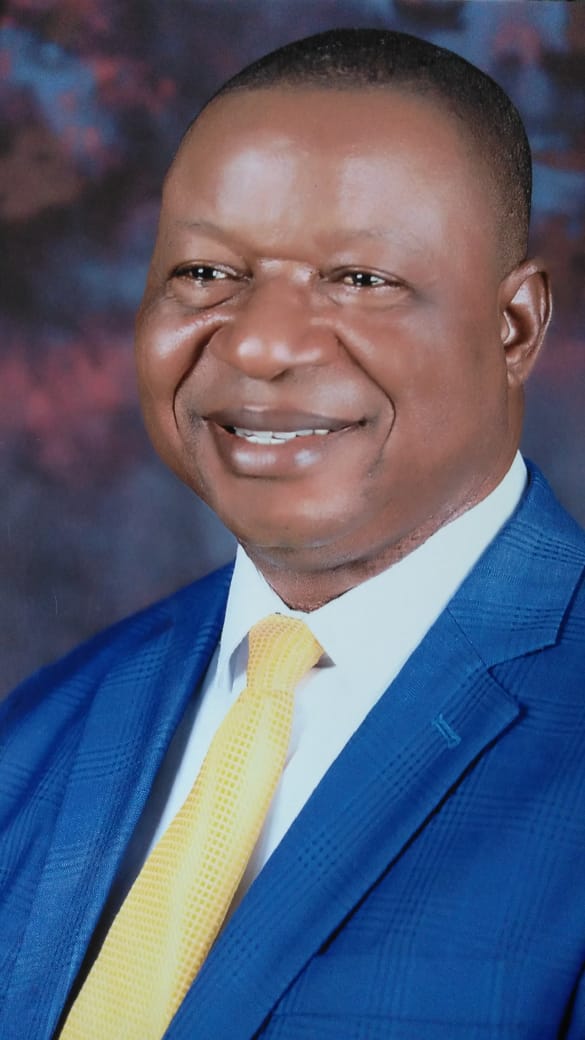
Dr. Chris Osoba Ebare (Esq) FICS is the Immediate Past Chairman of the Institute of Chartered Shipbrokers (ICS) Nigeria. In this interview with Joshua Yousouph, he talks about ship brokerage, the controversial Coast Guard Bill, port concession and sundry industry issues.
How can you assess the maritime industry so far this year?
I would say, first and foremost, so far so good in terms of improvement in operation and in terms of revenue generation, we have not done badly. According to the Minister of Marine and Blue Economy, I think, in a nutshell, I would say we are good so far. On the other hand, we have not really had much controversies or crises since the Minister came on board. I think he has managed the affairs of the maritime sector and the industry so well.
I can recall that last year, you ended your tenure as the Chairman of the Institute of Chartered Ship Brokers (ICS) Nigeria. Can you highlight some of the achievements during your tenure?
I would say during my tenure as the Chairman of ICS Nigeria, a lot was achieved. First, we were able to increase our numbers from about 20 something to close to 40 members in the country. We achieved this by encouraging more members and enlightening students in universities, including the Nigerian Law School, on why they should go into shipping and ship brokerage. Secondly, we encouraged our members to pay their annual dues through our collaboration with our West Africa branch. It was difficult for us to open an account here in Nigeria due to the charter nature, but we eventually got approval from the UK. Thirdly, we were able to expose the activities of the ICS. For the first time, we were invited to the National Assembly to make our presentation. Our position was made known to the maritime committee, and the ICS was given the right of place by Members of the National Assembly. Fourthly, for the first time, the operating agencies, the Nigerian Maritime Administration and Safety Agency (NIMASA), Nigerian Ports Authority (NPA), and the Nigerian Shippers’ Council (NSC) granted us an audience. We educated them on why we should partner together. This collaboration led to NIMASA giving us a brief to review their law, particularly the International Convention, which was later sent to the National Assembly for amendments. Although we were unable to conclude this before the immediate past Director General, Bashir Jamoh finished his tenure, but it was a significant milestone.
Similarly, we had a collaborative training programme between ICS and the NPA, facilitated by the immediate past Managing Director of the NPA. Most excitingly, at the Shippers’ Council, the immediate past Executive Secretary, Barrister Emmanuel Jime, admitted during our courtesy visit that it was the first time he was receiving an ICS paper. He acknowledged that before our arrival, he had to research who ship brokers were. After going through the ICS profile and website, he was amazed and admitted that Nigeria was not doing the right thing. He recognized that ICS members are chartered ship brokers and that, under the Federal Ministry of Transportation (now the Ministry of Marine and Blue Economy), we were supposed to be consulted for policy formulation in the Nigerian maritime industry. He accorded us due respect and solicited a partnership with ICS Nigeria. Additionally, during my tenure, we hosted several conferences, engaging foreign delegates in annual deliberations. The foundation we laid during my tenure is what the current executive team is building upon.
What were the major challenges you faced during your tenure, and how were you able to overcome them?
The major challenge was making the Federal Ministry of Transportation (which was later split into the Ministry of Marine and Blue Economy and the Ministry of Transportation) to embrace the principles and ideas of doing the right thing in the Nigerian shipping industry. We made spirited efforts, but due to political distractions, particularly the former Minister’s presidential ambition, we were unable to get the needed attention for ICS. Despite our repeated attempts to meet with him, we were often asked to “come at another time” because of his busy schedule. This was one of our biggest challenges.
Now that a new executive is in place, what do you think they should focus on?
My advice to them is simple—remain focused. The current President is a well-experienced person. He was my Vice Chairman when I was in office, so I believe he understands the system. First, he should not be discouraged by the challenges in the maritime sector. The way things are done in Nigeria is different from Liberia or Ghana, where maritime regulations are more structured. If they attempt to meet CEOs in the maritime sector and are unable to do so today, they should persist because, when we get it right, the entire industry benefits. Most importantly, they should strive to increase ICS membership. I know it is very difficult to pass the ICS exams, but they should continue to encourage young professionals to sit for the exams and support them in any way possible. Many people want to take the exams, but are hesitant due to their comfort zones. They should be motivated to go through the process.
There has been a lot of controversy regarding the Nigerian Coast Guard Bill, which has been repeatedly rejected by the National Assembly. What is your take on this?
It is very unfortunate. Even today in our democracy, we are in a learning process. We wobble and fumble. Nigeria is still in a learning process when it comes to democracy and governance. Even in advanced countries like the U.S., their Coast Guard system is not perfect. The National Assembly should understand that no country gets it right overnight. They should study the frameworks of established Coast Guard systems in countries like the U.S., Germany, and China and tailor them to our needs. They would have to look through the laws, which would have been able to assist the NIMASA and the NPA, combined with the Navy, and let us at least have something in place. I think the Navy, as a body, also made their own input and contributed to it, and that was sent to the National Assembly.
There have been controversies as regards duplication of duties; that the Coast Guard may also take some of the duties of the Nigerian Navy.
I think that is where they are missing it. The reality is that no agency has a monopoly of knowledge. The Navy may not be trained 100% in certain areas, just like the Maritime Academy of Nigeria in Oron is not a naval institution. Coast Guard personnel receive specialized training, and the Navy can complement their skills. There should be synergy between the Coast Guard and the Nigerian Navy. If the U.S. can operate both successfully, why can’t we? The National Assembly should rethink its stance and work towards making the Coast Guard a reality.
Ww heard that the Federal Government is considering overhauling the port concession agreement, with some foreign companies already lobbying to take the space of non-performing terminal operators. Do you think the FG should shop for foreign companies?
Well, most of this thing have a political undertone. If you look at those foreign operators some of them don’t even have a valid and standing agreement. That, you now say, well, based on this, this is the bedrock upon which these concessions were built. Secondly, there have been a lot of controversies, maybe high rates, inefficiency, lack of equipment for some of these operators. Why foreigners in the first place? Are you saying we don’t have Nigerians who can operate these ports effectively? Why not encourage Nigerians who are ready to invest in these terminals, who can go to other countries, bring in more equipment, and operate the ports effectively? Why look outside the country to bring people in? If the argument is that we need efficiency in the ports, why not send our people for training, send them to Antwerp, to Liverpool, even to China or America and see what they do?
Most importantly, why not encourage Nigerians in the industry; some of these shipowners to send their boys and girls abroad to study and replicate the knowledge here? Sometimes they tell you, “Oh, in Malaysia, they took some palm oil seeds from Nigeria and became a world leader in palm oil production.” Those people came here to study us! They took seeds, planted them in their country, and now they are heroes. Why not do the same thing? Why are we looking at the foreign side? Why don’t we prevent capital flight? These foreign operators make millions here, and they remit most of it back to their country.
For me, the idea of inviting foreign terminal operators to handle our ports is a great indictment. It suggests that nobody in Nigeria can do it, which is not true. It’s crazy. I’m not in support of the federal government or whoever is behind this, whether it’s from the Ministry of Transport or the Ministry of Marine and Blue Economy terminating contracts only to replace them with foreigners. Why foreigners? They don’t have greater ability than us.
The government is currently working on a national policy for the Marine and Blue Economy sector. What are your recommendations?
The issue boils down to ignorance. How many members of the committee drafting this policy are actually from the industry? Don’t be surprised if the people on that committee are outsiders! I know some of my classmates who are maritime lawyers are there but how many of them are involved? Do they consult ship brokers in this country? The next thing we will hear is that they’ve traveled to the UK or China to bring in foreign experts. Meanwhile, we have chartered shipbrokers here, almost 40 of them. Someone in the National Assembly once said, “Oh, we never knew we had you guys in this country!” Can you imagine? Around the world, strategy brokers formulate policies, even at the United Nations. If you go to the UN, you won’t find anyone who isn’t a member. I’m a fellow. The same way you have a fellow in England, you have fellows in America, China, Singapore, Norway, and Canada. We all have the same qualification, the same exams, the same seminars.
But here, people stay in their comfort zones and ignore the experts we have. The former executive secretary of the Shippers’ Council even admitted it. He said when he researched us, he was shocked by how knowledgeable we are. Yet, despite having this level of expertise, we still go abroad looking for solutions. We recruit people who don’t know what to do to formulate policies for us. It’s unfortunate. Let me ask you, as a maritime journalist, how many chartered shipbrokers are on this committee? I recently wrote a memo to the Nigerian Economic Council asking why they don’t include experts. They sit there with their B.A. and B.Sc. in Economics, but we also have maritime economists and lawyers. In Nigeria, I am the first maritime lawyer to become a chartered shipbroker. The first Nigerian maritime legal practitioner who is also a shipbroker. If anyone wants to challenge that, let them come forward. But the problem is, people sit in their comfort zones and refuse to see beyond it. Being a chartered shipbroker is not about being a professor. It’s about knowledge and expertise.