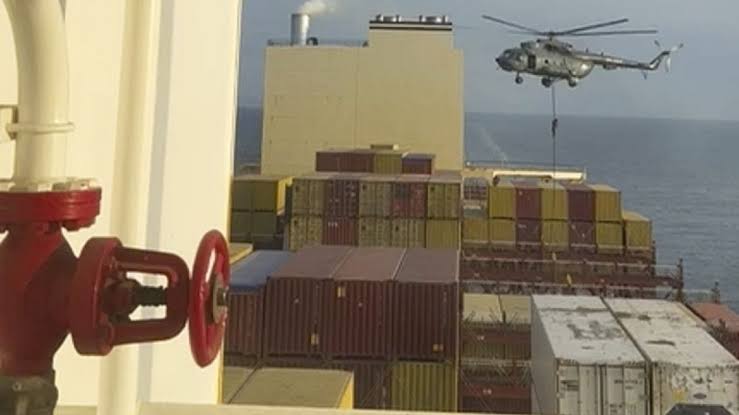
The World Shipping Council has raised an alarm that the Iran-USA,Israel war is capable of causing disruption to global shipping, even as it warned that safety of seafarers is paramount to the Council.
The Council spoke on the heels of the attacks on Iran on Saturday and its spread to many Middle East countries.
Reacting, the World Shipping Council President, Joe Kramek said. “The recent escalation of conflict in the Middle East is causing disruption to global liner shipping, with many carriers pausing or rerouting services as they assess the evolving security situation”.
Already, Iran has announced the closure of the strategic Strait of Hormuz, a critical international waterway located between Iran and Oman. It connects the Persian Gulf with the Gulf of Oman and the Arabian Sea.
Global oil prices have risen after at least three ships were attacked near the Strait of Hormuz, as Iran continues to launch strikes across the Middle East in response to ongoing attacks by the US and Israel.
Two vessels have been struck, and an “unknown projectile” was reported to have “exploded in very close proximity” to a third, the UK Maritime Trade Operations Centre (UKMTO) said.
Iran has warned ships not to pass through the strait, which carries about 20% of the world’s oil and gas.
International shipping has almost come to a standstill at the strait’s entrance, with analysts warning that a prolonged conflict could push energy prices even higher.
On the strength of these escalations, the WSC, says in the statement issued on Monday that: “The safety of seafarers is paramount. Seafarers must not be targeted or placed at risk as a result of conflict, and the fundamental principle of freedom of navigation must be respected. Ocean carriers are making operational decisions based on the best available information and their individual risk assessments. Our thoughts are with the seafarers currently in and around the affected region.”
“The Middle East sits at the crossroads of major global trade routes. When services through the region are suspended or diverted, the impact is not limited to the immediate area. Longer voyages and changes to network rotations can lead to delays and scheduling adjustments across connected trades routes worldwide.”
“The industry has recent experience navigating disruption, including during increased hostility in the Red Sea. While rerouting is complex and can extend transit times, it has enabled trade to continue moving under difficult conditions,” Joe Kramek concluded.