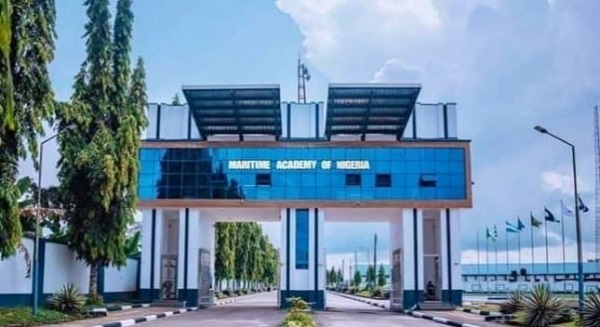
By Oluyinka Onigbinde
Stakeholders in Nigeria’s maritime sector have raised fresh concerns over the quality of training, certification limitations, and inadequate sea-time opportunities at the Maritime Academy of Nigeria, Oron, warning that the issues continue to undermine the global competitiveness of the country’s seafarers.
Industry experts who spoke in separate interviews with our correspondent said that while the academy remains a key training institution, structural and policy challenges have limited its effectiveness in producing globally competitive graduates.
A former National President of the Nigeria Merchant Navy Officers and Water Transport Senior Staff Association, Captain Thomas Kemewerigha, said inadequate funding and weak institutional linkages have continued to affect the academy’s performance.
According to him, the maritime sector had long proposed a funding model that would see operators contribute a percentage of their annual earnings to support maritime training institutions, but this has not been effectively implemented.
He noted that funding remains central to addressing key gaps in infrastructure, training equipment, and manpower development.
“Any system where adequate funding is lacking will struggle to deliver results. You need the right facilities, qualified instructors, and modern equipment to meet global maritime training standards,” he said.
Kemewerigha also questioned the capacity of the academy to meet international certification requirements, noting that many graduates are restricted in their scope of practice.
He explained that Nigeria’s maritime certification regime does not fully align with global standards, limiting the opportunities available to cadets who were trained locally.
“Our certification is still largely restricted, and that affects employability in an industry that is inherently global,” he added.
Another major concern raised by stakeholders is the lack of structured sea-time training, which is a critical requirement for professional certification in the maritime industry.
Kemewerigha described the situation as a major setback, noting that many cadets spend years after graduation without securing mandatory sea-time experience.
He likened the situation to a law graduate being unable to attend law school, stressing that without sea-time exposure, maritime training remains incomplete.
Stakeholders also pointed to weak collaboration between the academy, regulators, and shipping companies, which has made it difficult to secure placements for cadets.
They argued that a coordinated framework is needed to ensure that cadets are systematically deployed to vessels upon graduation, similar to national service schemes in other professions.
“There should be a structured system where cadets are posted directly from school to shipping companies for their mandatory training. Without that, the cycle remains broken,” Kemewerigha said.
On his part, another former President of the association; Engr Matthew Alalade, linked the challenges partly to policy and regulatory constraints affecting certification and industry acceptance.
He explained that clauses attached to Nigerian maritime certificates limit their global recognition and acceptability, making it difficult for locally trained seafarers to compete internationally.
According to him, removing such restrictions and entering into mutual recognition agreements with other countries would significantly improve opportunities for Nigerian seafarers.
“If those limitations are removed and proper agreements are in place, our seafarers can operate more freely across international waters,” he said.
Alalade, however, acknowledged that the academy has made some progress in recent years, including efforts to engage foreign instructors to improve training quality.
He said expanding such collaborations could help bridge existing gaps in expertise and align the academy more closely with international standards.
Adding a personal perspective, an alumnus of the academy who requested anonymity said the challenges around sea-time placement remain one of the biggest frustrations for MAN Oron graduates.
According to him, many former cadets struggle for years after completing their academic training to secure the mandatory sea-time experience required to advance professionally.
“You spend years in school, invest a lot of money, and after graduation, you are left on your own to find sea-time. Some people wait three to five years without getting placement. It slows down your entire career,” he lamented.
He also noted that while classroom training at the academy has improved in recent years, the absence of a structured transition from school to onboard training continues to limit the value of the education received.
However, when contacted for reaction, the Public Relations Officer of the school Mrs Domo Umoekpe said she was not authorised to speak on issue of certification of the cadets. She offered no further comments.