The Comptroller-General of Customs (CGC), Bashir Adewale Adeniyi, has formally adopted a public school in Lagos State, marking a significant milestone in the Nigeria Customs Service’s (NCS) expansive Corporate Social Responsibility (CSR) drive. The move underscores the Service’s renewed focus on education, youth empowerment, and community development.
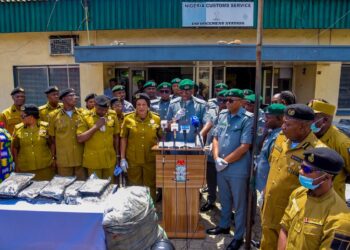
Speaking during a vibrant handover ceremony attended by elated pupils, teachers, and community members, the Customs boss emphasized the transformative power of education, describing it as the foundation for long-term national progress and personal advancement.
“Education is life-changing,” Adeniyi told the cheering crowd. “I began my journey just like you—sitting in a public school classroom—and with God’s grace and the support of good people, education laid the foundation for my growth and eventual rise to this position.”
Drawing inspiration from his own humble beginnings, the CGC urged the students to remain diligent, focused, and committed to their academic pursuits, assuring them that the NCS will continue to stand as a pillar of support in their educational journey.

Adeniyi commended the school principal and teaching staff for their commitment to excellence, especially amid previous infrastructural challenges. He noted that the adoption and intervention by the Nigeria Customs Service had brought about a visible transformation in the school’s condition—turning what was once a neglected institution into a more conducive and promising learning environment.
“This school is no longer what it used to be. The classrooms, the facilities, the learning atmosphere—everything has changed. We did not just come here to renovate buildings; we came to inspire hope and restore dignity to public education,” Adeniyi said.
As part of the NCS’s broader CSR goals, the Customs CG revealed that the Service aims to empower at least 50,000 pupils across the country with essential educational materials by 2025. So far, over 10,000 school children have benefitted from the initiative, including 3,000 pupils from Lagos State alone.
He explained that the effort is not a one-time gesture but a long-term investment in the future of Nigerian youth. The CGC also assured that Customs will continue to champion causes that uplift young Nigerians and foster community development.
“We see these children not just as students but as future leaders, inventors, entrepreneurs, and public servants. It is our responsibility as an institution to sow into their future,” he declared.
In a related development, Adeniyi disclosed that plans are underway to convert the nearby Maracana Stadium into a dedicated school sports ground. This, he said, is aimed at promoting physical education and encouraging sports development among school-aged children in the area.
In what may be one of the most ambitious aspects of Customs’ CSR agenda, the CGC also revealed that the proposed Customs University of Trade, Commerce and Technology will be sited in Badagry, Lagos. According to him, Governor Babajide Sanwo-Olu has approved the allocation of 50 hectares of land for the institution, and funding for the project has already been secured through the National Assembly.
Adeniyi explained that the university would serve as a centre of excellence for customs-related research, trade innovation, and technological development, offering academic and professional opportunities not just to Customs officers but also to civilians interested in fields aligned with Nigeria’s trade and economic aspirations.
“This university will be a place where ideas about commerce, border management, and technology are not only discussed but developed and implemented. It is our vision to create a globally competitive institution that will support the next generation of customs officers, trade experts, and economic leaders,” he added.
The event ended on a hopeful note, with the pupils pledging to work hard and the school community expressing deep appreciation for the Customs CG’s intervention. Teachers and parents alike hailed the adoption initiative as a life-changing development that will positively alter the trajectory of the school and its pupils.