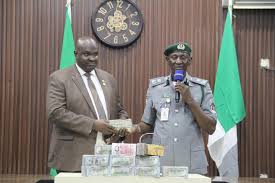
In a significant stride against illicit financial activities, the Nigeria Customs Service (NCS), Kano/Jigawa Area Command, has intercepted undeclared foreign currencies valued at over ₦653.9 million at the Mallam Aminu Kano International Airport (MAKIA). The seizure, which underscores the Service’s commitment to tackling financial crimes, was announced during a press briefing held on Monday, July 8, 2025, at the Customs House, Bompai, Kano.
During the event, the intercepted funds and three apprehended suspects were formally handed over to the Economic and Financial Crimes Commission (EFCC) for detailed investigation and prosecution.
Comptroller Dalhatu Abubakar, Customs Area Controller for Kano/Jigawa, who addressed journalists on behalf of the Comptroller-General of Customs, Bashir Adewale Adeniyi, described the operation as a critical milestone in the fight against financial crimes often associated with smuggling and money laundering.

He explained that the arrest stemmed from credible intelligence and the alertness of officers at the airport, who flagged one of the suspects, identified as Ahmed Salisu, a Ghanaian passport holder, shortly after his arrival from Saudi Arabia via Ethiopian Airlines.
“Upon landing, all arriving passengers were reminded of their legal obligation to declare foreign currency above the $10,000 threshold. Despite this, the suspect failed to make any declaration. Based on prior intelligence, our officers singled him out for an intensive inspection, leading to the discovery of concealed foreign currencies hidden within cartons of clothing,” the Comptroller stated.
Abubakar revealed that the physical examination of Salisu’s baggage uncovered foreign currencies amounting to $420,900 in United States Dollars, £5,825 in British Pounds, 3,946,500 West African CFA Francs, and 224,000 Central African CFA Francs—together valued at over ₦653.9 million based on prevailing exchange rates.
He stressed that the seizure reinforces the Nigeria Customs Service’s commitment to national security and its ongoing partnerships with other regulatory and enforcement agencies such as the EFCC and the Independent Corrupt Practices and Other Related Offences Commission (ICPC).
“This operation is a demonstration of what proactive enforcement, inter-agency collaboration, and consistent stakeholder engagement can yield. Our operations are not just focused on interception; they are also meant to deter future violations. Let this serve as a strong warning to smuggling cartels and financial criminals—our eyes are open, and we will not hesitate to act,” he declared.
Abubakar further disclosed that the interception aligns with initiatives rolled out earlier in the year under the directive of CGC Adeniyi, aimed at raising awareness about currency declaration laws. According to him, the Command had conducted several sensitisation campaigns in both Kano and Jigawa states, targeting stakeholders such as Bureau de Change operators, travel and airline agencies, as well as pilgrim boards.
Speaking on behalf of the EFCC, the Zonal Director of the Commission’s Kano Command commended the Customs Service for its vigilance and reinforced the EFCC’s resolve to ensure that the matter is pursued rigorously in line with legal provisions.
“On behalf of the Executive Chairman of the EFCC, Mr. Ola Olukoyede, we extend our deep appreciation to the Nigeria Customs Service for this well-executed operation. This case goes beyond currency; it touches on national security. The illicit movement of cash has long been a financial pipeline for terrorism, organized crime, and cross-border banditry,” he stated.
He emphasized that the arrest and seizure were carried out in compliance with the provisions of the Money Laundering (Prevention and Prohibition) Act of 2022, alongside the Nigeria Customs Service Act of 2023, which mandate the declaration of any foreign currency above $10,000 at all entry and exit points in Nigeria.
The EFCC official also used the occasion to call on stakeholders in the aviation and financial services sectors to remain proactive and continue to collaborate by sharing actionable intelligence that could help disrupt criminal operations before they escalate.