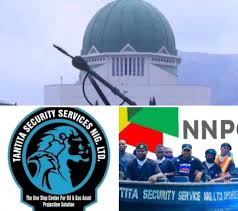
The National Assembly has endorsed the continued engagement of Tantita Security Services Nigeria Limited for pipeline surveillance, passing a unanimous vote of confidence in the company at a joint roundtable convened by the Senate and House of Representatives Committees on Petroleum Resources.
The committees also dismissed the petitions against the pipeline surveillance contract following a motion moved by the Chairman of the House Committee on Petroleum Resources (Midstream), Hon. Henry Okojie, at a one-day parliamentary roundtable on the state of pipeline security and the battle against crude oil theft.
The lawmaker pointed out that Tantita and the security agencies have recorded significant achievements in securing the nation’s petroleum assets, thereby increasing oil revenue for the country, and, as such, needed to be encouraged.
The decision followed extensive deliberations at the hearing on Tuesday, where legislators reviewed submissions from stakeholders across the oil and gas sector.
Data presented at the hearing indicated increased crude oil output and a significant reduction in pipeline vandalism since Tantita’s engagement.
At the end of the session, the committees dismissed all allegations levelled against the firm, describing them as unsubstantiated.
Speaking while declaring open the roundtable event, the Speaker of the House of Representatives, Rep. Abbas Tajudeen, disclosed that despite the ongoing tensions in the Middle East and the protracted conflict involving Russia and Ukraine, the need for valiant efforts at finding alternative energy sources has become necessary, adding that crude oil still remains the largest source of primary energy in the world, especially in the transport sector, where it still powers 95 per cent of all vehicles, planes and ships.
Speaker of the House of Representatives, Abbas Tajudeen, said the gains from enhanced pipeline security have helped boost Nigeria’s oil production to about 1.8 million barrels per day, compared to previous lows.
He noted that illegal tapping points had been largely dismantled, while crude deliveries to export terminals had improved markedly. He recalled that at some point, production dropped sharply amid widespread oil theft, resulting in significant revenue losses.
According to the speaker, the surveillance arrangement has also generated employment for thousands of youths in the Niger Delta, many of whom were previously involved in agitation, thereby providing alternative livelihoods and strengthening community participation in asset protection.
He explained that Nigeria previously lost between 10 and 30 per cent of its crude oil output to theft annually, costing the country billions of dollars and weakening its standing as a reliable oil producer.
He said the federal government introduced the pipeline surveillance framework, including private security operators and community-based structures, to address these challenges, noting that collaboration between security agencies, private contractors, and host communities has improved production levels.
“It was within this context that the federal government introduced the pipeline surveillance contract, including the engagement of private security actors and community-based structures,” he said.
He added that legislative measures such as the Petroleum Production and Distribution (Anti-Sabotage) Act and reforms under the Petroleum Industry Act (PIA) have strengthened enforcement against pipeline vandalism and improved sector governance.
He also highlighted the role of institutions such as the National Oil Spill Detection and Response Agency (NOSDRA), as well as provisions such as the Host Community Development Trust under the PIA, which mandate corporate responsibility and give host communities a financial stake in protecting oil infrastructure
The Chairman of the House Committee on Petroleum Resources (Downstream), Ikenga Ugochinyere, said the panel subjected every petition and complaint to detailed scrutiny but found no credible evidence to support the claims.
“There is no credible evidence to sustain any of the allegations. Accordingly, all complaints against Tantita are hereby dismissed,” he said.
Similarly, the Chairman of the Senate Committee on Petroleum Resources (Downstream), Agom Jarigbe, stressed the need for policy consistency, warning that disrupting an arrangement already yielding results could undermine progress in the sector.
“Disrupting a system that is already delivering results would be counterproductive. Our responsibility is to ensure stability,” he said.
Also contributing, Odianosen Okojie cautioned against calls to fragment the surveillance contract, noting that such a move could weaken coordination and reduce accountability.
“We must strengthen what works, not dilute it. Nigeria’s economic security depends on disciplined execution,” he added.
Similarly, officials of the federal government who attended the session, including the Minister of State for Defence, Bello Matawalle, and the Group Chief Executive Officer of the Nigerian National Petroleum Company Limited, Bayo Ojulari, acknowledged improvements recorded
The Group Chief Executive Officer of Nigerian National Petroleum Company Limited told the meeting that national crude oil production has grown from a historic low of 960,000 barrels per day in 2022 to an average of 1.71 million barrels per day and a peak production of 1.84 million barrels per day in 2025, owing to the establishment of the integrated energy security for pipelines in the Niger Delta.
Speaking on the success of the security arrangement, Ojulari explained that it was not accidental, and that it involved an “integrated energy security model that combines legislative and executive policy alignment, actionable intelligence, kinetic deployment capabilities, regulatory oversight, industry cooperation, and community‑embedded surveillance mechanisms”.