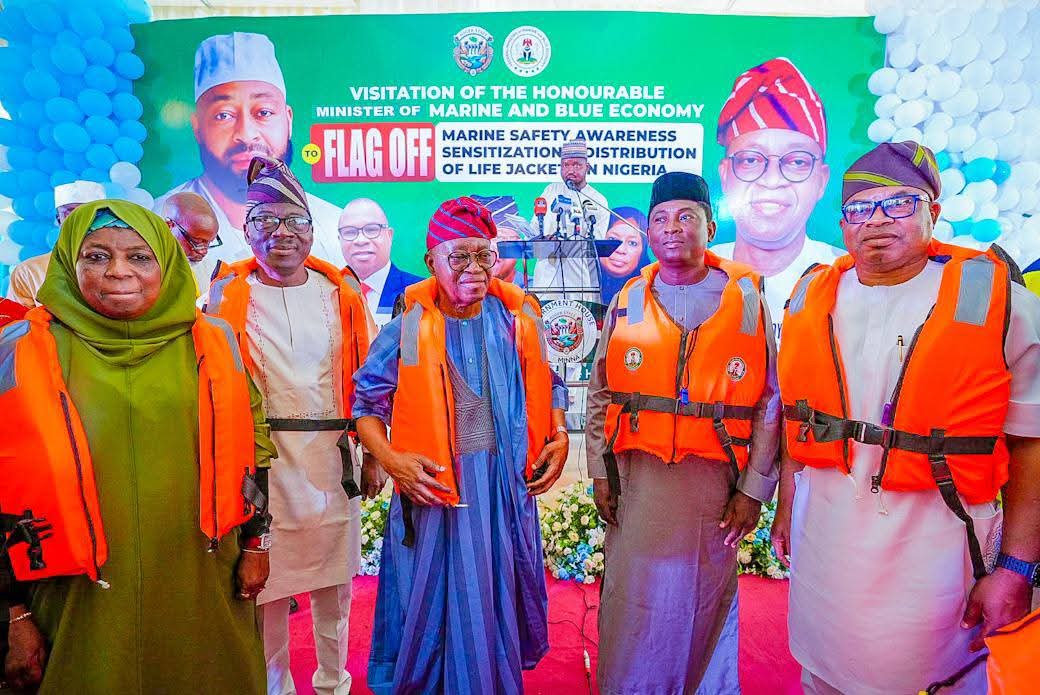
Findings by Shipping Position Daily have revealed that the National Inland Waterways Authority (NIWA) has so far distributed 3,500 life jackets each to eight riverine states — Lagos, Ogun, Taraba, Akwa Ibom, Niger, Delta, Anambra and Bayelsa — as part of its ongoing safety campaign aimed at reducing fatalities and injuries from boat accidents on Nigeria’s inland waterways.
The initiative, which was flagged-off earlier this year, is targeted at eight littoral states of Akwa-Ibom, Bayelsa, Cross River, Delta, Lagos, Ogun, Ondo, and Rivers, and four others, all across the country. However, only eight states have been covered so far.
The remaining four states are expected to receive their allocations in the coming months, although NIWA has not given a definite timeline for completion.
In total, the distribution to the eight states amounts to 28,000 life jackets. While NIWA has not disclosed the official procurement value, which would likely have gone through a contract bidding process, a market survey conducted by our correspondent revealed that a moderate standard life jacket sells for about ₦27,000.
Based on this market estimate, the total value of the jackets already distributed comes to roughly ₦756 million. It remains unclear whether the authority was able to secure the jackets at a lower cost through bulk procurement or whether the jackets meet specific international safety certifications such as ISO or EN standards.
The programme was launched in response to the recurring tragedies on Nigeria’s waterways, where boat mishaps have claimed hundreds of lives in recent years, often due to overcrowding, poor vessel maintenance, and lack of safety equipment.
Many riverine communities depend heavily on water transport for daily movement of people and goods, making safety a critical concern. Despite existing regulations mandating the use of life jackets, compliance has remained low in many areas, either because users cannot afford them or because of lax enforcement.
A recent report by the special committee on the prevention of boat mishaps underscored the importance of sustained intervention beyond distribution of safety gear.
According to the report, while the provision of life jackets is an important first step, it will have limited impact unless backed by strict enforcement, regular safety inspections, and continuous public education. The committee emphasised the need for consistent sensitisation campaigns in high-risk communities, the imposition of penalties for non-compliance, and greater transparency in procurement processes to guarantee value for money and ensure that distributed jackets are of adequate quality and durability.
It also stressed the importance of monitoring mechanisms to track usage, noting that in some past interventions, equipment ended up un-used, re-sold, or used improperly, reducing effectiveness.
In a chat with our correspondent, the National President of the Association of Tourist Boat Operators and Water Transporters of Nigeria (ATBOWATON), Alhaji Gani Tarzan Balogun, welcomed the Federal Government’s intervention, but warned that the jackets were yet to reach many operators who need them most. He confirmed that each state is expected to receive 3,500 jackets, but distribution is reportedly happening in batches, with some states still awaiting their allocation. According to him, even in states like Lagos and Ogun, which were listed among beneficiaries, many operators have not yet been given the jackets, a delay he linked to state-level processes and documentation.
“We appreciate the Federal Government for this gesture, but the state governments need to act fast. From what I have gathered, some states, including Lagos and Ogun, are yet to release these life jackets to operators. This delay is dangerous, especially with the current rough water conditions. If someone refuses to wear a life jacket, they should not be allowed to board. That has to be the slogan now — no life jacket, no entry,” he said. Alhaji Balogun added that giving life jackets alone would not completely solve the problem of mishaps on the waterways, stressing the need to channelise waterways, remove wrecks, and invest in navigational aids such as depth sounders or GPS equipment to help operators detect and avoid underwater hazards.
Stakeholders in the maritime and transport sectors have echoed similar sentiments, insisting that the availability of life jackets must be complemented by proper enforcement and public education. Some operators have reported that passengers often resist wearing jackets, questioning the authority of crew members to enforce such rules.
Balogun noted that operators must adopt a zero-tolerance approach in such cases, making it clear that passenger safety is ultimately the captain’s responsibility.
The NIWA campaign also raises broader questions about funding and prioritisation in Nigeria’s inland water transport sector. While the ₦756 million estimated value of the current distribution underscores the scale of investment required for safety, industry observers believe that long-term solutions will require much more — including modernising vessels, enforcing safety standards across the board, and integrating safety education into the culture of water transport communities.
With the rainy season and increased waterway activity approaching, pressure is mounting on NIWA and the relevant state governments to ensure that the remaining life jackets are promptly distributed to operators and that usage is enforced.