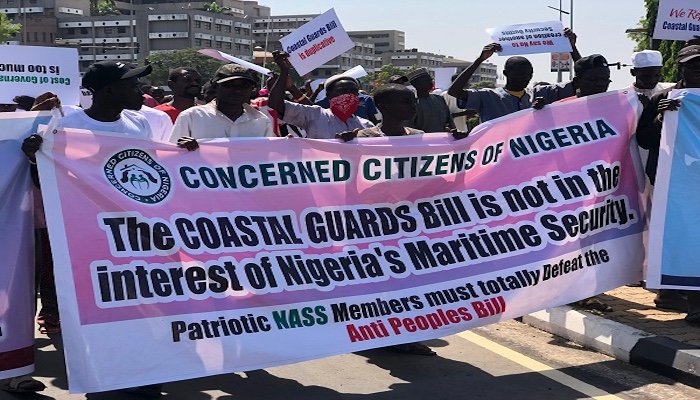
The renewed move to establish a Nigerian Coast Guard has triggered a wave of alarm across the maritime sector, as industry experts raise fresh doubts over the credibility, competence, and moral integrity of personnel who may eventually be recruited into the proposed agency.
Though the Coast Guard model is globally recognized, stakeholders insist Nigeria risks creating a compromised institution that could worsen maritime insecurity, if recruitment is tainted by politics and corruption.
The concerns come despite many industry players agreeing that a formal Coast Guard could strengthen the country’s maritime security architecture and tackle long-standing gaps in surveillance, enforcement, and coastal governance. Yet the glaring fear is that Nigeria may be setting itself up for another security agency that is underperforming from birth.
These renewed anxieties follow the position of the new Chief of Naval Staff, Vice Admiral Idi Abbas, who has openly dismissed the idea of a separate Coast Guard. During his Senate screening, Abbas said the Nigerian Navy already performs the functions of a Coast Guard and warned that creating another entity would only duplicate roles, waste scarce resources, and undermine existing operations. He urged government to instead redirect funding and attention toward strengthening naval capabilities.
Abbas went further to outline new strategies by the Navy, including the creation of a Special Operations Command in Makurdi, Benue State, to secure inland waterways linking Benue and Lokoja. He also revealed ongoing deployment of drones, artificial intelligence systems, and advanced surveillance tools to combat oil theft, piracy, smuggling, and other maritime threats. According to him, these technologies will expand naval coverage, cut operational costs, and reinforce security across the Niger Delta and other high-risk coastal routes.
But Marine Engineer and maritime analyst, Mr. Ifeanyi Okey, told Shipping Position Daily that the Coast Guard could easily become another vulnerable, corruption-ridden outfit, if Nigeria fails to entrench rigorous vetting and uphold strict integrity standards in recruitment. He warned that creating a new maritime security agency without addressing the country’s history of weak oversight could be catastrophic.
“I support the Coast Guard concept, but I’m extremely worried,” Okey said. “The danger is in the quality and integrity of the people that will be recruited. If we rush into this and allow all kinds of individuals into that structure, we will end up bastardizing the entire operation. National security demands disciplined, trustworthy people. The Navy has been tested over time. Recruiting fresh people straight into sensitive operations without proven training backgrounds is dangerous. The devil you know is better than the one you don’t.”
Similarly, former President of the Nigerian Merchant Navy Officers and Water Transport Senior Staff Association, Engr. Matthew Alalade, emphasized that while a Coast Guard remains important for Nigeria’s future maritime safety, its creation must not undermine the Navy nor duplicate constitutional roles. He warned that the excitement surrounding the idea should not overshadow the need for a phased, well-structured framework backed by competent personnel.
Alalade noted that although successive naval leaderships have opposed the establishment of a Coast Guard, the global trend suggests Nigeria will eventually have to adopt the model. According to him, a properly structured Coast Guard would boost coastal surveillance, curb rising criminal activities at sea, and strengthen maritime governance.
“The government hasn’t formally approved a stand-alone Coast Guard, so for now, the Navy retains those responsibilities,” he said. “But nations around the world have adopted Coast Guards. South Africa has one, and many others do. Nigeria can’t remain behind forever. At some point, we’ll revisit it. But it must not be a rushed, compromised process.”
A more forceful position came from Maritime Security Expert and Nigerian Maritime Students and Youths Ambassador, Amb. Utibe-Abasi Isaac, who accused the Navy of resisting the Coast Guard, partly out of fear of losing operational dominance and influence. He claimed the opposition is more about institutional politics than national interest.
Utibe-Abasi argued that Nigeria already has the human capacity and institutional framework needed to create a functional Coast Guard under the supervision of the Ministry of Marine and Blue Economy. He warned that maritime crimes are increasingly being carried out by highly trained but unemployed maritime professionals, many of whom have been pushed into illegal activities due to lack of opportunities.
According to him, establishing a Coast Guard could provide employment for skilled maritime graduates while improving surveillance, protecting national assets, and reducing the loopholes that currently enable corruption and criminality in existing maritime agencies. But he stressed that the success of such an agency would depend heavily on transparent, merit-based recruitment.
“We have competent, well-trained professionals who can form the backbone of a Coast Guard,” he said. “The Marine and Blue Economy Ministry can coordinate it effectively. The Maritime Academy, Maritime University, and various private institutions produce qualified people every year. These crimes happening at sea are not by amateurs. They are executed by trained navigators and seafarers who know exactly what they’re doing, but are idle. A Coast Guard would channel their skills in the right direction”, he added.