By Joshua Yousouph
Following the expected launch of the National Single Window (NSW) last Friday, stakeholders in Nigeria’s maritime sector have introduced the ‘User Experience Diary’ as a proactive fallback mechanism to address operational disruptions and sustain accountability across port processes.
The introduction of the contingency platform comes amid growing concerns over the effectiveness of the NSW, with industry players calling for practical solutions to ensure seamless port operations.
Shipping Position Daily reports that, the Maritime Anti-Corruption Network (MACN) and the Council for the Regulation of Freight Forwarding in Nigeria (CRFFN) launched a User Experience Diary to enhance transparency and accountability in cargo clearance processes.
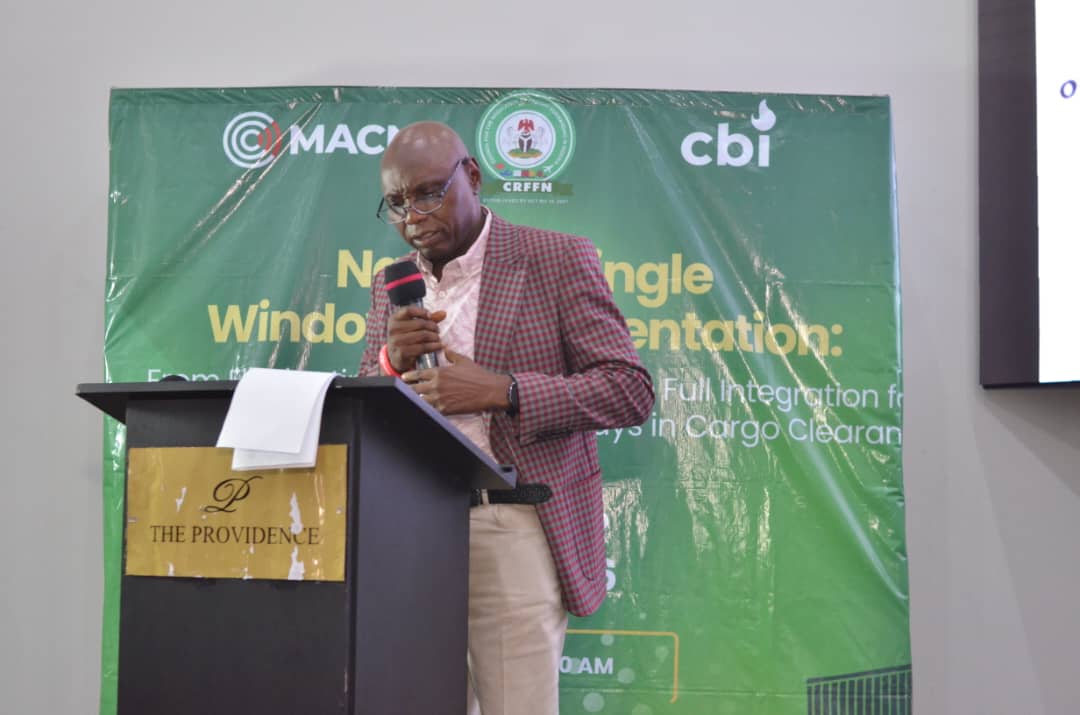
The initiative, championed by the CRFFN in collaboration with MACN and the Convention on Business Integrity (CBi), was announced in Lagos last Thursday at a high-level stakeholders’ engagement ahead of the National Single Window launch.
The User Experience Diary is designed as a real-time reporting tool that allows freight forwarders and other operators to document their experiences across the cargo clearance value chain, providing actionable data to regulators and policymakers.
Speaking exclusively with our Correspondent at the sidelines of the launch, Mr Moses Fadipe, Technical Adviser on Maritime to CBi and former Director at the Nigerian Shippers’ Council (NSC), said the initiative was conceived ahead of time, as a safeguard against possible system failures or downtime that may be associated with the NSW.
Fadipe explained that while the NSW is designed to integrate and digitize cargo clearance procedures, the reality of implementation challenges made it necessary to develop a parallel support structure. He noted that the User Experience Diary is intended to ensure continuity in monitoring service delivery, even when the primary system experiences setbacks.
According to him, the diary provides a structured platform for freight forwarders and other port users to document complaints, report inefficiencies, and escalate unresolved issues in real time. He stressed that the absence of such a mechanism in the past left many stakeholders without a reliable channel to seek redress during system breakdowns.
“This is a proactive initiative. We anticipated that there could be lapses or downtime, and there was a need for a backup where users can log their experiences and ensure that issues are not lost in the process,” he said.
He added that the system is built on collective industry participation, with the Council for the Regulation of Freight Forwarding in Nigeria (CRFFN) and other stakeholders collaborating to drive its implementation. A technical team, he disclosed, will be constituted to oversee operations, analyse feedback, and ensure that reported cases are escalated to the appropriate authorities for action.
Fadipe further noted that the User Experience Diary will leverage digital tools to generate data on service failures, including patterns, timelines, and locations, thereby enhancing transparency and strengthening regulatory oversight. He said such data would also support enforcement actions by providing verifiable evidence of infractions within the cargo clearance chain.
Registrar and Chief Executive Officer of CRFFN, Mr. Kingsley Igwe, noted that the diary; which is a Complaint and Feedback Portal, will help capture inefficiencies, infractions, and operational bottlenecks in real time, thereby supporting reforms aimed at eliminating fragmentation and reducing delays in cargo clearance.
According to Igwe, the initiative is part of a broader Integrity Alliance involving CRFFN, MACN, and CBi, aimed at strengthening transparency, professionalism, and accountability within the freight forwarding industry.