By Joshua Yousouph
Two weeks after the Presidential Enabling Business Environment Council (PEBEC) conducted a two-day clean-up and enforcement exercise along the Lagos Ports Corridor, findings by Shipping Position Daily have revealed that the corridor is again experiencing signs of congestion, with reports of a gradual return of checkpoints and enforcement bottlenecks along key access routes.
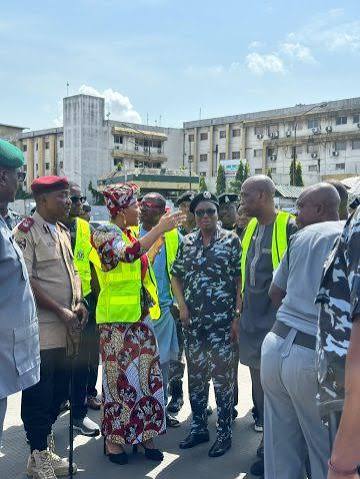
Shipping Position Daily recalls that PEBEC had completed a two-day clean-up and enforcement exercise along the Lagos Port Corridor from May 14 to 15, 2026, with the aim of restoring sanity to the ports’ corridors.
However, truck operators and industry stakeholders who spoke on the current situation described the post-operation period as one marked by temporary relief followed by a slow resurgence of operational challenges that initially prompted the intervention.
The General Secretary of the Association of Maritime Truck Owners (AMATO), Bala Muhammed, said some of the checkpoints dismantled during the exercise, had re-appeared shortly after enforcement team completed the assignment and withdrew from the corridor.
“Shortly after the operation, some checkpoints were dismantled. So we later realized that people will continue, so the checkpoints came back again,” he said, noting that such developments continue to affect cargo movement efficiency.
Muhammed explained that AMATO does not directly police enforcement points but only escalates concerns to relevant authorities, including maritime security agencies tasked with follow-up operations.
He added that agencies such as the Nigerian Ports Authority (NPA) and the Assistant Inspector-General (AIG) Police Maritime Unit have been carrying out monitoring visits to assess compliance with enforcement directives following the clean-up exercise.
Similarly, Mr. Seyi Adekanbi, a truck operator and chieftain of the Lagos State Truck and Cargo Operators Committee (LASTCOC), said while government intervention is acknowledged, enforcement consistency remains a major concern among operators using the corridor.
Adekanbi alleged that despite earlier dislodgement efforts, some actors have returned to exploit gaps within the system, contributing to persistent inefficiencies along the port access roads.
On his part, Mr Raji Adesina, a truck owner and chieftain of AMATO, maintained that operators are resisting any return of practices that previously contributed to congestion and extortion along the corridor.
“They are trying, but we are not going to give them the opportunity to come back,” he said, adding that stakeholders are determined to sustain improvements recorded after the intervention.