
June 25 of every year has come to stay as the world’s day of celebrating the seafarer. Records show that it was actually in 2010 at a Diplomatic Conference which held in Manila in Philippines to adopt milestone revisions to the International Convention on Standards of Training, Certification and Watchkeeping for Seafarers (STCW Convention) and its associated Code, that it was also agreed that the unique contributions made by seafarers from all over the world to international seaborne trade and the world economy should be marked annually with a ‘Day of the Seafarer’.
The objectives of the Day include: increasing awareness among the general public of the indispensable services you render to international seaborne trade, the world economy and society at large. It’s also meant as a day to send a clear message to all seafarers that they are recognised and appreciated; that the world understands the extraordinary conditions and circumstances of seafaring, that the world cares about them and that they will be protected whenever the circumstances of life at sea so warrant.
The World Seafarers’ Day is also set aside as a day to redouble efforts at the regulatory level to create a better, safer and more secure world for the seafarer .
As a maritime nation, every year Nigeria also joins the rest of the global community to celebrate seafarers and remember their sacrifices and contributions.
One can hardly forget how respectable it was to be a seafarer up till the mid- 1990s – before the liquidation of the Nigerian National Shipping Line (NNSL).
The average age of the youngest qualified master mariner and marine engineer in the country today is about 57 years. Of course, there are thousands of lower cadre seafarers, few of whom are gainfully employed.
But, irrespective of their current rating within the Nigerian maritime sector, the Nigerian seafarer is arguably an important stakeholder.
Statistically, there are about 1.2 million seafarers in the world, but regrettably, Nigerian seafarers don not make number. Truth is- most Nigerian seafarers are not qualified. Those who were once qualified are now on the other side – no thanks to the Nigerian System.
The reality is that Nigeria is a maritime nation where several seafarers are either unemployed or under employed, where there is actually no national fleet, and where the Registry is depleting by the day.
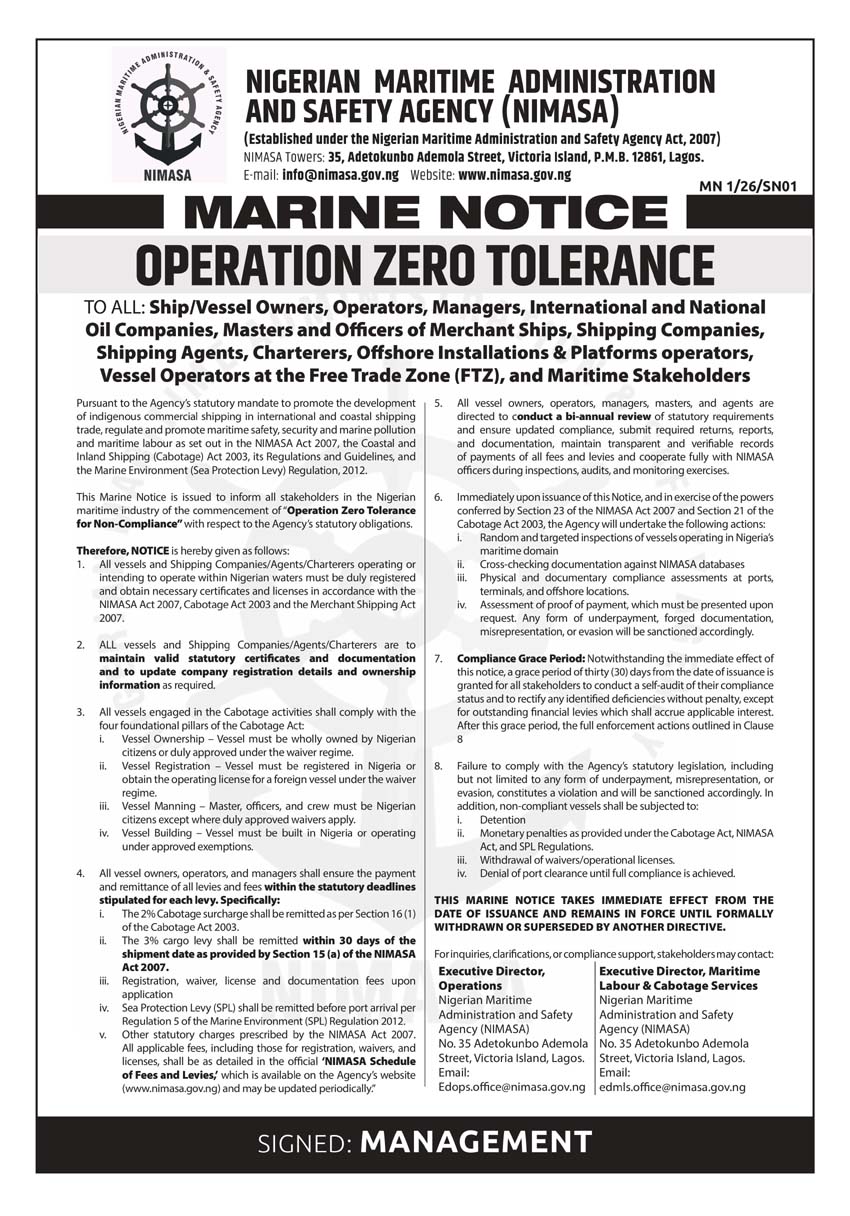
Many have rightly blamed the NIMASA for the prevailing travails of the Nigerian seafarers. The agency is in charge of maritime labour (including seafarers).
Without mincing words, NIMASA has not done well enough to boost the employability of emerging seafarers, this it would have done by ensuring that the Maritime Academy of Nigeria in Oron, Akwa Ibom state is well-funded and made to be at par with similar institutions in South Africa, Ghana and Egypt that were established about the same time as our own MAN, Oron.
But rather than do this, it is at present funding maritime institutes in universities and also sending young Nigerians to foreign maritime academies for training in nautical sciences and marine engineering and other course.
Even though NIMASA will beat its chest for the Nigerian Maritime University and the Science and Technical College that it is funding, the question to ask is: Will it translate to jobs for the would-be seafarers. The answer is may be, may be not!
The Nigerian seafarer is perhaps the most ‘unfortunate’ in Africa. While Nigeria prides itself as a maritime nation, it has no ships, except a handful of service and offshore crafts and single hull tankers.
The nation’s seafarers have degenerated so badly from the glorious days of the NNSL. But even if there is no national carrier anymore, cant the nation’s maritime managers think of other ways to make our seafarers employed, by first making sure that they are employable.
It is a shame that Nigeria no longer parades world-class seafarers, she no longer owns ships. But even if we no longer own ships, the abundance of budding and qualified seafarers should propel government to guarantee secured employment for them.
In spite of all the challenges they face, our future as a maritime nation still rests on the shoulders of today’s seafarers and those to come.
The seafarer must be celebrated, not only because they cause international trade to be. But more importantly because the sea is really a lonely place!












Discussion about this post