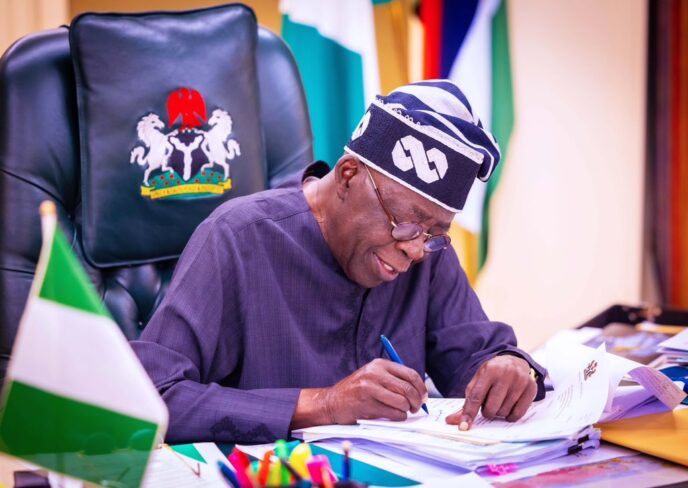
With President Bola Ahmed Tinubu set to mark two years in office on May 29, maritime industry stakeholders are intensifying calls for the immediate assent to the Nigeria Port Economy Regulatory Agency (NPERA) Bill; a long-awaited legislation which they describe as critical to unifying and sanitizing the nation’s fractured port system.
The bill, which has passed both chambers of the National Assembly, seeks to reposition the Nigerian Shippers’ Council (NSC) as the lead regulator of the port economy, thereby establishing a more structured framework for regulating service providers, shipping lines, and terminal operators. It also aims to resolve long-standing inter-agency rivalries that have historically slowed down efficiency and progress at the nation’s seaports.
The NPERA Bill has been described as one of the most significant legislative efforts in the maritime industry in the past decade. First introduced during the administration of President Goodluck Jonathan, the bill has suffered multiple setbacks due to bureaucratic bottlenecks, a lack of political will, and inter-agency power tussles, particularly involving the Nigerian Ports Authority (NPA), Nigerian Maritime Administration and Safety Agency (NIMASA), and NSC itself.
However, recent developments have rekindled hope. With the bill now resting on the President’s desk, maritime experts and stakeholders believe this is a defining moment.
Speaking to Shipping Position Daily, Dr. Kayode Farinto, former acting president of the Association of Nigerian Licensed Customs Agents (ANLCA), reflected the mix of skepticism and optimism within the industry.
Speaking to fears about possibility of withholding presidential assent, he said: “This is politics, and I don’t know, I’m not sure that it’s possible, but nothing is impossible where there are interests”. “Let’s give the presidency some few weeks, I’m sure of that. It’s not too late. Let’s hope it’s signed before May 29.”
Farinto emphasized the strategic importance of the bill, especially its implications for the Nigerian Shippers’ Council. According to him, the bill would empower the Council not just as a facilitator, but as a regulator with financial autonomy and legislative authority.
“We also contributed to the bill. One of my proposals was that the NSC should charge 0.05% of the funds allocated to shipping agents and shipwreck staff, which would improve their internally generated revenue. It’s a win-win situation for the federal government,” he added.
Echoing similar sentiments, Dr. Eugene Nweke, another respected maritime expert, and Head of Research, Sea Empowerment and Research Centre described the bill’s passage at the National Assembly as a “healthy development” and called on stakeholders not to relent until it is signed into law.
“This bill is crucial for regulating the maritime industry. Stakeholders should not go to sleep until Mr. President graciously assents to the bill” Nweke said.
He credited the Tinubu administration for opening up space for professional input in policymaking and regulatory reforms, noting that tribal sentiments appear to have taken a back seat in recent appointments and decisions.
“No matter how you look at Tinubu’s administration, to a large extent it gives room for professional input in certain policy arrangements,” he said.
Nweke further argued that the bill addresses a fundamental challenge in the maritime industry — the turf wars among various regulatory agencies, which has stifled development and led to policy inconsistencies over the years.
“One of the greatest problems in the industry has been the supremacy tussle among agencies. This bill introduces clarity. It brings all legislative empowerment into alignment, especially concerning revenue functions, and removes that function from multiple hands,” he explained.
He also lauded the leadership style of the Executive Secretary of the Nigerian Shippers’ Council, Dr Pius Akutah, for his quiet, yet focused drive to get the bill over the finish line.
“If you are following what is happening in the Nigerian Shippers’ Council, Akutah has never disappointed. He may not be loud, but he is results-driven. He understands the importance of having a regulatory ombudsman in the industry and is not witch-hunting anyone, but working to bring sanity,” Nweke said.
The proposed regulatory agency would act as the central economic umpire for Nigeria’s port system, setting tariffs, mediating disputes, ensuring fair trade practices, and eliminating arbitrary charges. It would also plug revenue leakages and give the federal government better oversight over port concessionaires and service providers.
The bill’s passage is particularly timely given the renewed focus on maritime development under the Ministry of Marine and Blue Economy, which was created by President Tinubu to harness the full potential of Nigeria’s maritime domain.
However, failure to sign the bill before May 29; which marks Tinubu’s one-year anniversary in office could be interpreted as a missed opportunity by industry observers.
“If it is not signed by then, then we can begin to question the delay,” Farinto warned. “This is the time to act.”
At the 2025 Sectoral Retreat of the Federal Ministry of Marine and Blue Economy, the Executive Secretary of the Nigerian Shippers’ Council, Dr. Pius Akutah, underscored the urgency of signing the bill into law. He emphasized not only the need for a swift passage of the bill, but also called for consistent statutory funding to enable the Council to fulfill its expected regulatory duties.
Akutah, who has continued to garner praise for his quiet but goal-oriented leadership, noted that the legislation would provide a solid framework for the Council to function effectively as an economic ombudsman in the maritime sector.