By Oluyinka Onigbinde
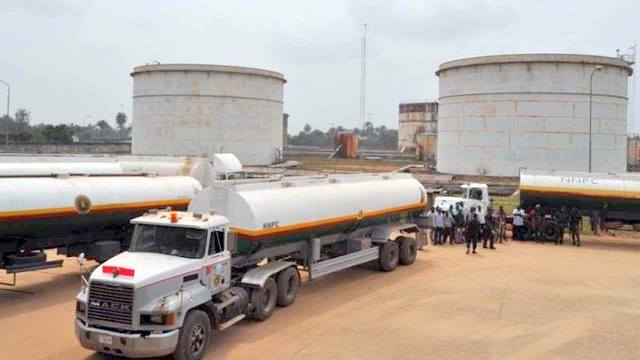
Findings by Shipping Position Daily have revealed that the petroleum products distribution arrangements being embarked upon by the Dangote Refinery is reshaping the downstream oil and gas market and leaving many private tank farms along the Apapa–Tin Can corridor deserted. This is even as our correspondent observed that the long queues of petroleum tankers that once clogged the Apapa-Oshodi expressway have all but disappeared, with several tank farms now recording little or no loading activity.
During a week-long visit to the corridor, our correspondent found that tank farms that were once a beehive of activity have been reduced to near-abandonment with loading bays largely idle.
Security personnel at some depots admitted that tanker traffic has dropped drastically in recent weeks, while a few tankers seen within the facilities were parked without product orders.
Members of National Union of Petroleum and Natural Gas Workers (NUPENG) who were sighted at some of the tank farms and who spoke to our correspondent on condition of anonymity as they were not authorised to speak on the issue, blamed the situation on Dangote’s aggressive push into the market, which they say has adversely affected demand for imported products and forced many depots to scale down operations.
Speaking on the development, Engr. Mansur Ahmed, the special adviser to the President and Chief Executive of Dangote Group, Alhaji Aliko Dangote, in a chat with our correspondent said the disruption was inevitable given the scale of the refinery’s operations. He called on stakeholders to adjust to the new market reality.
“All stakeholders should anticipate one thing—in every market, if there is a disruption, things change,” he told Shipping Position Daily.
“For over 30 years, we depended on imported fuel products. People made huge investments based on that model. Now something has happened that has turned that upside down. We now have enough capacity in our country to meet our total demand. That means it is not the same market anymore. The fundamentals have changed and investors should have begun planning the moment this refinery started.
“The refinery is here to stay, to produce for Nigeria, West Africa and beyond. Investors should start looking for ways to utilise their investments in the new environment, whether through collaboration, cooperation or partnerships. Dangote is willing to sit down with stakeholders and the government to minimise losses and maximise gains,” Ahmed added.
The refinery recently began a nationwide free fuel distribution using 4,000 compressed natural gas (CNG) trucks, a move that has unsettled petroleum marketers, depot operators and tanker drivers. Many of them accuse the refinery of seeking to dominate the market and render existing businesses unviable.
However, reacting to the issue, Captain Emmanuel Ihenacho, Chairman and Chief Executive Officer of Integrated Oil & Gas and a major tank farm operator, warned that the trend threatens jobs and long-standing investments.
“Job losses and slump in investment are bound to happen if tank farm owners are no longer able to sell their products,” he said. “What is happening currently in the downstream sector is something we have never seen before. It’s a complete emasculation of a class of business people. The normal thing is for everybody to canvass for their market share, not a situation where one single entity aims to take over the market. From time immemorial, we have people who produce and refine petroleum products, those who distribute, and those who store. Everybody has their roles marked out. There is nothing to be gained when one person aims to take over the market and every other person just parks up. Jobs will be lost. Investments will be lost. It is important we all find a common ground to co-exist”, he advised.
Also weighing in, the Chief Executive of the Centre for the Promotion of Private Enterprise (CPPE), Dr. Muda Yusuf, said the shift was a natural consequence of economic evolution. “The reality is that the oil and gas sector is witnessing a major disruption. In any economy, if there is a disruption, there will be winners and losers,” he said. “We have seen this in ICT—where are the Motorolas and Nokia 3310s today? We have seen it in finance, where fintechs are now competing fiercely with traditional banks. It is normal for the economy to evolve. If as an investor you fail to follow the trend or adopt strategies that ensure survival, such business is bound to have issues. Jobs or investment losses might be a sacrifice the country has to undertake to escape an import-dependent cycle.”