The Nigerian Maritime Administration and Safety Agency (NIMASA) has disclosed that it is considering an expansion of its flagship maritime security architecture, the Deep Blue Project, following what it described as the project’s growing impact across the Gulf of Guinea and increasing international recognition.
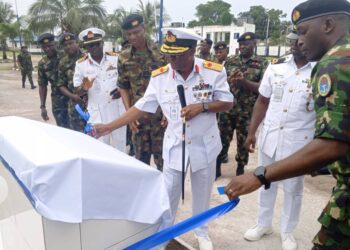
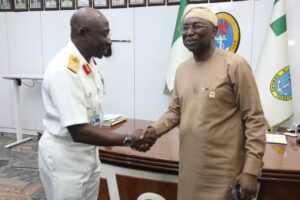
The Director General of NIMASA, Dr. Dayo Mobereola, made this known during a strategic visit to the Chief of Naval Staff (CNS), Vice Admiral Idi Abass, at the Naval Headquarters in Abuja on Thursday, where he also called for sustained and deeper partnership between the Agency and the Nigerian Navy to consolidate the gains recorded so far.
Mobereola said the purpose of the visit was not only to congratulate the Chief of Naval Staff, who previously served as Maritime Guard Commander under NIMASA, but also to review the achievements of the Deep Blue Project and explore ways to strengthen, sustain and expand its impact on maritime security in the Gulf of Guinea.
According to him, the success of the Deep Blue Project has positioned Nigeria as a reference point in maritime security on the African continent and beyond, with several countries already seeking to study and adopt the model. He noted that the project’s achievements have also attracted commendation from the International Maritime Organisation (IMO), which he said has expressed interest in understanding how a civilian maritime administration was able to drive such a far-reaching security architecture.
“It is important that we continue our partnership and strengthen our relationship. Our purpose here is to congratulate you and to discuss the benefits of the Deep Blue Project; how to sustain it, expand it, and increase its impact on the Gulf of Guinea,” Mobereola said.
He added that NIMASA was confident of the backing of the President, the Minister of Marine and Blue Economy and the Nigerian Navy in its plans to scale up the project, stressing that the Agency was already working towards presenting proposals on areas that require improvement and further investment.
“The Deep Blue Project is vital and countries around Africa and some other parts of the world are coming to copy our model. The IMO is asking how a civilian organisation was able to achieve this feat. It is therefore important that we continue to collaborate and do even better for greater sustainability,” he said.
The NIMASA boss also used the opportunity to congratulate the Chief of Operations, Nigerian Navy, Rear Admiral Musa Katagum, on his appointment to the NIMASA Governing Board as the Navy’s representative, describing the development as another boost to inter-agency cooperation in the maritime sector.
In his response, the Chief of Naval Staff, Vice Admiral Idi Abass, welcomed the NIMASA Director General and his delegation, and commended the Agency for what he described as its growing contributions to the maritime sector and its consistent support to the Nigerian Navy.
Abass said collaboration among government agencies remained central to achieving national objectives in the maritime domain, stressing that the Navy and NIMASA were partners with complementary roles rather than competitors.
“Part of my command’s objective is to work in synergy with other agencies to achieve our goal as a country. We complement each other. We have no option rather than collaborate and synergise,” the CNS said.
He, however, pointed out that there were areas requiring review and improvement, including the Memorandum of Understanding (MoU) between NIMASA and the Nigerian Navy, which has been in place since 2007. According to him, revisiting the agreement would help to align it with current realities and operational demands in the maritime sector.
The Naval Chief also urged NIMASA to make greater use of the Navy’s technical capacity in areas such as vessel repairs, hydrographic surveys and charting, noting that the Navy has the expertise and infrastructure to support such tasks.
In addition, Abass canvassed the Agency’s assistance in the area of wreck removal, particularly as the Navy prepares for its 70th anniversary celebration, during which it is expected to host foreign naval ships and delegations. He said clearing navigational hazards would further enhance safety and project a positive image of Nigeria’s maritime domain to visiting fleets.
The CNS also commended NIMASA for the recent launch of the Cabotage Vessel Financing Fund (CVFF) Application Portal, noting that the development marked significant progress in the long-awaited disbursement process of the fund and showed that the Agency was making steady efforts to unlock financing for indigenous shipping operators.
The meeting underscores the central role of the Deep Blue Project in Nigeria’s maritime security framework and highlights the growing emphasis on inter-agency collaboration as the country seeks to sustain recent gains against piracy, sea robbery and other maritime crimes in the Gulf of Guinea. It also signals NIMASA’s intention to move beyond consolidation of existing assets towards expanding and strengthening the architecture to ensure long-term sustainability and wider impact.