By Oluyinka Onigbinde
A total of 2,553,132.90 kilogrammes of illicit drugs valued at over ₦3 trillion were seized at Nigeria’s seaports between 2021 and 2025, investigation by Shipping Position Daily has revealed.
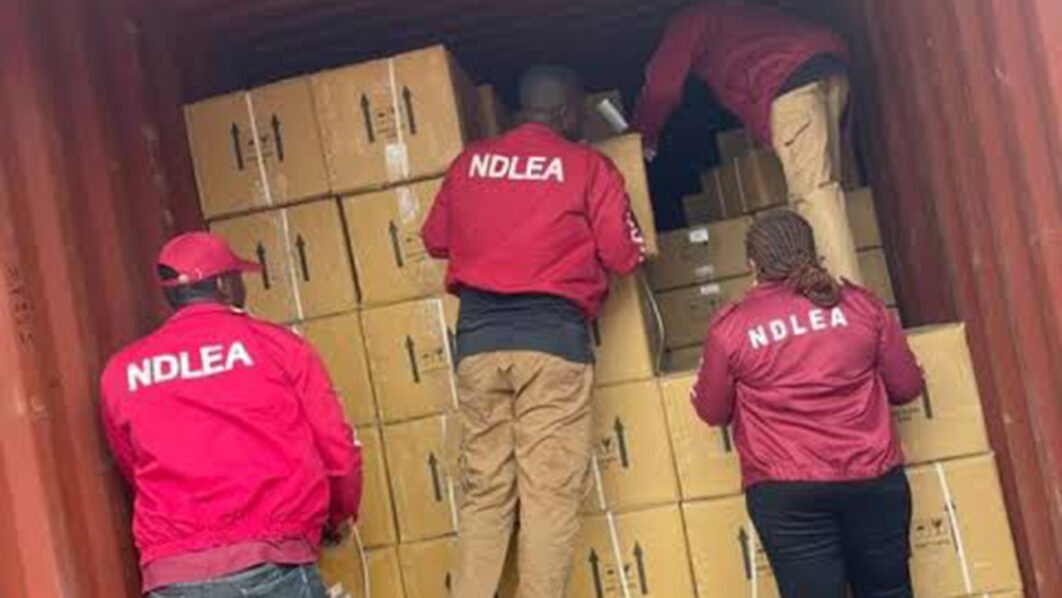
According to statistics obtained by our correspondent from the National Drug Law Enforcement Agency (NDLEA), the seizures were recorded across major seaports and marine commands nationwide, highlighting both the scale of drug trafficking through Nigeria’s maritime gateways and the intensity of enforcement operations over the five-year period.
The official data from the Directorate of Planning, Research and Statistics show that total seizures stood at 96,690.90kg in 2021, dropped sharply to 20,296.70kg in 2022, and rose to 86,169.54kg in 2023. The figures, however, surged dramatically in 2024 to an all-time high of 1,745,422.75kg, before settling at 605,553.01kg in 2025.
A port-by-port breakdown reveals that Apapa port recorded seizures of 33,540kg in 2021, 17,759.74kg in 2022, 85,491.59kg in 2023, 54,116.17kg in 2024, and a peak of 153,028.19kg in 2025.
At Tin Can Island port, eizures rose from 22,725.60kg in 2021 to 1,881.80kg in 2022 and 654.40kg in 2023, before exploding to 454,586.54kg in 2024. The command recorded 30,815.21kg in 2025.
The Port Harcourt Seaport Command posted some of the most dramatic figures, moving from 40,425.30kg in 2021 and 143.83kg in 2022 to 23.55kg in 2023, before a massive spike to 1,227,595.42kg in 2024 and 410,553.61kg in 2025.
Marine operations also intensified, with the Marine Command recording 9,121.49kg in 2024 and 11,156kg in 2025, reflecting expanded surveillance of coastal and inland waterways.
According to data obtained from Mr. Femi Babafemi, Director of Media and Advocacy of the NDLEA, the figures reflect sustained, intelligence-driven interdiction efforts across Nigeria’s seaports.
Babafemi noted that the agency is working to dismantle maritime drug trafficking routes through improved intelligence gathering, risk profiling, container tracking and stronger collaboration with sister security agencies at the ports.
He explained that traffickers increasingly target seaports for bulk shipments, exploiting concealment in containerised cargo and vessel movements, but stressed that NDLEA operations have significantly raised the cost and risk of doing business for drug syndicates operating through Nigeria’s maritime domain.
Further checks by our correspondent confirmed that the over 2.55 million kilogrammes of illicit drugs seized within the period translate into street values running into trillions of naira.
For instance, NDLEA valuation benchmarks show that one kilogramme of cocaine is valued at between ₦800 million and ₦1 billion, while methamphetamine sells for between ₦400 million and ₦600 million per kilogramme. Although cannabis sativa, tramadol, codeine and other controlled pharmaceutical opioids attract lower unit prices, their massive volumes significantly drive up the cumulative value.
Based on conservative estimates, the total seizures made at the seaports between 2021 and 2025 are valued at well over ₦3 trillion, representing one of the heaviest financial blows ever inflicted on drug trafficking networks operating in and through Nigeria.
Babafemi noted that the data not only exposes the scale of attempted drug inflow through the nation’s ports but also underscores the strategic importance of maritime interdiction in Nigeria’s broader anti-drug campaign.
He add that the sharp spike recorded in 2024 and sustained high interceptions in 2025 suggest traffickers are being forced into riskier operations, often resulting in catastrophic losses due to tighter port controls and improved intelligence coordination.
He added that NDLEA has reiterated that Nigeria’s seaports will remain hostile territory for drug traffickers, regardless of the volume, value or sophistication of their operations.