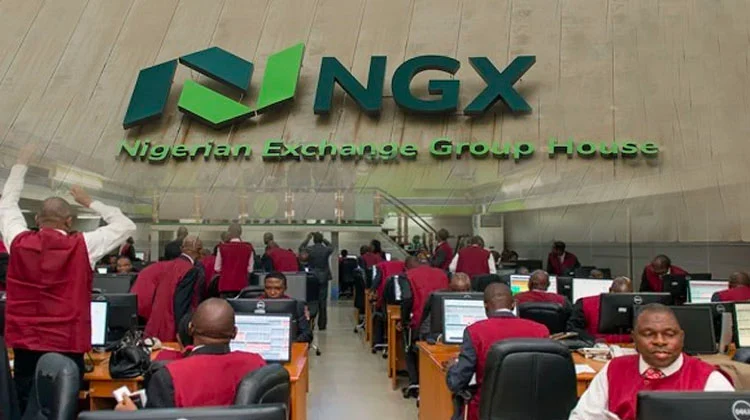
The Nigerian stock market closed lower on Friday, June 26, 2026, extending its recent bearish trend as investors recorded more losses across major counters despite the market maintaining a robust year-to-date performance.
At the close of trading on the Nigerian Exchange (NGX), the benchmark All-Share Index (ASI) shed 1,620.47 points, or 0.69 per cent, to settle at 231,960.36 points. The decline reflects a one-week loss of 1.69 per cent and a four-week decline of 7.12 per cent, although the market remains up by an impressive 49.06 per cent since the beginning of the year.
The overall market capitalisation stood at N148.9 trillion (about $108 billion), underscoring the continued depth of the Nigerian equities market despite the day’s negative sentiment.
Trading activity also weakened compared with the previous session. Investors exchanged a total of 388.59 million shares valued at N18.36 billion in 44,557 deals, representing a one per cent decline in trading volume, a four per cent drop in turnover, and a three per cent decrease in the number of deals from Thursday’s session.
Market breadth remained negative as 37 stocks recorded losses, outweighing the 13 gainers recorded at the close of trading, while a total of 132 listed equities participated in the day’s transactions.
Universal Insurance emerged as the best-performing stock, appreciating by 6.32 per cent to close at N1.01 per share. It was followed by McNichols, which gained 5.52 per cent, Linkage Assurance with 4.67 per cent, and Nigerian Exchange Group, which advanced 4.35 per cent.
On the downside, Aradel Holdings topped the losers’ chart after its share price declined by the maximum daily limit of 10 per cent to close at N1,417.50 per share. International Energy Insurance lost 9.95 per cent, Trans-Nationwide Express fell 9.89 per cent, while E-Tranzact International dropped 9.79 per cent.
In terms of trading volume, Access Holdings maintained its position as the most actively traded stock with 33.2 million shares changing hands. Wema Bank followed with 24.3 million shares, while Deap Capital Management & Trust traded 24.1 million shares, and Chams recorded 19 million shares.
Across the broader market, sectoral indices posted mixed performances. The NGX Top 30 Index declined by 0.70 per cent, while the NGX Main Board Index and NGX Consumer Goods Index lost 1.13 per cent and 1.15 per cent, respectively.
However, the NGX Premium Index recorded a marginal gain of 0.01 per cent, reflecting resilience among some of the market’s blue-chip stocks. The NGX Banking Index also remained relatively resilient despite easing 0.31 per cent on the day and retaining a 3.48 per cent weekly gain and 40.49 per cent year-to-date return.
Similarly, the NGX Industrial Index ended the session largely flat but continues to post one of the strongest year-to-date performances among the sectoral gauges, with a gain of 79.72 per cent.
Friday’s trading session highlighted continued profit-taking and cautious investor sentiment following weeks of sustained market gains. Nevertheless, the exchange’s nearly 50 per cent year-to-date return suggests that the Nigerian equities market remains one of the stronger-performing investment destinations in the region, despite the recent wave of price corrections.