By Joshua Yousouph
As the International Maritime Organization (IMO) prepares to commence the non-mandatory implementation of its Maritime Autonomous Surface Ships (MASS) Code on July 1, 2026, maritime stakeholders have raised concerns over Nigeria’s level of preparedness for the emerging era of autonomous shipping.
The MASS Code is a regulatory framework developed by the IMO to guide the safe design, construction, operation and certification of autonomous and remotely operated vessels. The code covers varying degrees of automation, ranging from ships with automated processes and crew onboard to fully autonomous vessels capable of operating without any human presence on board.
Industry stakeholders believe that while the IMO MASS Code represents a significant milestone in the future of shipping, countries that fail to invest in awareness, regulatory adaptation, digital infrastructure and human capacity development may struggle to keep pace with the rapidly evolving maritime landscape.
With the July 1, 2026 implementation date now at hand, stakeholders say Nigeria must begin serious conversations on autonomous shipping to ensure that its maritime sector remains competitive and compliant with emerging international standards.
Speaking on the development exclusively with Shipping Position Daily last week, Secretary of the Association of Marine Engineers and Surveyors (AMES), Engr. Abuja Kato noted that autonomous shipping is not a new concept, as several maritime nations have already commenced trials and deployment of such vessels. According to him, countries including Japan, South Korea, Norway and the United Kingdom have already introduced autonomous vessel technologies within their maritime domains.
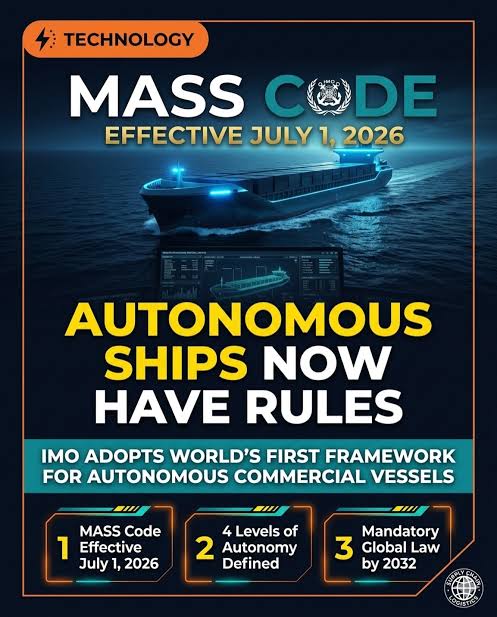
Engr. Kato explained that the MASS framework is divided into different levels of autonomy, beginning with vessels that still carry crew members but rely heavily on automated systems, progressing to remotely controlled vessels with limited onboard personnel, and eventually fully autonomous ships operated entirely from shore-based control centres using satellite and digital technologies.
Kato expressed concern that despite the imminent commencement of the code’s implementation phase, there appears to be limited awareness among Nigerian maritime stakeholders. “The technology is already evolving globally. The question is whether our government and maritime regulators are sufficiently prepared and whether stakeholders are being sensitized on what is coming,” he said.
He noted that while the code’s implementation beginning in July 2026 would not immediately be mandatory, the framework is expected to gradually become fully integrated into international shipping operations over the coming years. According to him, Nigeria risks being left behind if proactive measures are not taken to understand, domesticate and regulate the emerging technology.
“There is a need for workshops, seminars and stakeholder engagements so that ship owners, seafarers, regulators and maritime operators understand the implications of the MASS Code. Government should establish committees and begin reviewing regulatory frameworks to align with global developments,” Kato stated.
Drawing parallels with the global phase-out of single-hull tankers, Kato warned that many initially dismissed such international regulations until compliance became unavoidable. “People thought the single-hull tanker phase-out would not work, but today they have disappeared completely. The same thing can happen with autonomous shipping. If we fail to prepare, we may eventually be compelled to adopt technologies and systems developed elsewhere without having built local capacity,” he added.
Also speaking, a Marine Engineer and former President of the Nigerian Merchant Navy Officers and Water Transport Senior Staff Association (NMNOWTSSA), Engr. Matthew Alalade acknowledged the growing global shift toward autonomous shipping, but expressed reservations about the readiness of developing countries, including Nigeria, to embrace the technology.
Alalade explained that some autonomous vessels may still require minimal crew complement, such as a master and chief engineer, while most operational functions would be managed remotely through advanced computer systems.
While describing the technology as part of the inevitable digital transformation of global shipping, he cautioned that the increasing reliance on automation could introduce new safety concerns.
“Even with fully-manned ships, accidents still occur. With increasing computerization, there are concerns about how such systems will perform under different operational conditions. However, if developed countries can successfully manage it, then the rest of the world may gradually follow,” he said.
The former merchant navy president further argued that developing nations may require additional years before they can effectively integrate autonomous shipping technologies into their maritime sectors.
“For countries like ours, I think we still need time. Maybe in the next five to ten years, we will better understand how the system works and how to adapt to it. The world is moving towards digitalization and automation, and shipping is not exempt,” he said.