By Joshua Yousouph
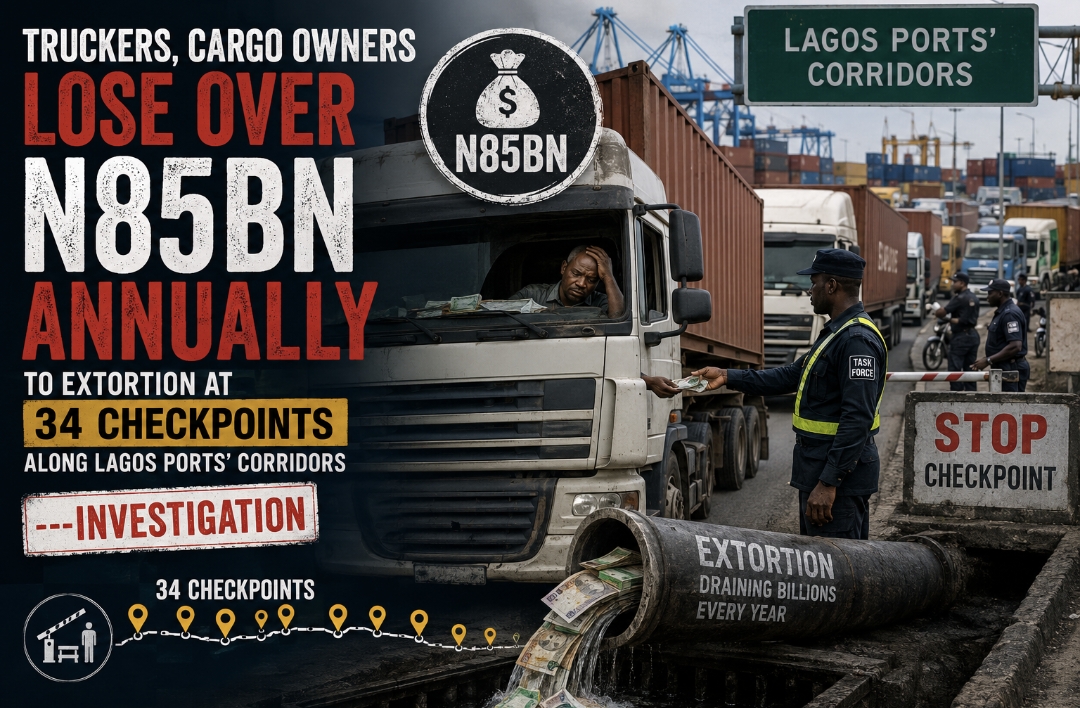
Investigation by Shipping Position Daily has revealed that truckers and cargo owners operating along the Apapa and Tin Can port corridors may be losing over N85 billion annually to alleged extortion at no fewer than 34 checkpoints mounted by various government security and traffic agencies, a situation stakeholders say is significantly driving up logistics costs and the prices of imported goods in Nigeria.
The investigation found that truck drivers encounter more than 17 checkpoints on the Apapa corridor and another 16 along the Tin Can Port access road, where operators are allegedly compelled to make unofficial payments, with industry estimates showing that a single checkpoint alone could generate as much as N5.04 billion annually from trucks accessing the ports.
The findings emerged from physical assessments and interactions with truckers, importers and freight stakeholders who decried the continued proliferation of checkpoints along major port access roads despite ongoing efforts by government agencies to improve cargo evacuation and facilitate ease of doing business.
Using an estimated daily traffic volume of 3,000 trucks, truckers who spoke with Shipping Position Daily explained that unknown to many, collections at the checkpoint amount to approximately N15 million daily. This translates to N105 million weekly and about N420 million monthly.
Extrapolating the figures across the 17 checkpoints identified on the Apapa corridor, truckers estimate that as much as N7.14 billion could be collected monthly from operators. On an annual basis, the figure rises to over N85.6 billion.
Stakeholders told Shipping Position Daily that the financial burden ultimately finds its way into the cost of goods consumed by Nigerians, as transporters and importers are left with little choice but to transfer the additional expenses to cargo owners and consumers.
In an exclusive chat with our correspondent last week, General Secretary of the Association of Maritime Truck Owners (AMATO), Bala Muhammed, confirmed that truckers encounter over 17 checkpoints on the Apapa corridor and more than 16 checkpoints along the Tin Can Port corridor.
According to him, the proliferation of checkpoints has become a major burden on truck operators despite ongoing efforts by stakeholders and government agencies to improve cargo evacuation and facilitate ease of doing business at the nation’s seaports.
Muhammed explained that at one of the checkpoints, truck drivers are compelled to pay about N5,000 per truck. Using an estimated traffic volume of 3,000 trucks daily, he said collections at a single checkpoint could amount to N15 million every day. This translates to about N105 million weekly, N420 million monthly and approximately N5.04 billion annually from just one checkpoint.
Based on this estimate, truckers believe collections across the 17 checkpoints on the Apapa corridor alone could exceed N85.6 billion annually. Operators noted that the figure could be significantly higher when the more than 16 checkpoints along the Tin Can corridor are factored into the calculation.
Muhammed alleged that personnel from various government security and traffic management agencies operate the checkpoints, stressing that truckers are not reporting the involvement of non-state actors in the collections.
He, however, disclosed that last week, a multi-agency committee was established to monitor reports of extortion and illegal checkpoints. According to him, the committee comprises representatives of the Police, Department of State Services (DSS), Lagos State Traffic Management Authority (LASTMA), Federal Road Safety Corps (FRSC), Nigerian Ports Authority (NPA), and other relevant agencies, with a dedicated platform created for real-time reporting of infractions.
“There are no non-state actors collecting money in the port corridor. It is all state actors and security operatives,” he alleged.
Beyond truck operators, cargo owners also lamented the impact of checkpoint-related delays and unofficial charges on the movement of goods from the ports to warehouses and markets across the country.
President of the Shippers Association of Lagos State (SALS), Rev. Nicodemus Odolo, described the situation as a major contributor to rising logistics costs, noting that the expenses incurred moving cargo from the ports to warehouses within Nigeria can sometimes exceed the freight cost of transporting the same cargo from China to Nigeria.
According to him, cargo owners ultimately absorb the burden by adding the extra expenses to the final cost of goods, a development that contributes to rising prices and weakens consumers’ purchasing power.
Odolo further complained that cargoes already examined and released by relevant agencies within the ports are often subjected to repeated checks by multiple government officials on the roads, resulting in delays, additional payments and operational inefficiencies.
“You can’t believe it. From port to cargo warehouse, the cost can be more than the freight cost from China to Nigeria,” Odolo said
Similarly, South-West Chairman of the Importers Association of Nigeria (IMAN), Joseph Ajoku, argued that arbitrary interceptions of cargoes and containers by enforcement officials after clearance remain a significant challenge for importers.
He noted that importers are frequently compelled to incur additional expenses arising from delays and repeated inspections, costs which are eventually transferred to end-users through higher prices of goods.
Ajoku maintained that the persistent increase in logistics and compliance costs is discouraging many importers from remaining in business, while also limiting the government’s ability to maximize revenue from legitimate trade activities.
“All this money that we spend here and there from one point to another is part of the expenses which we are going to add to the cost of the goods. At the end of the day, the price of the goods will go up. Who is going to bear the brunt? It is the end consumer. The amount we pay to these checkpoint varies, but the truth is that it’s a problem. If you insist on your rights, they can delay you. They will say one thing or the other. The point is that it is a problem, and it is part of the challenges importers are facing at the ports,” Ajoku added.
The stakeholders agreed that eliminating illegal checkpoints and addressing extortion along port corridors would significantly reduce logistics costs, improve cargo movement, enhance trade competitiveness and lower the prices ultimately paid by Nigerian consumers.