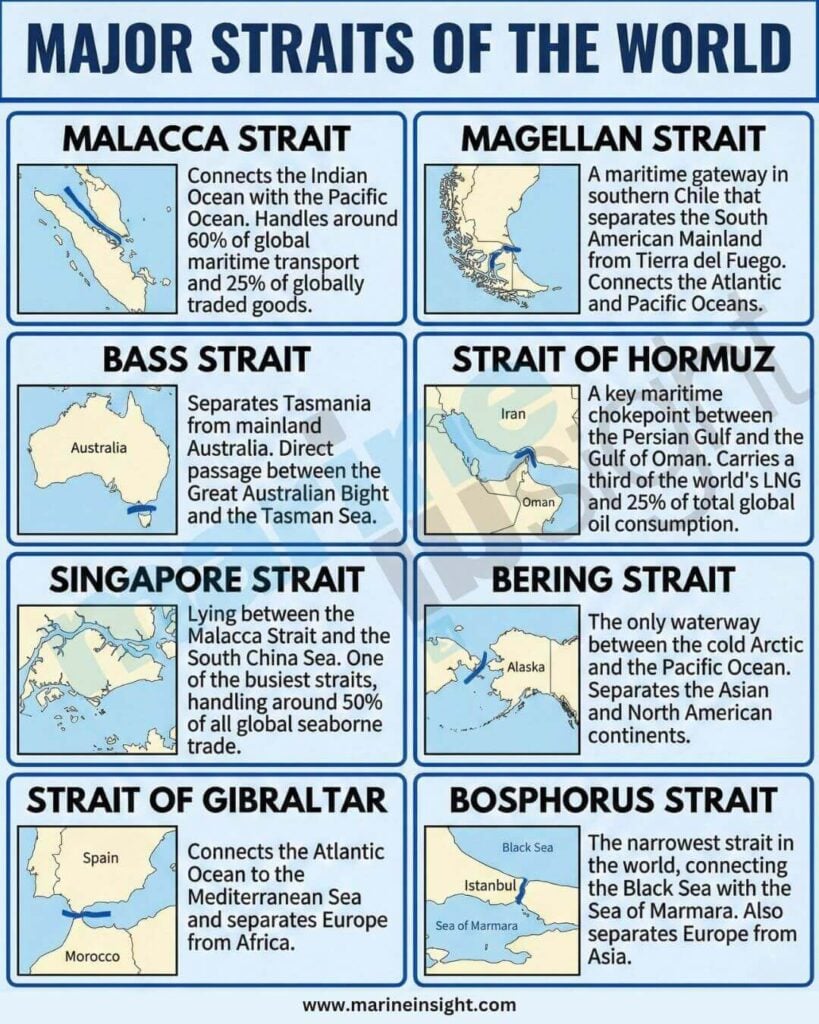
Straits are narrow waterways that link two larger bodies of water. Commonly straits are formed by tectonic activity, such as a fracture in an isthmus. Alternatively straits can appear due to water overflowing an area of eroded or subsided land. A canal, though it may function in the same way as a strait, is an artificially constructed waterway between two bodies of water, generally built for purposes of maritime transportation.
Certain straits are of great commercial importance. More than 80 percent of international trade consists of goods transported by sea, which means that straits are vital gateways and choke points. Of the straits listed below, the two most important for the global economy are the Strait of Malacca (accounting for 30 percent of all global trade), and the Strait of Hormuz (through which a fifth of both the world’s oil and liquefied natural gas pass).
List of Important Straits
- Bab el-Mandeb Strait
Located between Africa and the Arabian Peninsula, Bab el-Mandeb has been a strategic trade route connecting East Africa, Arabia, and India since ancient times. It gained even greater importance after the Suez Canal opened in 1869, as the canal allowed traffic between Europe and Asia to bypass Africa completely.
- Bering Strait
The Bering Strait separates the continents of Asia and North America. The strait connects the Bering Sea to the south with the Arctic Ocean to the north while also marking the closest point between Russia and the United States. During the Ice Age, the strait formed a land bridge linking Asia and North America.
- Bosporus
The Bosporus (from a Greek term that literally means “ox ford”) separates Europe and Asia by cutting through Istanbul—the largest city in the world that is situated on two continents. The Bosporus connects the Black Sea to the Sea of Marmara and by extension to other significant bodies of water, including the Mediterranean Sea.
- Strait of Gibraltar
This channel connects the Mediterranean Sea with the Atlantic Ocean while also separating Europe from Africa. At its narrowest it is 8 miles (13 km) wide. Historically this strait has been of great strategic and economic importance; as a shipping route, it remains of vital significance.
- Strait of Hormuz
The Strait of Hormuz is the only sea channel that links the Persian Gulf with the Gulf of Oman and the Arabian Sea. It is the primary route for petroleum exports from Iran, Iraq, Kuwait, Qatar, and the United Arab Emirates. Most of the oil shipped via this strait goes to countries in Asia; however, because of the large volume of traffic, the Strait of Hormuz has a strong effect on oil prices worldwide.
- Strait of Magellan
The Strait of Magellan links the Atlantic and Pacific oceans. It lies between the southern tip of South America and the island of Tierra del Fuego and is entirely within the territorial waters of Chile. A narrow strait with a width of 2–20 miles (3–32 km), its significance as a travel route was diminished after the Panama Canal was opened.
- Strait of Malacca
This waterway connects the Andaman Sea (and by extension the Indian Ocean) with the South China Sea (Pacific Ocean). Running between the Indonesian island of Sumatra and the Malay Peninsula—and thus forming the shortest sea route between India and China—it is one of the most heavily traveled shipping routes in the world.
- Strait of Messina
This strait separates Sicily from the Italian mainland and connects the Tyrrhenian and Ionian seas in the Mediterranean. It gained notoriety among sailors in ancient times because of dangers posed by its rocks, currents, and whirlpools.