Anthrax is a rare but serious illness caused by a spore-forming bacterium, Bacillus anthracis. Anthrax mainly affects livestock and wild game. Humans can become infected through direct or indirect contact with sick animals.
There’s no evidence that anthrax is transmitted from person to person, but it’s possible that anthrax skin lesions may be contagious through direct contact or through contact with a contaminated object (fomite). Usually, anthrax bacteria enter the body through a wound in the skin. You can also become infected by eating contaminated meat or inhaling the spores.
Signs and symptoms, which depend on how you’re infected, can include skin sores, vomiting and shock. Prompt treatment with antibiotics can cure most anthrax infections. Inhaled anthrax is more difficult to treat and can be fatal.
Specific Things To Know About Anthrax Disease
· Anthrax is a severe disease caused by the bacteria – Bacillus anthracis. It can affect both humans and animals, including wild animals and livestock such as cows, pigs, camels, sheep, goats, etc. The bacteria, which exist as spores, can be found in the soil, wool, or hair of infected animals.
· Anthrax spores are resistant to extreme conditions and can survive in the soil or environment for decades, making controlling or eradicating the disease very difficult. The spores are brought to the surface by wet weather, by deep digging, or when eaten by livestock or wild animals when they graze.
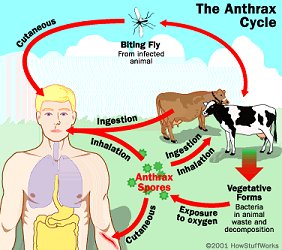
· Anthrax affects humans through skin infection (Direct contact with infected animals through wounds or cuts); gastrointestinal (Through eating raw or undercooked meat of infected animals or their products including milk); and inhalation (breathing in the spores).
· In animals, anthrax can cause symptoms such as high fever, weakness, loss of appetite, bleeding from all body openings (nose, mouth, ears, anus, etc.), swelling and difficulty in breathing, and bloody diarrhoea. It can lead to sudden death in most cases. The blood of an animal with anthrax does not clot on slaughter. Also, at slaughter, marked bloating and quick decay are observed.
· In humans, depending on the type and route of infection, anthrax can cause fever, painless skin sores with a black centre that appears after the blisters, general body weakness, and difficulty in breathing. It can also cause severe digestive illness that resembles food poisoning.
· Veterinarians, veterinary laboratory workers, farmers, abattoir workers, butchers, cattle rearers, livestock producers and traders, wildlife handlers, hunters, park rangers, processors, importers, and exporters of hide and skin, animal health workers are at risk of contracting anthrax.
· People who consume animals (cattle, sheep, and goats) that were found dead, healthcare workers, diagnostic laboratory workers, and caregivers who are exposed to patients or their biological specimens are also at risk of contracting anthrax.
· Law enforcement officers (Police, Military, Immigration, Customs, Point of Entry Personnel) and anyone travelling to a location with a confirmed anthrax case within and outside Nigeria are at risk of contracting anthrax.
· Vaccination is the most effective preventive measure against anthrax in livestock.
· Ensure a clean and safe water supply for livestock and avoid using water from stagnant sources.
· Practice biosecurity measures, such as controlling access to the farm, restricting the movement of animals, and disinfecting vehicles and equipment entering and leaving the premises.
· Sick animals should be isolated and strict quarantine measures implemented to prevent the spread of anthrax to other animals or humans.
· Exercise caution when buying cows, camels, sheep, goats, and other livestock from Nigerian states bordering Benin, Chad, and Niger, and from Ghana and Togo via waterways.
· Do not slaughter animals (cattle, sheep, and goats) at home, rather make use of abattoirs or slaughter slabs.
· Avoid contact with meat/bush meat or animal by-products such as skin, hides (ponmo), and milk of a sick or dead animal.
· Do not slaughter sick animals. Slaughtering the sick animal can cause significant exposure with the risk of inhalation of the bacteria by humans around at the time.
· Do not eat products from sick or dead animals.
· Carefully observe livestock to be slaughtered for consumption or sale for signs of ill health before slaughter.
*Culled from The Punch
———-Incineration Best Disposal Method For Anthrax Carcasses, Says NCDC
The Nigeria Centre for Disease Control has advised Nigerians to incinerate anthrax carcasses, stressing that it remains the ideal method of disposing and curbing the spread of the disease.
The Director-General of NCDC, Dr Ifedayo Adetifa, said in Abuja last week that where this method was not possible, deep burial was the alternative.
A statement signed by the Chief Veterinary Officer of Nigeria, Dr. Columba Vakuru, the animals were showing signs of a possible case of anthrax on a farm in Suleja, Niger State.
He said that it was reported to the Office of the Chief Veterinary Officer of Nigeria on July 14, 2023.
According to Adetifa, livestock farmers while disposing of the anthrax-infected carcass should ensure that they dig pits that is 6–8 feet, two metres deep, while the bottom should be well above the water table (minimum of three feet (0.9 m ).
“Considering the water table level and soil composition, clay soil is preferable, whereas, sand or gravel should be avoided,” he advised.
Adetifa said that anthrax was a contagious and highly fatal zoonotic bacterial disease affecting primarily herbivores.
He said that the clinical symptoms seen in animals infected with anthrax include high fever at the start of the infection, then restlessness, convulsions, and death.
“Not infrequently, livestock die suddenly without clinical symptoms. Some easily spotted clinical symptoms that include bleeding from the orifices, such as ears, nose, and mouth,” he added
Adetifa said that mortality can be very high, especially in herbivores, adding that the disease has a worldwide distribution and was a zoonosis.
“The etiological agent is the endospore-forming, Gram-positive, non-motile, rod-shaped Bacillus anthracic. And has an almost worldwide distribution.
“Once introduced into an area, anthrax is maintained in the environment by resistant spores that may remain dormant in the soil for many years.
“Spores are more likely to persist in areas with ideal soil conditions alkaline, calcium-rich,” he said.
According to him, Anthrax is a re-emerging infection and consequently, endemic areas may provide additional sources of alternative strains of B. anthracic for bioterrorism, which places global security at renewed risk.
He urged livestock farmers to report suspected cases of the disease at their livestock farms, cattle markets and other areas with the aforementioned symptoms of Anthtax.
Adetifa said that Nigerians should be vigilant and report any unusual happenings, such as sickness or sudden death of animals on their farms.
He advised animal owners to intensify efforts on annual vaccination and proper disposal of infected dead animals by burying them deep in the soil after applying disinfectant chemicals.
The NCDC boss advised Nigerians to refrain from consuming the meat of livestock infected with anthrax.
“This is because boiling the meat for hours will not kill the bacteria. Once the spore is inhaled, people usually experience death within 24 hours,” he said.
Adetifa noted that all infectious diseases have amplified the importance of hand washing with soap to reduce the spread.
Follow us on Facebook/ twitter