The Nigeria Customs Service (NCS) has launched a new handbook detailing import and export procedures for renewable energy equipment, as part of its ongoing efforts to support Nigeria’s energy transition agenda and promote sustainable trade.
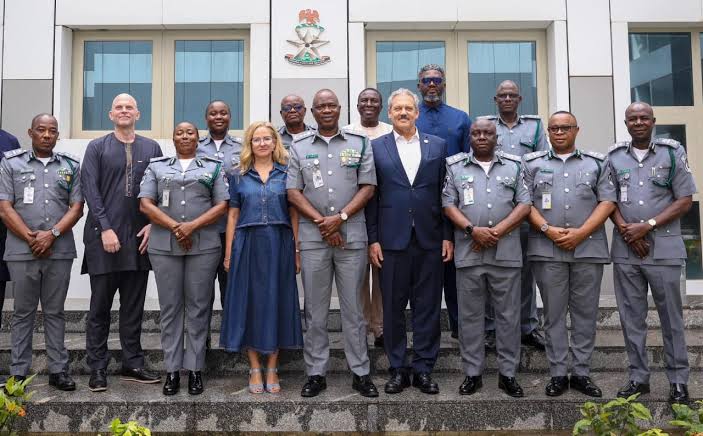
The unveiling ceremony, which took place recently at the Customs Headquarters in Abuja, was attended by representatives of the European Union (EU), the German Embassy, and the Deutsche Gesellschaft für Internationale Zusammenarbeit (GIZ), who partnered with the Service on the initiative.
Comptroller-General of Customs (CGC), Adewale Adeniyi, said the handbook is designed to simplify clearance processes for renewable energy-related equipment such as solar panels, inverters, batteries, and wind turbines. He noted that the document addresses past challenges associated with classification, valuation, and documentation, providing clarity to importers, exporters, and Customs officers alike.
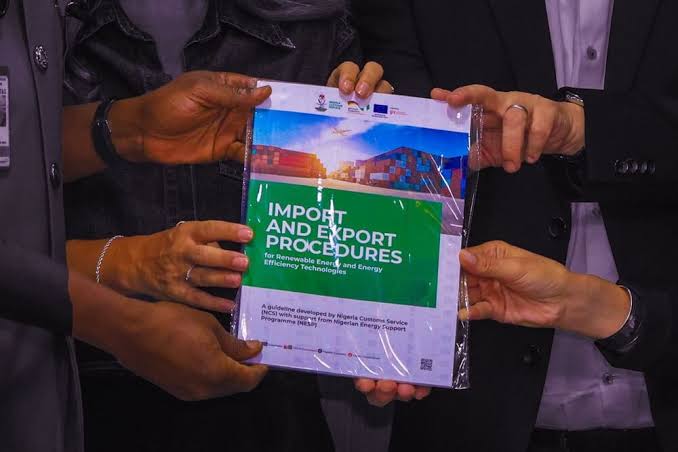
“This handbook is a living document and will be updated regularly to reflect advancements in renewable energy technology, changes in international best practices, and evolving government policies,” Adeniyi stated.
The CGC said the launch is part of Customs’ broader strategy to facilitate legitimate trade while supporting Nigeria’s Energy Transition Plan (ETP), which targets net-zero emissions by 2060.
He expressed appreciation to the EU, the German Government, and GIZ for their technical and financial contributions to the project, describing the partnership as a model for institutional collaboration in support of economic and environmental goals.
“This is more than just a Customs guide; it is a strategic tool that aligns trade facilitation with national development priorities,” Adeniyi added.
Head of the Green and Digital Economy at the EU Delegation to Nigeria, Ms. Inga Stefanowicz, commended the NCS for its commitment to trade reform and environmental sustainability. She noted that the EU is proud to support initiatives that promote a circular economy and highlighted the increasing participation of women within the Nigeria Customs Service as a positive sign of institutional inclusiveness.
Also speaking, Ms. Karin Jansen, Head of Cooperation at the German Embassy, reaffirmed Germany’s interest in deepening cooperation with Nigeria in areas of renewable energy and trade efficiency.
Country Director of GIZ Nigeria and ECOWAS, Mr. Marcus Wagner, lauded the leadership of the Comptroller-General, while congratulating him on his recent emergence as Chairperson of the World Customs Organisation (WCO) Council — a position he said reflects international recognition of Nigeria’s growing influence in global Customs reforms.
The handbook, which provides step-by-step guidance on tariff classification, exemptions, valuation processes, and required documentation, is expected to serve as a reference for Customs officers, freight forwarders, renewable energy companies, and other stakeholders involved in cross-border trade.
The initiative is also aligned with international frameworks such as the Paris Agreement and the African Continental Free Trade Area (AfCFTA), which aim to advance green trade and regional integration.
By simplifying Customs procedures in the renewable energy sector, the Nigeria Customs Service says it hopes to attract more investment, reduce delays at ports, and contribute to the country’s broader climate and development objectives.