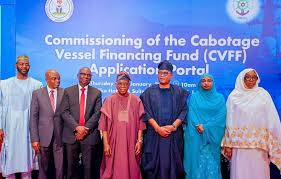
 Two months after the launch of the Cabotage Vessel Financing Fund (CVFF), stakeholders in Nigeria’s maritime sector say applications are ongoing, but no disbursement has yet been made.
Industry stakeholders say the portal has improved accessibility and transparency, but banks remain the primary gatekeepers in determining which indigenous operators qualify for the fund.
The CVFF, administered by the Nigerian Maritime Administration and Safety Agency (NIMASA), was designed to strengthen Nigeria’s Cabotage framework by providing local shipping companies with access to financing through participating commercial banks. The online portal, which was launched in January, allows operators to submit applications, upload relevant documentation, and track the status of their requests.
Dr. Edward Sowho, Chairman of the CVFF Committee of the Nigerian Indigenous Shipowners Association (NISA), told Shipping Position Daily that while the volume of applications is increasing, no disbursement has occurred so far.
“Companies are applying, but there has been no disbursement that we are aware of,” Sowho said.
“Applications are considered by the banks, not directly by NIMASA. Applicants have to meet the required criteria. I wouldn’t describe it as a delay; evaluation is a necessary step.”
According to Sowho, the CVFF process involves multiple stages, including submission of application forms, verification of company documents, assessment of financial capacity, and bank-level credit appraisal. Only after banks complete their evaluations can funds be released to qualified applicants.
“The portal has made the process more transparent, and operators now have a structured avenue for submitting requests,” he said. “It also helps ensure that the funds go to companies capable of deploying them effectively in the shipping sector.”
Sowho agreed that while the cautious approach may prolong the process, it ensures that only financially viable operators receive funding, thereby protecting the integrity of the fund.
However while the launch of the portal has been welcomed by many, some industry operators remain cautious, pointing to the long history of the CVFF, which has accumulated contributions over more than two decades without recorded disbursement.
Otunba Sola Olatunji, a leading shipowner, described the current phase as normal procedure but urged operators to maintain realistic expectations.
“Before any disbursement, there must be processing, application, evaluation, and approval,” he said. “Those steps cannot be skipped. The portal launch is a positive signal, but tangible outcomes will ultimately determine confidence in the scheme.”
Olatunji added that the CVFF should be viewed in the context of broader developments in Nigeria’s maritime and energy sectors, which are witnessing rising cargo volumes and vessel traffic due to refinery operations and increasing exports.
“There are significant opportunities in shipping tied to Nigeria’s growing export capacity,” he said.
“The expectation is that financing mechanisms like the CVFF will, over time, help indigenous operators to position themselves to participate more actively in this space.”
NIMASA on its part, has consistently emphasized that the CVFF must remain credible, sustainable, and bankable to avoid the pitfalls of past intervention funds.