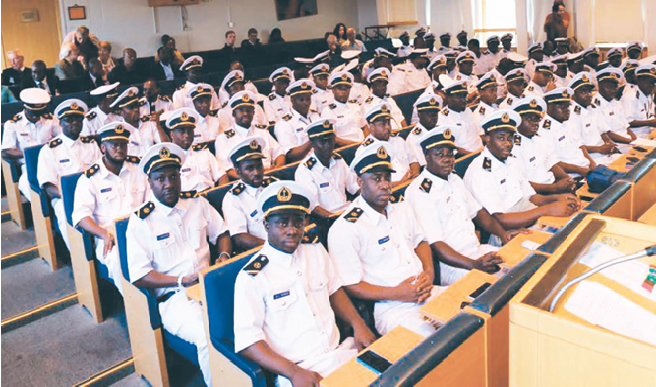
During a recent visit to Nigeria, the International Transport Workers Federation (ITF) dropped a bombshell. Speaking through its Africa Regional Secretary; Mr Safiyanu Muhammed, the global body tactically queried the essence of the huge amount that has been devoted to the training of budding seafarers under the National Seafarers Development Programme (NSDP).
Despite spending more than N16 billion on training of over 2000 seafarers over the years, under the National Seafarers Development Programme, which is being promoted by the Nigeria Maritime Administration and Safety Agency (NIMASA), the ITF raised concerns over the whereabouts of Nigerian seafarers who were trained under the NSDP.
The global seafarers’ body also raised concerns about the quality of certified seafarers in Nigeria and other African countries.
Reeling out statistics, the ITF noted that Africa accounts for only 78,000 of the over 1 million certified seafarers serving on international merchant ships globally. The figure, he said, stands in sharp contrast to major seafaring nations like the Philippines and China, which have a large pool of trained and certified seafarers.
In a veiled reference to the NSDP, the ITF Scribe expressed dismay that in the past, Nigerian government had invested in training hundreds of seafarers, but their current whereabouts and employment status were unknown.
He equally cited a report which had indicated that only about 100 Nigerian seafarers are currently working internationally, despite the country’s vast resources and potential.
We recall that about three years ago, some embattled Nigerian youths who were beneficiaries of the National Seafarers Development Programme (NSDP) took to the streets in Manila, Philippines. Their grievance was that they were allegedly abandoned by the Nigerian Maritime Administration and Safety Agency in Philippines.
In the video that went viral, the cadets alleged that they had been abandoned by NIMASA, even as they said that they had been in that country for about 10 years.
The Nigerian cadets under the NSDP were seen protesting at the Nigerian Embassy in Manila Philippines, over alleged refusal by the Embassy to listen to and receive them and address their grievances against NIMASA.
That was not the first time that the NSDP would be openly rubbished. We recall that, in September 2018, some cadets of the programme who had been sponsored by NIMASA, stormed the agency’s head office in Apapa, Lagos to protest a three-year delay in sending them on a mandatory sea time training that will make them certified sailors.
The peak of the protest was when they pointedly accused the agency of siphoning the fund earmarked for their training. Surprisingly, NIMASA never reacted to nthat weighty allegation.
When it was conceived by the then-Director General of NIMASA; Dr Ade Dosunmu, the Nigerian Seafarers Development Programme was designed as an interventionist programme for youths to develop interest in shipping and also to provide a pool of seafarers that will fill emerging vacuum, especially, the indigenous manning requirements of Coastal and Inland Shipping (Cabotage Act).
The NSDP was borne out of the need to harness the country’s opportunity of being a coastal nation and its endowment with a vibrant and energetic youth population and turn them into concrete economic benefits for the country and its people.
The objective is specifically to invest heavily in the training of Nigerian youths aged between 17 and 22 years to acquire both theoretical and practical skills and hands-on knowledge in internationally recognized maritime institutions around the world for the purpose of having a rich pool of operational and officer cadre seafarers, with attendant economic benefits to the country.
The NSDP was designed to be funded partly by the state governments of the prospective seafarer and NIMASA.
With the evidences that have piled-up over the years, the NSDP story is (indeed) not a pleasant one. Apart from stories of cadets being abandoned without funding and upkeep, there are stories of those who have graduated are yet to secure sea time, while those who have managed to secure sea time could not find a job! There are some cases of cadets who have made a success of the NSDP, but it is either that their number is insignificant or they are non-existent.
While we agree with NIMASA that the NSDP is a good interventionist programme, its implementation is faulty and gives little hope.
Each time the issue of the NSDP is raised, NIMASA is eager to point at Philippines, a country that is reputed to be the maritime manning capital of the world. Yes, it is possible to replicate the Philippines achievement in Africa. But NIMASA is not towing the Philippines line.
Nigeria can not wishfully want the NSDP to launch it to the status of leading supplier of seafarers in Africa.
NIMASA says with the NSDP, the growing army of unemployed and restive youths would be professionally trained and groomed to provide the much-needed capacity for the maritime industry. Yes, we agree that these youths are being trained, but they are largely jobless. Of what use is the training that offers no jobs thereafter.
It smirks of lack of due diligence for NIMASA to base the conception of NSDP on availability of viable and sustained employment prospects for qualified and globally-qualified seafarers. How many of the products of the NSDP have benefitted from the global employment pool?
We however agree that NSDP will enable Nigeria to have a rich and diverse pool of well-trained and globally-qualified seamen who can participate in both coastal and international shipping business.
It is a tall dream and also wishful thinking that the NSDP is an alternative source of income for Nigeria through earning of foreign exchange from repatriated funds by seafarers who would earn salary in hard currency.
While this may happen in the long run, it will depend on the percentage of NSDP products who are able to secure job opportunities outside the shores of Nigeria. If indeed it is possible to earn foreign exchange from the NSDP, why haven’t we seen this, several years after the programme was flagged-off?
Having implemented the NSDP since 2008, it is obvious that it is ripe for a review. Part of the review that we advocate is such that the sea-time component is embedded in the programme from the start. With this, there will be no waiting time by the cadets. The students will learn for a period to be determined by the institutions, and be engaged on sea-going ships before going back to school to complete their programme.
This is unlike the previous arrangement in which cadets completed shore-based training and waited for allotment and call-up to board vessels.
Also, NIMASA will need to rejig the funding arrangement. It is obvious that NIMASA can no longer continue to cough out that chunk of foreign exchange to fund the NSDP. Perhaps, the sharing formula for funding needs to be reviewed, between the states of origin of the cadets, NIMASA and perhaps, the cadets themselves.
We also think that NIMASA may need to reduce the number of beneficiaries to a manageable size. This is to enable proper monitoring.
Finally, we urge NIMASA to look in the direction of the Maritime Academy of Nigeria (MAN), Oron in Akwa Ibom state for the NSDP. This is because the Nigerian nautical institute in Oron has been upgraded and can now compare with its contemporaries elsewhere.
Most importantly, products of the NSDP must get immediate employment. Only then can it be said to be a success!