The new Chief of Naval Staff, Vice Admiral Idi Abbas, has dismissed calls for the creation of a separate coast guard, saying such a move would be unnecessary and counterproductive.
Speaking during his Senate screening, Abbas said the Nigerian Navy already performs the duties of a coast guard and that setting up another agency would amount to duplicating functions.
“We don’t need a separate Coast Guard because the Nigerian Navy already performs those functions. Creating another agency would only duplicate efforts. It’s better to channel those funds toward boosting naval operations,” he told the lawmakers.
He disclosed that the Navy had recently established a Special Operations Command in Makurdi, Benue State, to strengthen security along inland waterways linking Benue and Lokoja, as part of efforts to secure the country’s internal maritime routes.
The naval chief also outlined plans to integrate advanced technologies such as drones and artificial intelligence (AI) into naval operations to combat oil theft, piracy, and other maritime crimes.
According to him, the use of technology will modernise naval surveillance, cut fuel costs, and enhance operational efficiency in hard-to-reach areas, particularly in the Niger Delta and coastal regions.
“We will incorporate more technology, including the use of drones, to tackle maritime crime,” he said. “A lot of resources are currently wasted fueling boats to reach remote areas. Technology will help us respond faster and more effectively.”
Abbas explained that traditional fuel-heavy patrols would be complemented by digital and remote surveillance systems to create a smarter, faster, and more cost-effective security framework.
He noted that AI-driven tools and drone surveillance would help detect and prevent oil theft, illegal bunkering, and other economic crimes, thereby plugging financial leakages in the petroleum sector.
“Some of our patrols do not yield expected results, because of the nature of the terrain, and resources are often wasted on fuel. Using drones will allow us to monitor these areas more effectively,” he said.
Responding to a question from Senator Olamilekan Solomon, Chairman of the Senate Committee on Appropriation, Abbas said most oil theft occurs in difficult-to-access creeks and coastal areas. He added that while individual thefts may seem small, their cumulative impact is significant.
He revealed that the Navy had made progress in curbing the use of offshore tankers for transporting stolen crude and was implementing digital tracking systems to monitor suspicious vessel movements.
He reaffirmed the Navy’s commitment to its Total Spectrum Maritime Strategy, a framework addressing the full range of maritime security challenges, from piracy and oil theft to smuggling and kidnapping.
“The challenges we face cannot be solved by the military alone,” Abbas concluded. “It requires a whole-of-society approach. We must synergise across the armed forces and with civil institutions to make Nigeria safer.”
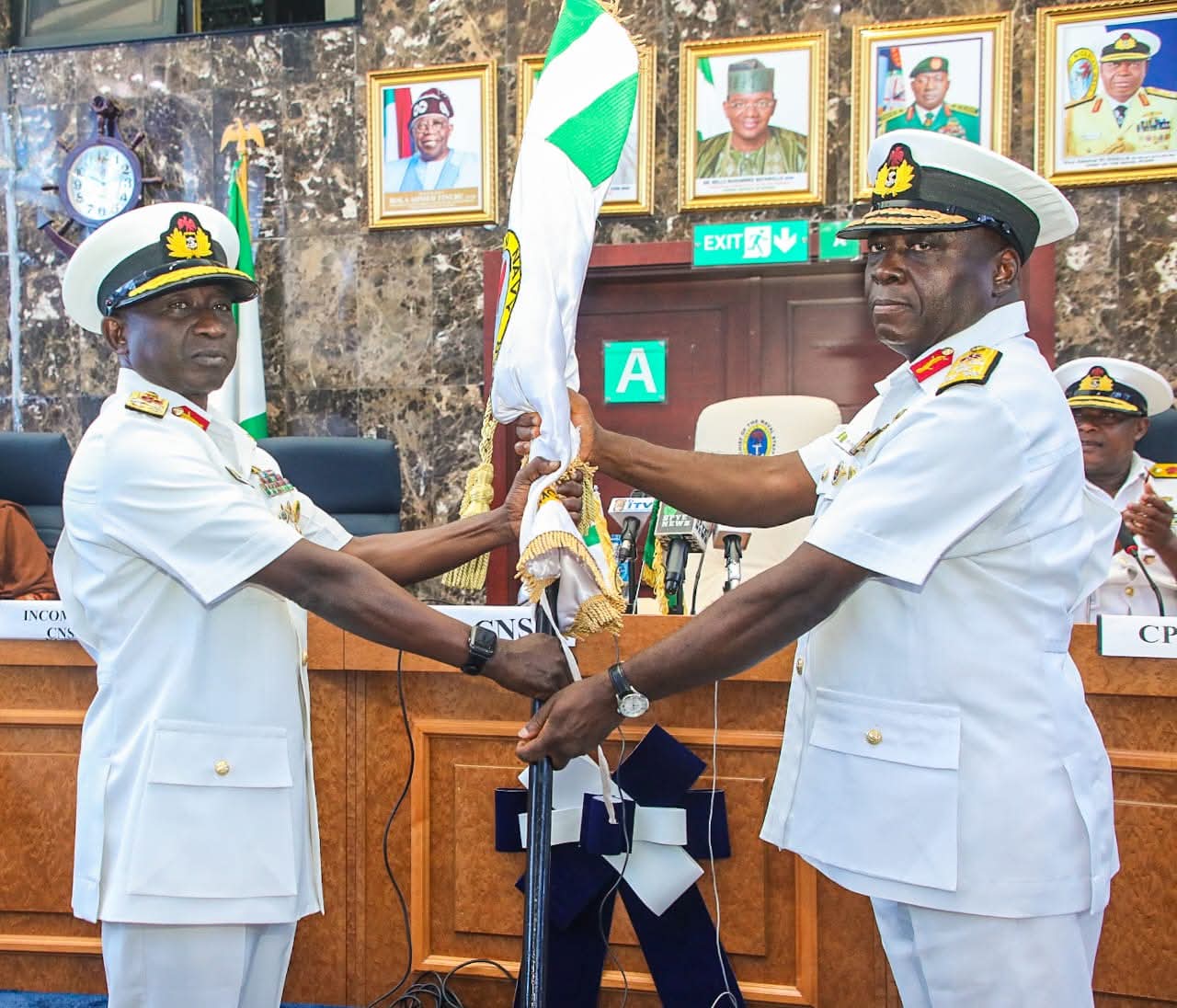
Meanwhile, Rear Admiral Abbas, has identified crude oil theft, sea robbery, illegal bunkering, Illegal, Unreported and Unregulated (IUU) fishing, and drug trafficking as major threats to Nigeria’s maritime sector.
In a speech delivered on Thursday during the handing-over ceremony, Admiral Abbas said these threats not only undermine Nigeria’s national economy and energy security but also endanger the livelihoods of coastal communities and the nation’s overall economic stability and prosperity.
He told the officers that: I salute every member of the Navy family for your service and sacrifice.
“However, I am not unaware that our maritime environment remains threatened by the scourge of crude oil theft, sea robbery, illegal bunkering, Illegal Unreported Unregulated fishing and drug trafficking. These crimes not only undermine our national economy and energy security but also threaten the livelihoods of our coastal communities and the economic stability and prosperity of our dear nation.
“To confront these challenges decisively, my tenure will be guided by a clear and actionable strategic approach focusing on strengthening maritime security and combating illegalities, enhancing the operational capability of our fleet through aggressive fleet renewal, the use of technology, prioritising training and personnel welfare, as well as fostering inter-agency synergy, regional and international collaboration. Specifically, serious attention will be given to the imperatives of jointness with sister services and close cooperation with relevant security agencies in the conduct of operations towards tackling the pervasive security threats confronting our dear nation”.
In his valedictory speech, the outgoing Chief of Naval Staff, Vice Admiral E. I. Ogalla, presented a scorecard of his tenure as Chief of the Naval Staff.
In his words: “In the last 2 years and 5 months of my command, the Nigerian Navy made significant strides in its operational activities with commendable improvement in the nation’s maritime security.
“We have preserved the sanctity of our maritime space, ensuring there was no piracy incident under my watch, following Nigeria’s delisting from the International Maritime Bureau’s Global Piracy Report on 3 March 2022.
“Our anti-crude oil theft/illegal bunkering operations were rejigged through the introduction of Operation DELTA SANITY in January 2024 and sustained as DELTA SANITY II on 30 December 2024 to build on recorded gains.
“Since the launch of the operation, over 800 illegal refining sites and 5,515 storage facilities were deactivated, with over 240 suspects and 76 vessels arrested. It is also gratifying to state that, sequel to Presidential Directive, the NN under my watch commenced fiscalisation duties in the nation’s major oil and gas export terminals.
“This measure has supported the efforts of statutory agencies by enhancing transparency at the terminals, resulting in increased oil production, which has been acclaimed to be the highest in the last decade.
“I am equally pleased to recall significant progress made in fleet recapitalisation and maintenance. During my tenure, the NN acquired 2 survey vessels, 57 riverine boats, 7 fast patrol boats, 6 insurrection patrol crafts, 3 tugboats, and 2 capital ships.
“We also acquired 5 transport helicopters, 5 logistics barges, and 23 unmanned aerial vehicles. Our indigenous shipbuilding effort is progressing well, with the construction of Seaward Defence Boats 4 and 5 at the Naval Dockyard nearing completion”.