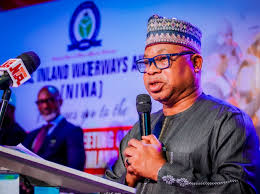
The Managing Director of the National Inland Waterways Authority (NIWA), Dr. Bola Oyebamiji, has responded to the recent call by the Lagos State Government urging the federal agency to cease the issuance of sand-filling permits on Lagos waterways, stating that NIWA does not issue sand-filling licenses as widely perceived.
This comes after Lagos State Governor, Mr. Babajide Sanwo-Olu, through his deputy, Dr. Obafemi Hamzat, raised concerns at the 2025 Regional Ferry Safety Conference held in Lagos, where he alleged that NIWA’s continued approval of sand-filling activities was endangering the state’s water transport system and threatening its sustainability.
Dr. Hamzat, representing Governor Sanwo-Olu at the conference, made a passionate appeal to NIWA to immediately stop granting approvals for sand-filling operations on inland waterways in Lagos, stressing that such activities have detrimental effects on the environment and pose long-term risks to the viability of the ferry transportation network the state has been heavily promoting as a strategic alternative to road congestion.
“We must say it clearly: NIWA must stop giving licenses for sand filling in Lagos waters,” the deputy governor stated firmly. “The collaboration between Lagos State and NIWA used to be very strong, but we must now return to that deep collaboration. We need to work closely to protect our waterways and ensure that safety and sustainability are not compromised.”
The Lagos State Government has consistently expressed concerns over indiscriminate sand filling and dredging activities, warning that these practices could reduce the capacity of waterways, alter navigation channels, and increase safety hazards for ferry operators and commuters.
However, in an exclusive chat with our correspondent, the NIWA Managing Director, Dr. Bola Oyebamiji, clarified the agency’s position and its operational procedures regarding sand-filling approvals. He stressed that NIWA does not issue licenses but only grants controlled access to waterways, following strict evaluation criteria.
“NIWA does not grant licenses for sand filling as being widely assumed,” Oyebamiji said. “What we do is give access to the water, and before that access is granted, we require certain documentation, the most important of which is a letter of allocation either from the Lagos State Government or from the Federal Ministry of Lands and Housing.”
He explained that following a recent court judgment, the authority now primarily recognizes letters of allocation issued by the Federal Ministry of Lands and Housing or the office of the Surveyor General.
“The moment we receive a valid letter of allocation, our technical team conducts a thorough site evaluation to ensure that the proposed sand-filling activity will not obstruct the natural flow of the water or compromise safety,” Oyebamiji said.
According to him, if the evaluation reveals no threat to water flow or safety, NIWA may issue what he described as a “provisional permit,” which is temporary and subject to further regulatory checks. He emphasized that at no point does NIWA issue permanent licenses for sand filling.
“We don’t issue licenses. The permits we issue are based on professional assessments and are often provisional. When we detect that the sand-filling activity could impede water flow, we withhold approvals,” he said.
Oyebamiji also pointed out that the perception of NIWA as the body authorizing unchecked sand-filling activities is misplaced, adding that the agency’s processes involve inter-agency consultations and environmental considerations.
The deputy governor had stressed at the ferry conference that beyond infrastructure investments in jetties, terminals, patrol boats, and monitoring systems, protecting the waterways’ natural ecosystems is critical for the success and longevity of water transportation in Lagos.
“We must remember that safety is not only about the vessels and the passengers but also about the integrity of the waterways themselves,” Hamzat said. “If we allow sand filling to continue unchecked, we are jeopardizing the very future of our inland water transport.”
The exchange between Lagos State and NIWA highlights an enduring jurisdictional tension over the management of inland waterways, a regulatory grey area that has sparked several disputes in recent years between federal and state authorities.
While both sides appear committed to the broader goal of developing efficient and safe water transportation, the disagreement over sand-filling activities underscores the need for a more harmonized regulatory framework and clearer inter-governmental cooperation to protect Nigeria’s inland waterways.
As Lagos continues to expand its ferry services to decongest its overstretched road networks, industry stakeholders say stronger coordination between NIWA and the Lagos State Government will be essential to ensure that commercial interests, environmental sustainability, and public safety are balanced effectively.