By Joshua Yousouph
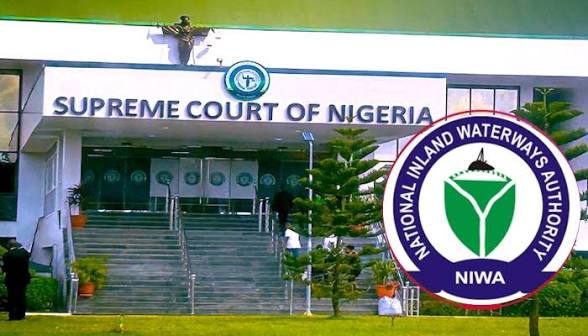
Boat operators and waterways stakeholders have defended the regulatory authority of the National Inland Waterways Authority (NIWA), following a Supreme Court judgment that restricts the Federal Government’s control over waterfront lands not used for navigational purposes.
Shipping Position Daily recalls that the Supreme Court of Nigeria had recently ruled that while certain provisions of the NIWA Act relating to adjoining waterfront lands are unconstitutional to the extent that they extend beyond navigation-related purposes, the Federal Government cannot exercise sweeping control over such lands within states.
The judgment, which has generated wide industry debate, reaffirmed that regulatory powers over inland waterways navigation remain largely intact under the National Inland Waterways Authority Act, particularly Sections 10 and 11, which cover navigation safety, channel management, and waterways transportation.
However, stakeholders who spoke with Shipping Position Daily last week broadly agreed that while it limits federal control over adjoining waterfront lands, it does not remove NIWA’s central role in regulating inland waterways transportation across Nigeria.
In an official press statement made available to our correspondent last week, the acting Managing Director and Chief Executive Officer of NIWA, Umar Yusuf Girei, said the apex court upheld the Authority’s statutory responsibilities concerning inland waterways navigation, safety regulation, channel management, river infrastructure development and the promotion of inland waterways transportation as contained in Sections 10 and 11 of the NIWA Act.
Girei clarified that Sections 12 and 13 of the Act, which deal with land matters unrelated to maritime activities, were only voided to the extent of their inconsistency with the Constitution. According to him, the judgment does not remove NIWA’s core regulatory powers over inland waterways navigation across the country.
He therefore advised stakeholders and clients of the Authority to remain calm, law-abiding and await an official statement from NIWA after obtaining the Certified True Copy of the judgment from the Supreme Court.
Reacting to the development, the National Public Relations Officer of the Waterfront Boat Owners and Transporters Association of Nigeria (WABOTAN), Chief Raymond Gold, said the ruling should not be misinterpreted as weakening NIWA’s core mandate.
According to him, NIWA remains the only legally recognised authority responsible for regulating inland waterways navigation in Nigeria. “So far, what we understand is that the judgment is mainly about adjoining waterfront lands that are not related to navigation. When it comes to navigation and inland waterways, NIWA is still the agency recognised by law,” he said.
He noted that activities such as jetty approvals, boat operations, and navigational infrastructure still fall within NIWA’s regulatory jurisdiction, stressing that such functions are central to safe inland water transport.
Gold, however, called for cooperation between federal and state authorities, warning against institutional rivalry, and urged stakeholders to await the Certified True Copy of the judgment for clearer interpretation.
Similarly, the Secretary of the Lagos State chapter of the Association of Tourist Boat Operators and Water Transporters of Nigeria (ATBOWATAN), Mr Ayomikun Aworetan, said the ruling reinforces constitutional clarity rather than stripping NIWA of its mandate.
He explained that while disputes over waterfront land ownership and control have persisted for years, the judgment does not affect NIWA’s authority over core waterways operations.
According to him, operators will still be required to obtain approvals for jetties, dredging activities, and boat operations where such activities relate directly to navigation. “NIWA still has control. As long as it involves jetty operations and waterways usage, approvals are still required from NIWA,” he said.
Aworetan urged NIWA to intensify enforcement against illegal jetties and unsafe boat operations, noting that safety on Nigeria’s inland waterways should remain the priority.
All efforts to get reactions from Lagos State Waterways Authority (LASWA) prove abortive as messages and calls made to the Public Relations office as well as the Special Adviser to the State Government on Marine and Blue Economy, were not responded to.