If you or a loved one has been diagnosed with breast cancer, it’s important to understand some basics: What is breast cancer and how does it happen?
In this section, you can learn about how breast cancer develops, how many people get breast cancer, and what factors can increase risk for getting breast cancer. You also can learn more about signs and symptoms to watch for and how to manage any fears you may have about breast cancer.
“Breast cancer is never anyone’s fault. Feeling guilty, or telling yourself that breast cancer happened because of something you or anyone else did, is not productive.
What Is Breast Cancer?
Breast cancer is an uncontrolled growth of breast cells.
To better understand breast cancer, it helps to understand how any cancer can develop.
Cancer occurs as a result of mutations, or abnormal changes, in the genes responsible for regulating the growth of cells and keeping them healthy. The genes are in each cell’s nucleus, which acts as the “control room” of each cell. Normally, the cells in our bodies replace themselves through an orderly process of cell growth: healthy new cells take over as old ones die out. But over time, mutations can “turn on” certain genes and “turn off” others in a cell. That changed cell gains the ability to keep dividing without control or order, producing more cells just like it and forming a tumor.
A tumor can be benign (not dangerous to health) or malignant (has the potential to be dangerous). Benign tumors are not considered cancerous: their cells are close to normal in appearance, they grow slowly, and they do not invade nearby tissues or spread to other parts of the body. Malignant tumors are cancerous. Left unchecked, malignant cells eventually can spread beyond the original tumor to other parts of the body.
The term “breast cancer” refers to a malignant tumor that has developed from cells in the breast.
Usually breast cancer either begins in the cells of the lobules, which are the milk-producing glands, or the ducts, the passages that drain milk from the lobules to the nipple. Less commonly, breast cancer can begin in the stromal tissues, which include the fatty and fibrous connective tissues of the breast.
Symptoms of Breast Cancer
Initially, breast cancer may not cause any symptoms. A lump may be too small for you to feel or to cause any unusual changes you can notice on your own. Often, an abnormal area turns up on a screening mammogram (x-ray of the breast), which leads to further testing.
In some cases, however, the first sign of breast cancer is a new lump or mass in the breast that you or your doctor can feel. A lump that is painless, hard, and has uneven edges is more likely to be cancer. But sometimes cancers can be tender, soft, and rounded. So it’s important to have anything unusual checked by your doctor.
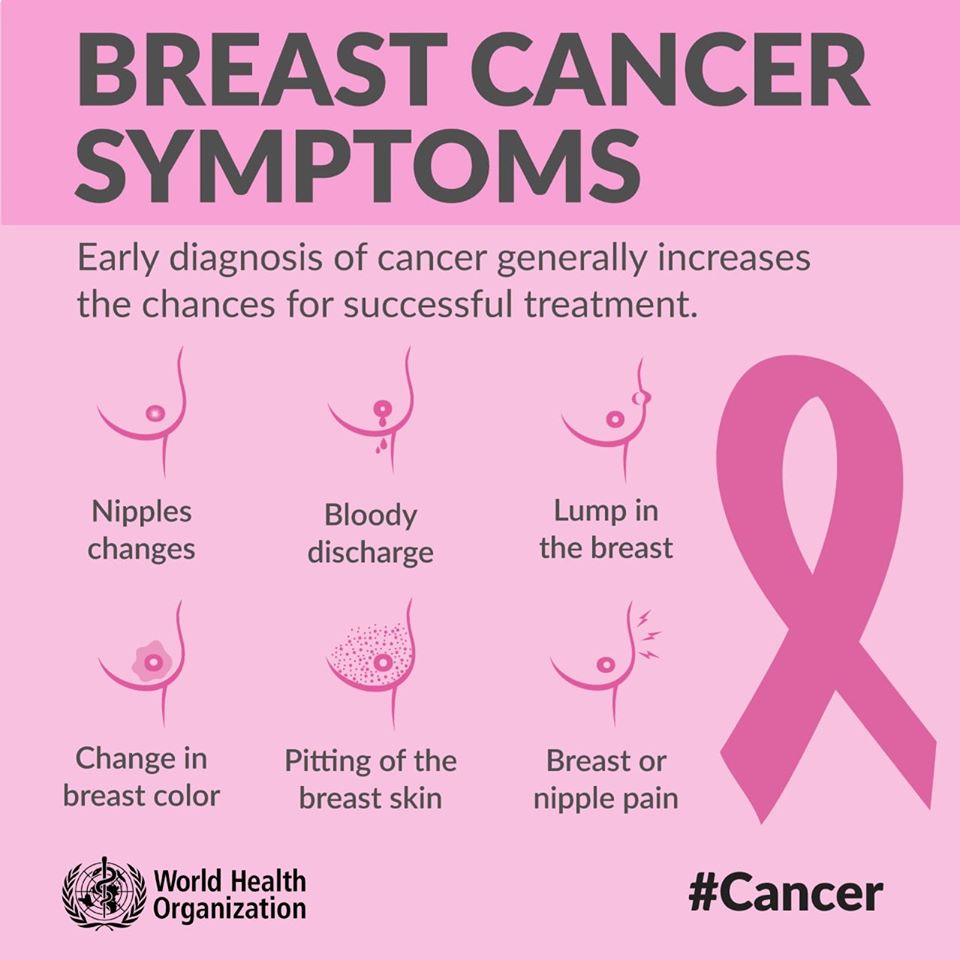
According to the American Cancer Society, any of the following unusual changes in the breast can be a symptom of breast cancer:
- swelling of all or part of the breast
- skin irritation or dimpling
- breast pain
- nipple pain or the nipple turning inward
- redness, scaliness, or thickening of the nipple or breast skin
- a nipple discharge other than breast milk
- a lump in the underarm area
These changes also can be signs of less serious conditions that are not cancerous, such as an infection or a cyst. It’s important to get any breast changes checked out promptly by a doctor.
Breast Cancer Risk and Risk Factors
By now you may be familiar with the statistic that says 1 in 8 women will develop breast cancer. Many people misinterpret this to mean that, on any given day, they and the women they know have a 1-in-8 risk of developing the disease. That’s simply not true.
In reality, about 1 in 8 women — or 13%, or 13 out of every 100 — can expect to develop breast cancer over the course of an entire lifetime. An average lifetime is about 80 years. So, it’s more accurate to say that 1 in 8 women. who reach the age of 80 can expect to develop breast cancer. In each decade of life, the risk of getting breast cancer is actually lower than 13% for most women.
People tend to have very different ways of viewing risk. For you, a 1-in-8 lifetime risk may seem like a high likelihood of getting breast cancer. Or you may turn this around and reason that there is a 7-in-8, or 87.5%, chance you will never get breast cancer, even if you live to age 80. How you view risk often depends on your individual situation — for example, whether you or many women you know have had breast cancer, or you have reason to believe you are at higher-than-normal risk for the disease — and your usual way of looking at the world.
Even though studies have found that women have a 13% lifetime risk of developing breast cancer, your individual risk may be higher or lower than that. Individual risk is affected by many different factors, such as family history, reproductive history, lifestyle, environment, and others.
This section is designed to help you better understand breast cancer risk and some of the factors that can increase risk.
Breast Anatomy
Over time, cancer cells can invade nearby healthy breast tissue and make their way into the underarm lymph nodes, small organs that filter out foreign substances in the body. If cancer cells get into the lymph nodes, they then have a pathway into other parts of the body. The breast cancer’s stage refers to how far the cancer cells have spread beyond the original tumor
Breast cancer is always caused by a genetic abnormality (a “mistake” in the genetic material). However, only 5-10% of cancers are due to an abnormality inherited from your mother or father. About 90% of breast cancers are due to genetic abnormalities that happen as a result of the aging process and the “wear and tear” of life in general. While there are steps every person can take to help the body stay as healthy as possible (such as eating a balanced diet, not smoking, limiting alcohol, and exercising regularly).
——Hormonal Contraceptives Raise Breast Cancer Risks —Study—–
All hormonal contraceptives carry a slightly increased risk of breast cancer, including the increasingly popular progestogen-only pills, according to a study published on Tuesday.
The researchers who carried out the study stressed that the increased risk of breast cancer needs to be weighed against the benefits of hormonal contraceptives, including the protection they provide against other forms of female cancer.
Previous studies have established an increased risk of breast cancer from two-hormone, or combined, contraceptives that use both estrogen and progestogen.
While the use of progestogen-only contraceptives has been on the rise for well over a decade, little research had been performed previously on their links to breast cancer.
The study, published in the journal PLOS Medicine, found that the risk of a woman developing breast cancer was about the same for hormonal contraceptives using both estrogen and progestogen as for those using just progestogen.
According to the study, women taking hormonal contraceptives have a 20 to 30 percent higher risk of developing breast cancer than those who do not use them.
The findings are similar to those published previously, including in a vast 1996 study.
The risk remains about the same regardless of the delivery method — oral pill, IUD, implant, or injection — or whether it is a combined pill or progestogen alone.
Taking into account that the likelihood of breast cancer increases with age, the authors of the study calculated how much absolute excess risk is associated with hormonal contraceptives.
For women taking hormonal contraceptives for a period of five years between the ages of 16 to 20, it represented eight cases of breast cancer per 100,000, they said.
Between 35 and 39 years old, it was 265 cases per 100,000.
– Very small increase in absolute risk –
“Nobody wants to hear that something that they’re taking is going to increase their risk of breast cancer by 25 percent,” said Gillian Reeves, a professor of statistical epidemiology at the University of Oxford and a co-author of the study.
“What we’re talking about here is a very small increase in absolute risk,” Reeves said.
“These increases in risk for breast cancer have to, of course, be viewed in the context of what we know about the many benefits of taking hormonal contraceptives,” she added.
“Not just in terms of birth control, but also because we know that oral contraceptives actually provide quite substantial and long-term protection from other female cancers, such as ovarian cancer and endometrial cancer.”
The study also confirmed, like others, that the risk of breast cancer declines in the years after a woman stops using hormonal contraceptives.
Stephen Dufy, a professor at Queen Mary University of London who did not take part in the study, described the findings as “reassuring in that the effect is modest.”
The study involved data from nearly 10,000 women under the age of 50 who developed breast cancer between 1996 and 2017 in the United Kingdom, where the use of progestogen-only contraceptives is now as widespread as the combined method.
Reeves said there were several explanations for the growing use of progestogen-only contraceptives.
They are recommended for women who are breastfeeding, who may be at risk of cardiovascular problems, or smokers above the age of 35.
“It might just be because women are taking hormonal contraceptives possibly into later years now,” Reeves said.
“So they are naturally at higher risk of those other conditions for which risk is increased with combined contraceptives.”
(AFP)
—————————————————
Nigeria’s Fertility Rate Drops To 4.8 Children Per Woman — NDHS
The 2024 Nigeria Demographic and Health Survey (NDHS) Report says Nigeria’s Total Fertility Rate (TFR) has declined from 5.3 children per woman in 2018 to 4.8 in 2024, marking a major demographic shift over the past five years.
The Minister of State for Health and Social Welfare, Dr Iziaq Salako, disclosed this on Friday in Abuja at the launch of the report.
Salako said the decline reflects gradual gains in access to and use of family planning services nationwide.
“Modern contraceptive use among currently married women increased modestly to 15 per cent in 2023 from 12 per cent in 2018, while satisfied demand for family planning rose to 37 per cent,” he said.
He noted that although the improvements were encouraging, they remained below the levels required to drive rapid social and economic progress.
According to him, antenatal coverage currently stands at 63 per cent, skilled birth attendance at 46 per cent, while postnatal coverage within two days after delivery rose from 38 per cent in 2018 to 42 per cent in 2024.
Salako said the under-five mortality rate had dropped significantly from 132 deaths per 1,000 live births in 2018 to 110 per 1,000 in 2024, while neonatal mortality remained nearly stagnant, moving from 39 to 41 per 1,000 live births within the same period.
“More efforts are required to reduce neonatal deaths, which account for about 40 to 45 per cent of under-five mortality,” he added.
The minister said the findings highlight urgent gaps requiring coordinated responses, adding that the ministry had already begun translating them into policy reforms.
He said initiatives such as the Maternal and Maternal Fatality Reduction Initiative and the Nigerian Child Survivor Act (2023–2025) were designed to address context-specific challenges through coordinated interventions.
“This is being done with better health investment targeting, improved coordination, a more efficient planning system, stronger community involvement, and building partnerships.
“However, the utilisation of the 2024 NDHS report to strengthen the health system and drive measurable improvements is the responsibility of all stakeholders,” he said.
Salako added that the data would also guide sub-national governments to identify geographical areas requiring urgent intervention.
Also speaking, the Executive Chairman of the National Population Commission (NPC), Hon. Nasir Kwarra, said the NDHS remains a vital instrument for understanding population trends, child and maternal health, nutrition, malaria, HIV, and other development indicators.
“Since its inception in 1990, the NDHS has been a central pillar in Nigeria’s demographic data architecture.
“The 2024 edition continues this legacy, providing fresh insights at a time when the need for reliable evidence to guide policy has never been greater,” he said.
Kwarra said the survey was implemented by the NPC with oversight from the Ministry of Health and Social Welfare and support from development partners.
He added that the success of the exercise demonstrated the power of institutional collaboration and reaffirmed that “data is not merely a technical output but a public good that empowers evidence-based governance”.
World Bank Senior Health Specialist, Dr Ritgak Tilly-Gyado, said the data would support the Bank’s analytical work and policy modelling in key areas such as health, education, and nutrition.
“The NDHS provides critical data points that help us understand what has worked and where further support to the Nigerian government is most needed,” she said.
The 2024 NDHS, the sixth in the series since 1999, was designed to provide reliable data for monitoring population and health indicators in Nigeria.
Its pre-data collection phase ran from August 2022 to November 2023, covering tool development, training, recruitment, pre-testing, and logistics, while fieldwork was conducted across 42,000 households nationwide between Dec. 1, 2023 and May 5, 2024.