Industry stakeholders have criticized the ongoing power tussle among government agencies over the responsibility for wreck removal on the country’s waterways, while also demanding clarity and justification from the Nigerian Maritime Administration and Safety Agency (NIMASA) over multiple environmental charges levied on vessel operators.
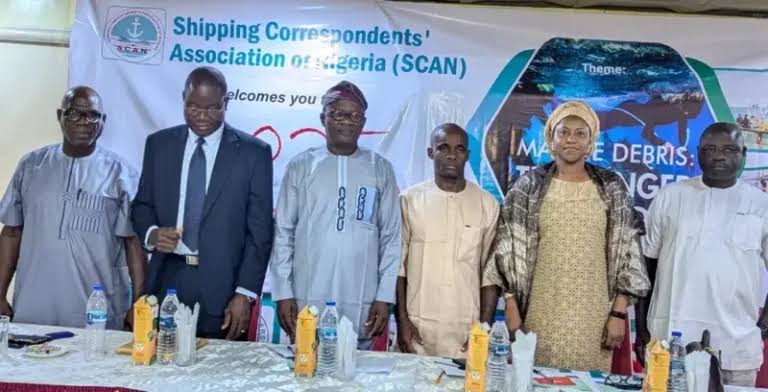
These concerns came to the fore during the 2025 Annual Summit of the Shipping Correspondents Association of Nigeria (SCAN), held in Lagos recently with the theme: “Marine Debris: The Danger Ahead.” where participants described marine debris not just as pollution, but as a growing threat to biodiversity, navigation safety, trade, coastal tourism, and the health of local communities.
Stakeholders who spoke during the maritime industry engagement, lamented the alarming number of wrecks littering key waterways and questioned why no single government agency has taken ownership of the issue despite several public declarations over the years.
Shipping Position Daily recalls that in 2021, NIMASA opened up what could be a N30 Billion wreck removal and recycling market in Nigeria by commencing the first phase of the nationwide wreck removal exercise. The then the Director-General of NIMASA, Dr Bashir Jamoh disclosed this during the official flag off of nationwide wreck removal exercise in Lagos noting that the exercise was divided into four phases including the Badagry-Tin-Can Island axis, Western Zone, Eastern Zone with headquarters in Port Harcourt, and Central Zone headquartered in Warri.
However, in the 2025 budget, the National Inland Waterways Authority (NIWA) allocated N850 million for wreck removal and waterways clean-up, with N300 million specifically for wreck removal in the South-East, South-West, and South-South regions. The remaining N550 million will be used for mechanical and manual clearing of floating debris, seaweeds, and waste materials across the country.
Findings by Shipping Position Daily reveal that section 22(1)(n) of NIMASA Act ,2007, gives it the responsibility to receive and remove wrecks and derelicts in Nigerian waters. The NIWA Act of 1997, also confers upon it the duty ‘’to survey, remove and remove wrecks and derelicts and other obstructions from the country’s Inland waterways. The removal of such wrecks and derelicts from the nation’s waters may have been made difficult to do by either NIMASA or NIWA, because section 7 of the Nigerian Ports Authority (NPA) Act 1999 also gave it powers to remove all wrecks and derelicts blocking access to Nigerian waterways.
Speaking at the summit, a leading Nigerian shipowner and Chief Executive Officer of Sea Transport Services Nigeria Limited, Alhaji Aminu Umar who was represented by Dr Anthony Joshua expressed frustration over the lack of clear leadership among maritime regulatory agencies regarding the removal of wrecks and derelicts from critical navigational channels. He noted that the absence of a coordinated approach among NIMASA, the NPA and NIWA has left vessel operators confused and exposed to avoidable risks.
The shipowner recalled a wreck removal initiative launched in Lagos by NIMASA under the former Minister of Transportation, Rotimi Amaechi. However, he lamented that nothing tangible has come from the campaign since its inauguration. Umar described the situation as a serious safety and environmental concern, citing other incidents in the Warri–Escravos channel where vessels’ propellers were damaged by abandoned fishing nets and traps.
While calling for collective action by regulators and operators, the shipowner also criticized NIMASA for imposing what he described as “overlapping and unjustified” levies under the guise of environmental protection.
According to him, both Nigerian-flagged and foreign vessels are burdened with annual Sea Protection Levies, while vessels operating offshore face even more charges with no visible evidence of what the funds are used for.
“Our concern in the industry is that for every vessel that comes to Nigeria, NIMASA charges an Environmental Protection Levy. For vessels going to offshore terminals, there is an additional Offshore Waste Reception Management Levy. Are they going offshore to receive waste?” he queried.
“You have 10% deductions from NIMASA. You pay the Sea Protection Levy for every vessel, whether foreign or Nigerian-flagged. Nigerian vessels are charged annually. Foreign vessels pay per entry. And if you’re heading offshore, you pay all three – the Sea Protection Levy, the Environmental Levy, and Offshore Waste charges. It’s choking and it’s raising serious apprehension among stakeholders. We are not opposing environmental regulation, but these levies must be transparent, accountable, and justified,” he said.
The shipowner called on the Ministry of Marine and Blue Economy to clarify issues including a national conversation involving all maritime regulators, port authorities, and industry players to streamline responsibilities, enhance environmental compliance, and eliminate unnecessary financial burdens on shipowners.
“Whose responsibility is this? Is it NIWA? Is it NPA? Is it NIMASA? Ideally, I think it should be NIWA, but everybody just seems to be playing their own part with no coordination. There has to be clear direction. When we need to report a wreck or raise safety concerns, we should know exactly who to approach.” the shipowner asked.
Responding to concerns on the wreck removal responsibility, the Managing Director of the National Inland Waterways Authority (NIWA), , Mr. Bolaji Oyebamiji who was represented by Assistant General Manager, Mrs. Aisha Eri clarified that the task is being jointly handled by a multi-agency platform.
He noted that there is a committee on wreck removal that has the combined agencies involved. “NIWA, NIMASA, NPA are involved. It’s called the Wreck Removal Committee. So, if you have a wreck issue, you can come to us, you can come to any of us. There is a consensus. We are all involved.” the NIWA boss stated
The NIWA boss added that the agencies coordinate their efforts in clearing wrecks based on jurisdiction. “We all come together and clear certain wrecks, including the ones on our inland waterways. I believe NPA also clears wrecks within its jurisdiction. NIWA clears wrecks too on our own waterways,” he assured.
On his part, the Managing Director of the Nigerian Ports Authority (NPA), Mr. Abubakar Dantsoho who was represented by Principal Manager, Marine, Capt. Femi Oyewole clarified that the responsibility for wreck removal largely depends on the location of the wreck.
He explained that NPA, in collaboration with Lagos Channel Management (LCM), is actively involved in clearing wrecks that are situated close to navigational channels. However, he noted that when the wrecks are located further inland, particularly within the hinterland waterways, the responsibility falls under the jurisdiction of NIWA.
“On wrecks removal, I just want to add that it depends on where the wreck is. At NPA, we have a collaboration with Lagos Channel Management (LCM), which handles wreck removal, especially those close to our navigational channels. But if the wreck is in the hinterland, NIWA takes care of that” he said.