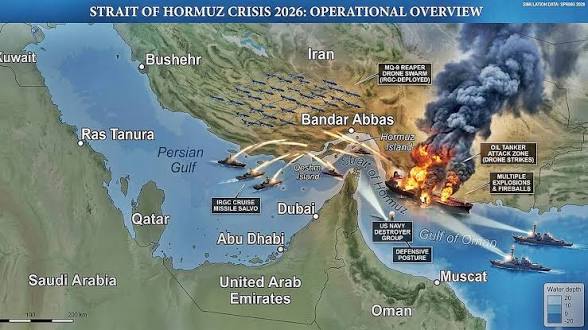
Findings by Shipping Position Daily have revealed that war risk insurance premiums on vessels valued at $100 million have surged from $250,000 to as high as $1 million per voyage, as escalating tensions in the Strait of Hormuz disrupt global shipping and significantly raise the cost of maritime trade.
This dramatic, fourfold increase (from around 0.25% to 1% of the vessel’s value) is primarily driven by renewed escalations in the Middle East, particularly threats to shipping in the Strait of Hormuz and the Red Sea as of March 2026.
This was according to a latest report by the United Nations Conference on Trade and Development (UNCTAD), which was exclusively obtained by Shipping Position Daily last week.
The report noted that the sharp increase in insurance costs comes amid a near-total breakdown in shipping activities through the strategic chokepoint, where daily vessel transits have plunged by 97 per cent—from an average of 141 ships in February to single-digit movements in early March.
The Strait, which handles about 25 per cent of global seaborne oil trade, equivalent to roughly 20 million barrels per day, remains critical to global energy supply chains. Beyond insurance, freight markets have reacted strongly to the disruption. Between February 27 and March 6, 2026, dirty tanker rates rose by 54 per cent, while clean tanker rates surged by 72 per cent, reflecting tightening vessel availability and heightened risk exposure.
At the same time, bunker fuel prices have nearly doubled, with low-sulphur fuel increasing by 99 per cent and high-sulphur fuel by 100 per cent, further driving up the cost of maritime transportation. Energy markets have also responded sharply. Between February 27 and March 9, 2026, oil prices climbed by 27 per cent to about $91.8 per barrel, while gas prices surged by 74 per cent.
The UNCTAD further highlighted that the Strait of Hormuz is a vital route for fertilizers, accounting for about one-third of global seaborne fertilizer trade, raising concerns about agricultural supply chains and food security, particularly in developing countries.
The global agency warned that the combined effect of soaring insurance premiums, rising freight and fuel costs, and increasing borrowing expenses could significantly strain global trade and economic stability, especially for vulnerable economies already grappling with high debt burdens and limited fiscal space.
With Brent crude trading above $90 per barrel, UNCTAD stressed that the duration and intensity of the disruption will determine the scale of its global economic impact, calling for urgent de-escalation and protection of maritime trade routes to safeguard supply chains.