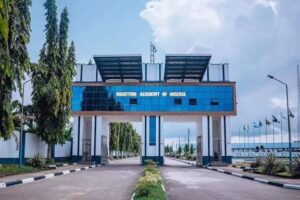
The Maritime Academy of Nigeria (MAN), Oron, is set to spend a staggering ₦1.74 billion on salaries and personnel-related costs in 2026, out of a total ₦2.73 billion allocation approved for the institution in the Federal Government’s Appropriation Bill, raising fresh questions about setting priorities at the nation’s foremost maritime training institution.
Details of the 2026 budget, contained in the Appropriation Bill for agencies under the Ministry of Marine and Blue Economy, show that personnel cost alone will consume more than 63 per cent of the Academy’s entire allocation, leaving less than ₦1 billion to run academic activities, maintain facilities and execute capital projects critical to maritime manpower development.
A breakdown of the figures reveals that ₦1.48 billion has been earmarked strictly for salaries and wages, while an additional ₦259.6 million will go into allowances and social contributions, including ₦147.1 million for employer pension contributions, ₦73.6 million for National Health Insurance Scheme payments and ₦17.25 million for employees’ compensation.
Beyond staff emoluments, the Academy will spend ₦290.3 million on overhead costs in 2026, covering travel, training, maintenance, utilities and other day-to-day operations. Of this amount, ₦107.5 million has been allocated to local and international travel and transport, while ₦38.8 million is set aside for training programmes.
Fuel and power generation remain a major cost burden, with ₦30.26 million budgeted for fueling the academy’s generators alone, underscoring the Academy’s continued dependence on alternative power sources amid unstable public electricity supply.
In a notable capital push, the Federal Government approved ₦694 million for capital expenditure at the Academy, with a strong focus on infrastructure, power supply and learning equipment.
The capital budget includes ₦342.6 million for the purchase of fixed assets, dominated by ₦233.6 million for teaching and learning equipment and ₦109 million for residential furniture intended for staff quarters.
Infrastructure development also features prominently, with ₦351.4 million allocated for construction and provision of fixed assets. Key projects include ₦183.27 million for the construction of internal roads and installation of street lighting within the Academy, and ₦168.18 million for the provision and installation of solar electrical power — a move expected to reduce the institution’s heavy reliance on diesel-powered generators.
Project details attached to the budget further show that the Academy will undertake the furnishing and equipping of offices and staff quarters, procure training equipment for the Seamanship Workshop, and install training facilities at the Marine Exhibition Hall, with individual projects valued between ₦109 million and ₦119 million.
Checks by our correspondent revealed that despite the capital allocations, the budget figures show that recurrent expenditure will still dominate spending at the Academy, with total recurrent costs standing at ₦2.03 billion compared to ₦694 million for capital projects.
The Academy is also projected to generate no internal revenue in 2026, with retained revenue and grants both listed at zero, making it entirely dependent on federal funding.
The budget has reignited debate among maritime stakeholders over whether the Maritime Academy’s spending pattern aligns with Nigeria’s ambition to become a leading maritime hub in Africa, particularly at a time when the country continues to grapple with a shortage of certified seafarers, inadequate training facilities and the high cost of overseas maritime education.