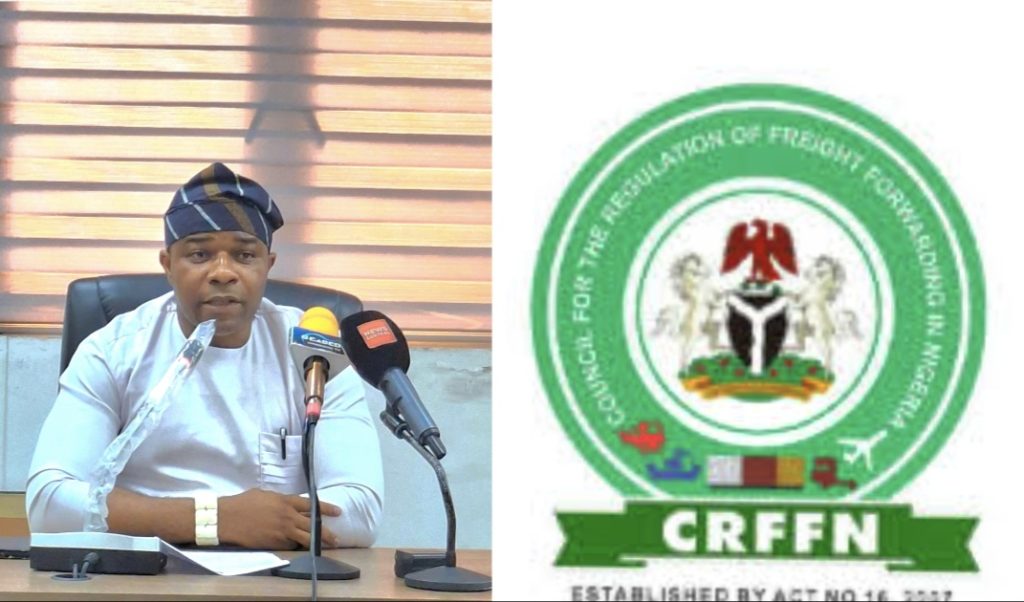
By Joshua Yousouph
Two years after the dissolution of the Governing Council of the Council for the Regulation of Freight Forwarding in Nigeria (CRFFN), stakeholders have expressed growing concern over the continued absence of the Council’s highest decision-making body, warning that the leadership vacuum is undermining regulation, policy implementation and the overall development of the freight forwarding profession.
The continued absence of the CRFFN Governing Council has remained one of the most contentious governance issues within Nigeria’s freight forwarding subsector, with stakeholders insisting that the Council requires a functional board to provide strategic direction, strengthen professional regulation and drive reforms capable of repositioning the sector.
The concerns were raised by former elected members of the Governing Council who argued that while the Council’s management has continued to perform administrative functions, the absence of a Governing Council has left critical policy decisions unattended, limiting the Council’s ability to effectively regulate the industry.
Speaking with Shipping Position Daily last week, a former elected member of the Governing Council, Dr. Kayode Farinto, lamented that despite the passage of two years since the Board was dissolved, the Federal Government is yet to reconstitute the Council, leaving the Registrar without the policy backing required to drive major reforms.
According to Farinto, the CRFFN Governing Council occupies a unique position among federal agencies because it comprises both elected freight forwarding practitioners and appointed representatives of government institutions.
He explained that unlike conventional government boards, the CRFFN Council was designed to ensure industry participation in policy formulation and professional regulation, adding that the continued delay in restoring the Council has created a governance gap within the sector.
“There is a limit to what a Registrar can do without a Governing Council,” Farinto said, noting that the prolonged absence of the Board has adversely affected the statutory responsibilities of the Council.
The former acting National President of the Association of Nigerian Licensed Customs Agents (ANLCA) disclosed that elected members had made repeated efforts to engage the Minister of Marine and Blue Economy over the issue, but were unable to secure a meeting.
He revealed that while some affected members had approached the courts to challenge the situation, he chose dialogue, insisting that restoring the Council was more important than prolonged litigation.
Farinto, who was among the elected members whose tenure was interrupted following the dissolution of federal boards, said he would support the conduct of fresh elections into the Governing Council, if the government first engaged the affected elected members and addressed issues surrounding their interrupted tenure.
Despite his concerns over the leadership vacuum, Farinto commended the performance of the Registrar of CRFFN, Mr. Kingsley Igwe Onyekachi, particularly in the area of training and professional capacity building.
He observed that the Council has continued to organize training programmes for freight forwarders despite operating without a Governing Council, urging the Registrar to sustain efforts aimed at preparing younger practitioners for the future of the profession.
Similarly, another former member of the Governing Council, Mr. Increase Uche, said many former Council members have gradually shifted their attention away from the prolonged delay in reconstituting the Board, stressing that the industry is presently confronted with more pressing operational challenges.
According to him, stakeholders are now more focused on addressing persistent inefficiencies at the nation’s seaports, reducing cargo clearance bottlenecks, improving port operations and tackling issues affecting trade facilitation than dwelling on the lingering uncertainty surrounding the Governing Council.
Uche maintained that while restoring the CRFFN Governing Council remains important for institutional governance, the industry must not lose sight of the need to resolve operational challenges that continue to affect freight forwarders and the competitiveness of Nigerian ports.
Speaking earlier with Shipping Position Daily, the Registrar of CRFFN, Mr. Kingsley Igwe, maintained that the reconstitution of the Governing Council does not fall within the powers of the Council’s management.
He explained that the responsibility lies with the Presidency, the Federal Ministry of Marine and Blue Economy and other relevant government authorities, stressing that no Registrar has the authority to determine when a governing council should be inaugurated.
Igwe also attributed part of the delay to the unusually large composition of the CRFFN Governing Council, noting that the Council’s 32-member structure makes it significantly more expensive to operate than the boards of most government agencies.
According to him, about 60 per cent of the Council’s annual overhead would ordinarily be spent on running the Governing Council, leaving limited resources for staff welfare, training, industry engagements and other statutory obligations.
He said government is already considering reforms that would reduce the size of the Council to make it more cost-effective, insisting that if the Board had been considerably smaller, it might have been reconstituted much earlier.