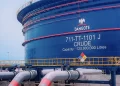
Nigeria’s crude oil production slumped to a seven-month low in September 2025, as a wave of industrial action, facility shutdowns, and global market pressures combined to disrupt output and threaten the country’s fiscal stability.
According to new figures from the Nigerian Upstream Petroleum Regulatory Commission (NUPRC), average daily crude oil production—excluding condensates—fell to 1.39 million barrels per day (mb/d) in September, marking a second consecutive monthly drop. The output level is the lowest since February 2024, when production was 1.32mb/d.
When condensate output of about 0.19mb/d is included, total liquid hydrocarbon production stood at 1.58mb/d—still far below the 2.06mb/d target set in the 2025 national budget.
The NUPRC attributed the shortfall mainly to a three-day strike by the Petroleum and Natural Gas Senior Staff Association of Nigeria (PENGASSAN), which disrupted operations at several export terminals. The agency also cited ongoing maintenance at key facilities and unplanned shutdowns across major production hubs as factors that dragged output lower.
“The decline in September’s production largely reflects temporary disruptions across the upstream segment,” a senior NUPRC official said. “While some of these challenges were short-term, their cumulative effect was significant enough to reduce overall national output.”
Among the worst-hit terminals was Forcados, operated by Shell Petroleum Development Company (SPDC), which saw its daily crude throughput fall sharply. The Forcados system—vital to Nigeria’s crude exports due to its linkage with multiple joint venture partners—has long faced recurrent disruptions from leaks, vandalism, and maintenance issues.
The sustained production shortfall has heightened concerns over Nigeria’s fiscal outlook, as crude oil remains the backbone of government revenue and foreign exchange earnings. Data show that in the first nine months of 2025, average production hovered around 1.67mb/d—well below the government’s 2.06mb/d benchmark—posing risks to budget implementation and external reserves.
Economists warn that each barrel lost translates to greater fiscal strain. “Oil still accounts for the bulk of Nigeria’s foreign exchange and government income,” said Johnson Chukwu, CEO of Cowry Asset Management. “Sustained underperformance in output will limit funding for infrastructure, increase borrowing, and weaken macroeconomic stability.”
Chukwu added that even with ongoing Central Bank of Nigeria (CBN) reforms aimed at stabilising the naira, reduced oil inflows could slow reserve growth and put renewed pressure on the currency.
The decline in Nigeria’s production coincides with a bearish global oil market. Brent crude, which traded above $90 per barrel earlier in the year, has slipped below $80 following OPEC+’s decision to raise production targets—fueling oversupply concerns and dampening investor confidence.
“Global oil prices are facing downward momentum at precisely the wrong time for Nigeria,” said Razia Khan, Chief Economist for Africa and the Middle East at Standard Chartered. “Lower volumes and weaker prices together mean reduced fiscal buffers and limited policy space.”
Despite earlier signs of recovery between March and June—when Nigeria’s output climbed toward 1.7mb/d due to improved pipeline security and reduced vandalism—industry analysts say the gains are fast eroding. They point to deeper structural problems such as aging infrastructure, delayed joint venture funding, and persistent insecurity along major pipeline corridors.
“The strike was only a spark,” an industry executive told *Independent*. “The core issue is that Nigeria’s upstream assets are old and fragile. Maintenance often overlaps with production schedules, and when labour unrest occurs, output collapses quickly.”
Experts insist that restoring production to target levels will require sustained investment, improved labour relations, and faster implementation of the Petroleum Industry Act (PIA), which seeks to attract private capital and ensure regulatory stability.
With oil receipts accounting for over 70 percent of Nigeria’s export earnings, a prolonged production slump could widen the budget deficit and heighten borrowing pressures in the fourth quarter of 2025. It could also lead to reduced inflows into the Federation Account Allocation Committee (FAAC), delaying revenue disbursement to states and local governments.
Meanwhile, Nigeria’s external reserves—currently at about $42 billion, according to CBN data—face potential pressure if both production and prices remain weak through year-end.
“Foreign exchange liquidity has improved modestly thanks to CBN reforms, but it remains extremely sensitive to oil market performance,” said Ayodele Akinwunmi, Senior Relationship Manager at FSDH Merchant Bank. “If output and prices don’t rebound soon, we may see those gains reversed.”