One of the shipping industry’s most outspoken figures has suggested owners would have been better off paying a transit fee to keep the Strait of Hormuz open rather than enduring months of disruption from the closure that followed the conflict involving Iran, Israel and the US.
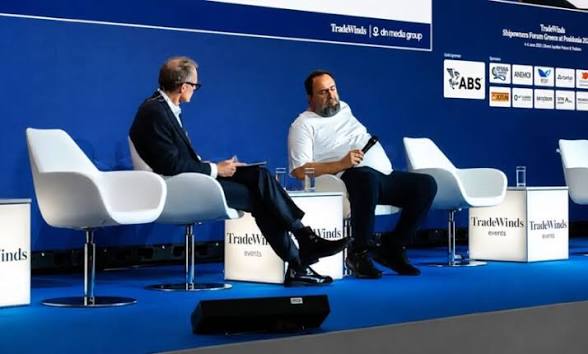
Speaking at the TradeWinds Shipowners Forum during Posidonia, Capital Maritime & Trading Corp founder and chairman Evangelos Marinakis argued that a practical solution would have been preferable to a prolonged shutdown of one of the world’s most important energy corridors.
“My argument is that we had to pay for a fee. For me, it was much better than having the straits closed,” Marinakis said.
The Greek shipowner went further, suggesting a structured payment system could have made more sense than the costs shipping has already absorbed through war risk premiums and market disruption.
“If you calculate how much money we have paid so far navigating in and out AG or even in the Red Sea area without having an actual war, it’s better to pay a fee of $100,000 or $150,000 depending on size of cargo or size of the vessel,” he said.
The comments come as shipowners, charterers and energy traders assess what a gradual reopening of the Gulf gateway means for tanker markets after more than two months of severe disruption.
Marinakis revealed that Capital Maritime avoided direct exposure to the crisis because none of its vessels happened to be trading in the region when hostilities escalated. That was not a strategic decision beforehand, he said, but once the conflict intensified, the company had no intention of sending ships through the area.
“We don’t want to navigate in a war stage,” he said.
The group’s position was reinforced by exceptionally strong freight earnings elsewhere.
“We are enjoying very good markets,” Marinakis noted, arguing there was little logic in chasing additional returns by exposing ships and crews to elevated risks.
“There’s no point when you already make a lot of money from the rates to be tempted to make some more,” he said.
While some market participants expect a sharp freight rally once countries begin rebuilding depleted strategic petroleum reserves, Marinakis offered a more measured outlook.
“There is expectation,” he said, but warned against anticipating another dramatic spike similar to the market reaction seen when the conflict first erupted.
“My view is that there is a frustration. We need to be there in the area. But maybe we will not see the freight rates that we have in mind and it will be something that will be built slowly.”
He argued that energy consumers have already adapted to a period of reduced availability and higher prices, making a gradual recovery more likely than an immediate surge in demand.
“We need to control our expectations and see that business will be back to normal with a period of time that is needed for stocks to be increased again to a normal environment,” Marinakis said.
The Capital Maritime chief also addressed broader tanker market fundamentals, pointing to an ageing global fleet and what he sees as a continuing need for replacement tonnage.
“If you analyse the profile of the world fleet, you see that it is the oldest we have in the last few decades,” he said.
That view underpins Capital Maritime’s recent newbuilding programme and tanker fleet renewal strategy. Marinakis said the company had sold a significant number of secondhand vessels over the past three months and was replacing them with more modern ships.
On Aponte-Sinokor’s efforts to build influence in the VLCC market through large-scale acquisitions, Marinakis described the strategy as “a brilliant move”.
“There is nothing in business that you can do at this size with such amount of money,” he said.
Beyond market dynamics, Marinakis returned repeatedly to what he sees as practical policy failures surrounding sanctions and the dark fleet.
He argued that sanctioned tankers should be given incentives to head directly to recycling yards, dismissing suggestions that owners would be rewarded by such a programme.
“We are not helping them, we are helping ourselves,” he said.
According to Marinakis, removing ageing and poorly maintained ships from service could have a meaningful impact on freight markets while simultaneously reducing environmental and safety risks.
The Greek owner also criticised European sanctions policy, arguing that restrictions have hurt European economies more than Russia.“The sanctions imposed by the European Union are completely wrong,” he said.
Marinakis reserved some of his strongest comments for the continued operation of uninsured and poorly maintained dark fleet vessels close to European coastlines.
“How can we afford to let that fleet operate next to our island coastline?” he asked.
Despite geopolitical turmoil, sanctions disputes and continuing uncertainty over energy flows, Marinakis concluded with a broader message about shipping’s growing strategic importance.
“The role of shipping worldwide has been very important and more important than ever before,” he said.
For governments focused on energy security and supply chains, the message was clear: shipowners should be viewed as partners rather than merely transport providers. In Marinakis’ view, recent crises have only reinforced how essential shipping remains to the functioning of the global economy.