By Oluyinka Onigbinde
Findings by Shipping Position Daily have revealed that the National Drug Law Enforcement Agency (NDLEA) intercepted 109,306.75 kilogrammes (109.3 tonnes) of illicit drugs with an estimated street value of over ₦45 billion at Nigeria’s seaports in the first half of 2026, underscoring the increasing use of the nation’s maritime gateways by international drug trafficking syndicates.
The findings, based on official first-quarter statistics obtained from the NDLEA and verified second-quarter seizure records released by the agency, showed that the anti-narcotics agency maintained sustained pressure on drug cartels operating through the country’s seaports, particularly Apapa, Tin Can Island and Port Harcourt ports.
The analysis indicated that 98,354.75 kilogrammes of assorted illicit drugs were intercepted between January and March, while another 10,952 kilogrammes were seized through separate intelligence-led operations between April and June, bringing the total seizures for the first six months of the year to 109,306.75 kilograms.
Although the NDLEA did not publish an official cumulative street value for the half-year seizures, Shipping Position Daily gathered from official seizure announcements and agency sources that the intercepted consignments are worth well above ₦45 billion, making the first half of 2026 one of the most successful periods in the agency’s maritime enforcement operations in recent years.
A breakdown of the figures showed that Apapa Port remained Nigeria’s biggest drug interception point, accounting for 71,181.45 kilograms of illicit drugs during the first quarter alone. When the verified second-quarter seizures of 1,819.5 kilograms and 4,959 kilograms recorded at the port are added, the cumulative seizures at Apapa rise to 77,959.95 kilograms, representing more than 71 per cent of the total quantity intercepted during the period under review.
The Port Harcourt Seaport Command followed with 25,635 kilograms, while Tin Can Island Port recorded 1,538.30 kilograms during the first quarter and an additional 4,173.5 kilograms in May, bringing its cumulative seizures for the six-month period to 5,711.8 kilograms.
The Lekki Deep Seaport did not record any reported seizure during the period.
Official NDLEA records further showed that 10 suspects, comprising nine males and one female, were arrested in connection with first-quarter seizures. Six of the arrests were made at Apapa Port, while Tin Can Island Port accounted for four arrests. Investigations into the second-quarter seizures also resulted in the arrest of suspected members of international trafficking syndicates, with investigations still ongoing.
Further analysis revealed that codeine-based cough syrup remained the most commonly intercepted illicit substance during the first quarter, accounting for 96,437.45 kilograms of the total seizures. Cannabis accounted for 1,885.80 kilograms, while 31.5 kilograms of cocaine were also intercepted.
One of the earliest major operations this year occurred on January 2, when NDLEA operatives, working jointly with the Nigeria Customs Service (NCS), intercepted 31.5 kilograms of cocaine concealed inside hatch three of the vessel MV Aruna Hulya at the Apapa Port. The vessel and its 22 Indian crew members were subsequently detained as investigations commenced.
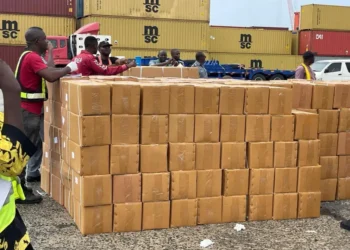
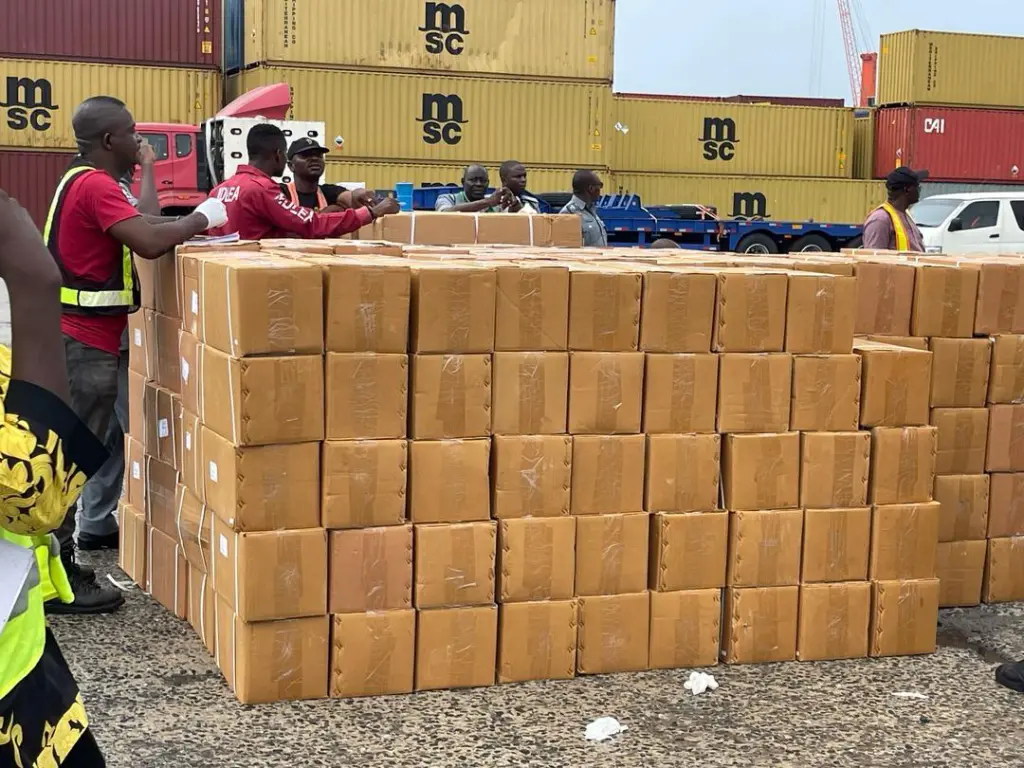
In another major operation in February, NDLEA intercepted 25 containers loaded with fake and illicit pharmaceutical products, including codeine-based cough syrups and sexual enhancement drugs valued at about ₦9.2 billion, further exposing the scale of pharmaceutical opioid trafficking through the nation’s ports.
The anti-drug agency sustained the momentum in the second quarter.
On May 12, NDLEA operatives intercepted 4,173.5 kilogrammes of Canadian Loud, a synthetic strain of cannabis, concealed inside imported vehicles in a container that arrived at the Tin Can Island Port from Canada. The illicit consignment, valued at over ₦10.4 billion, was uncovered after weeks of intelligence gathering and sustained surveillance.
Barely one month later, the NDLEA also recorded another breakthrough at the Apapa Port with the interception of 1,819.5 kilogrammes of the same substance, before uncovering another 4,959 kilogrammes concealed inside a 40-foot container carrying imported vehicles. The larger seizure alone was estimated to be worth over ₦12.4 billion.
Investigations by Shipping Position Daily showed that traffickers increasingly relied on imported used vehicles and fabricated compartments inside containers to conceal narcotic consignments destined for the Nigerian market.
The findings further indicated that intelligence-led profiling, improved cargo examination procedures and enhanced collaboration between the NDLEA and the Nigeria Customs Service have significantly strengthened interdiction efforts at the nation’s seaports.
Speaking with Shipping Position Daily, the NDLEA’s Director of Media and Advocacy, Mr. Femi Babafemi, said the seizures reflected the Agency’s improved intelligence gathering, operational efficiency and strengthened surveillance across Nigeria’s maritime gateways.
According to him, the dominance of codeine-based pharmaceutical products and repeated attempts to smuggle large quantities of cannabis through the seaports underscore the determination of criminal syndicates to exploit Nigeria’s maritime trade routes.
He explained that the Agency has continued to deepen collaboration with the Nigeria Customs Service and other security agencies to block trafficking routes, dismantle organised criminal networks and ensure that all persons connected with intercepted consignments are brought to justice.
Babafemi also disclosed that the Agency is intensifying intelligence gathering, strengthening surveillance mechanisms and deploying advanced detection strategies to identify emerging trafficking patterns and prevent illicit drugs from entering the country through the ports.
Checks by Shipping Position Daily further revealed that beyond the seizures, the NDLEA secured 974 convictions of drug offenders nationwide during the first quarter of 2026, including the conviction of 11 major drug kingpins, who were sentenced to a combined 254 years imprisonment, reflecting the Agency’s broader offensive against organised drug trafficking.