
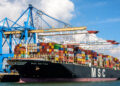
Roll On Roll Off (RORO) operation is gradually winding down in Nigerian seaports following the Federal Government auto policies and its effect on such operations.
As a result of the two years old policy, RORO operations have been badly hit even as huge investments have been sunk into port concession project by major vehicle-handling terminals in the country.
Roll On Roll Off (RORO) operation is gradually winding down in Nigerian seaports following the Federal Government auto policies and its effect on such operations.
As a result of the two years old policy, RORO operations have been badly hit even as huge investments have been sunk into port concession project by major vehicle-handling terminals in the country.
In Lagos, two major RORO terminal operators exist where vehicle importation is the main business; they are: Five Star Logistics Terminal and Ports and Terminal Multiservices Limited also called PTML; both located at Tin Can Island Port Lagos.
These major RORO operators have decried, lamented and bemoaned the introduction of the auto policy and its effect on vehicle importation because the disadvantages are more than advantages.
The automobile policy was introduced by the President Goodluck Jonathan administration in October 2013, but its implementation has experienced several shift because of resistance from stakeholders.
The Federal Government under former President Goodluck Jonathan believed that the automobile policy will not only transform the automobile sector by ensuring mass production of different vehicles in Nigeria, but it will also boost foreign exchange earnings through export of such made-in-Nigeria vehicles.
It also expected the policy to greatly tackle the rising unemployment rate in the country.
However, some Nigerians who kick against the implementation of the policy believe that government was putting the cart before the horse, by raising duty payable on imported vehicles without first putting the necessary structures on ground.
But the major players who are currently caught in the web of the implementation have appealed to the federal government to review the policy, in order for them to remain in business, because of the rising lull in vehicle importation business.
There has also been consistent downsizing of workers in the last two years by RORO operators, this has also increased the level of unemployment in the country.
Recently at PTML, workers were forced to embark on a three days strike over the terminal operator's move to reduce its workforce.
Both RORO operators have confirmed that the policy has killed automobile importation business in Nigeria and the only way for them to remain in business is to diversify their operations.
As part of effort to diversify, the RORO operators now engage in container handling, general cargo handling and export handling.
Sadly also, the number of RORO vessels coming into Nigeria has dropped in the last two years.
Between April and June 2015 alone, PTML raised alarm twice about drop in vehicular importation to its terminal.
General Manager of PTML, Mr. Tunde Keshinro had said that the policy on vehicle importation is affecting the terminal; he said that there has been a significant drop in the volume of vehicles imported through the terminal.
He said in 2013 and 2014 respectively, the facility experienced massive importation of vehicle but regretted that the situation has changed.
He added that vessel call has dropped and there has been low patronage by importers and freight agents, whom he said are clients that make business to thrive at the terminal.
Speaking further, he said, "PTML is just one of the terminals handling vehicles and for obvious reasons we have experienced decline in the number of vehicles imported and discharged in our facilities and today I will say we have an underutilized space in the terminal"
"The space we have now is much more than what number of vehicles the company handles"
"Looking at last year and the year before, you will find out that the records show that the terminal is always full of imported vehicles with high number of customers as well who want to obtain services from us"
"So in a way , what we have seen is that we have recorded a significant drop in the volume of vehicles coming to the terminal"
Keshinro further urged the President Buhari-led administration to focus more on the quality of vehicles imported into the country, pointing out that it should not lay much emphasise on tariff discrimination.
The PTML General Manager noted that tariff discrimination on import duty has not helped maritime growth and that such issues go beyond pricing.
He disclosed that some of the so-called vehicle manufacturers still import vehicles through the terminal, stressing the need for government to look at such activities.
At the Five Star Logistics terminal, the managers say the firm "just need to remain in business" , until the new administration revisits the auto policy.
At a recent visit to Five Star Logistics terminal by the Nigerian Shippers’ Council, the RORO operator appealed on the council to interface with the Federal Government on the need to revisit the automobile policy, so that vehicle importation business can thrive once again.
The RORO terminal operator also described the federal government policy on automotive as a "flip flop” policy, saying that it has adversely killed importation of vehicles into Nigerian ports
Mr. Rigo Nazzar said that there is need for the council to help the operator and relate with the federal government on account of the automotive policy for them to remain in business.
Nazzar also said that there has been significant drop in vehicle importation through the terminal and as investors in Nigeria; there is need for their businesses to be protected.
He said "we need somebody that can stand in between, from both sides"
Also speaking on behalf of the terminal, Documentation Manager, Mr. Nicolas Bruce said that RORO operation in Nigeria is badly affected by the policy, noting that “the company has staff to pay, will power generators regularly and all these cost money yet we are not operating in a conducive environment due to the policy".
"We are pleading with Shipper’s Council to intervene because it is a matter that needs to be addressed as regulator".
He also urged the council's boss to advice government on the automotive policy because it is killing RORO operations in Nigeria.
Also speaking, the Group Chief Accountant of the terminal, Mr. Bashiru Adeshina said that "as RORO terminal in 2014 we had a great number of vehicles importation but now it has reduced almost to zero"
He said that the federal government ‘flip flop’ policy has not helped to boost RORO operations calling on the Nigerian Shippers’ Council to relate with government and find ways to encourage vehicle importation into Nigeria.
As at the end of July 2015, report has it that importation of vehicles into Nigeria has further dropped by 70%.










Discussion about this post